Inspiration and information for filmmakers everywhere
February 18, 2013 by neiloseman

It Never Rains but it Pours

This is a clip from the feature-length documentary Going to Hell: The Making of Soul Searcher. You can rent the whole doc digitally from the Distrify player below for a small charge, and you can watch Soul Searcher itself for free at neiloseman.com/soulsearcher

The clip shows how we created a fake downpour for a fight between the outgoing Grim Reaper, Ezekiel (Jonny Lewis, doubled by Simon Wyndham), and his replacement, Joe (Ray Bullock Jnr.). Ironically it was actually raining for real, but not heavily enough to show up on camera with the impact we needed. We’d had some rain bars made (lengths of hosepipe with holes drilled in them, strapped to bamboo canes) but we found the water squirted out in unrealistic jets. Luckily the location – Westons Cider in Much Marcle, Herefordshire – had a high pressure hose and we found that by pointing it upwards the water back down looking like rain.

See last week’s post for how to add rain (and snow) onto scenes after the fact.

  •   •   •   •   •
February 12, 2013 by neiloseman

Falsification of Precipitation

Yesterday I had to shoot some fake snow. Ironic, I know, given the weather lately, but it had to be composited over a pre-existing shot. Various software plug-ins are available to add snow to a shot, but I’m of the school of thought that says it’s always better to use a real thing. Even if it’s a fake real thing.

A few years back, Col sent off for some free samples of artificial snow from a weather effects company called Snow Business. (Eternal winter in Narnia? That was them.) When Miguel pointed out that a snow-covered shot of Belper’s bandstand in Stop/Eject looked like a still photograph in the edit, I saw a way to make use of these samples to bring some movement into the frame.

From the box of samples we picked one that appeared to be made of shredded carrier bags, because it floated the most realistically as it fell. I suspect you could make some of this yourself with a lot of patience and a few trips to Tesco. I set up black drapes with a redhead poking over the top to ensure that the snowflakes would be backlit without any direct light falling on the drapes. Then we rolled the camera and started sprinkling.

Afterwards it was a simple case of using screen mode (or ‘Add’ in Final Cut Pro) to combine the footage with the background shot. This mode gives exactly the same results as double-exposing a traditional photograph would: the black areas naturally become transparent because they have no brightness.

Must resist temptation to use snow-based puns...

Must resist temptation to use snow-based puns...

Several years ago, Col and I did exactly the same thing with rain, filming water from a hosepipe in his back garden against a black night sky, then layering it on top of scenes from Soul Searcher.

Must also refrain from rain puns. Uh-oh, I said "refRAIN"...

Must also refrain from rain puns. Uh-oh, I said "refRAIN"...

We also shot one scene for Soul Searcher in “real” rain – real in so far as it was actually there falling on the actors, but not in so far as it actually came from clouds. Perhaps I’ll upload a behind-the-scenes clip of that for my next post.

Meanwhile, if you’re going out to shoot in real snow, check out the tips I posted a couple of weeks ago.

  •   •   •   •   •
January 27, 2013 by neiloseman

Scott Benzie: Composer Extraordinaire

Scott Benzie conducts the Worcestershire Symphony Orchestra as they perform his score for Soul Searcher.

Scott Benzie conducts the Worcestershire Symphony Orchestra as they perform his score for Soul Searcher.

Today’s post is an introduction to Scott Benzie, composer of Soul Searcher, The Dark Side of the Earth and now Stop/Eject. (The series on VFX planning will continue next week.)

After becoming interested in music at a relatively late age, thanks to a synthesizer Christmas present and the inspiration of James Horner’s Krull soundtrack, Scott majored in music at Notthingham Trent University. In 2002 he wrote an impressive orchestral score for Jim Groom’s noir feature Room 36, conducting the Westminster Philharmonic Orchestra and recording all 50 minutes of music in a single day. Scott repeated this feat for Soul Searcher three years later, after responding to an advert I posted on Shooting People for a fully orchestral John Williams-style score – a goal which many people mocked as naïve or over-ambitious, but not Scott.

The composer’s other feature film credits include Ten Dead Men (dir. Ross Boyask), Fear Eats the Seoul (dir. Nick Calder), and Dinner with my Sisters (dir. Michael Hapeshis) which was released in UK cinemas last November. Several of Scott’s soundtracks have been released in their own right, including Room 36 which is available on CD from KeepMoving Records.

Scott recently took his first crack at some music for Stop/Eject and this is the result:

This is rough, unmixed and all done with samples. The finished version will, I hope, be recorded with live players. On Soul Searcher  we were able to persuade a choir and a symphony orchestra to perform Scott’s score for us. Here’s a clip from Going to Hell: The Making of Soul Searcher covering the music recording, one of the few things that didn’t go horribly wrong during Soul Searcher’s creation. (Remember that you can watch Going to Hell in full for a small charge at neiloseman.com/soulsearcher and Soul Searcher itself completely free on the same site.)

Visit Scott’s website at www.scottbenzie.co.uk

  •   •   •   •   •
January 23, 2013 by neiloseman

Planning VFX: Computer Generated Imagery

Following on from last week’s thoughts on planning VFX shots, I’m now going to look at the issue of CGI vs. miniatures. In this post I’ll cover some of the advantages of choosing computer generated imagery, and next time I’ll look at the advantages of miniatures. As any regular readers will know, I much prefer miniatures, but I aim to be completely impartial in what follows.

To start off with let’s go back 20 years to Jurassic Park, the movie that really started the CGI revolution, and find out why Steven Spielberg chose this emerging technology over traditional techniques. (Skip to 13:12.)

So Spielberg favoured CGI because it produced more realistic motion. In fact, watching Jurassic Park these days I find the CG dinosaurs are easily differentiated from Stan Winston’s full size animatronics by the fact that the former move much more fluidly. Even when miniatures move “live”, i.e. without stop motion animation – vehicles powered by motors or pulled on hidden wires, for example – the motion is often less realistic than a CGI equivalent because the laws of physics dictate a small thing will always move differently from a large thing.

Next up, here’s a clip from Going to Hell: The Making of Soul Searcher, in which I discuss how I arrived at CGI as the best method of creating the spectral umbilical cords the script required. (You can watch the whole of this feature-length documentary at neiloseman.com/soulsearcher.)

So control was the key thing there. There were 80 shots, many with camera moves, and the umbilical cords had to be locked to the characters. Trying to achieve this with string and cables was just not realistic, or would have required so much manipulation in post as to make shooting a real element pointless. CGI can be controlled completely and adjusted quickly, without the need for reshoots.

Here are some other pros of CGI over traditional techniques:

  • No shooting required, so no crew to pay, feed, transport, etc. On a micro-budget where the crew are unpaid, CGI is completely free, whereas any kind of miniature shoot will always have costs.
  • CG elements can be tracked to moving plates without the need for expensive motion control cameras.
  • There are far more talented and experienced CG artists out there than model-makers.
  • You can create anything you can imagine, without any practical or logistical restrictions.

Can you think of any others? Let me know. Next time I’ll look at the advantages of traditional techniques.

  •   •   •   •   •
January 14, 2013 by neiloseman

Planning VFX

A few years back I taught a module on Visual Effects for filmmaking degree students at the SAE Institute in north London. Rather than getting into the nitty gritty of how to actually do VFX, it focused instead on how directors and producers should approach and plan for them.

Here is one of the examples I gave, using a shot from my 2005 feature Soul Searcher. Joe Fallow (Ray Bullock Jnr.) sprints down the platform of Hereford station as the Hades Express departs, bearing away the villain of the piece and the kidnapped love interest.

Finished shot from Soul Searcher

Finished shot from Soul Searcher

The train was a 1:18 scale miniature and was dropped into the live action plate by means of a simple, static matte drawn in Photoshop – essentially a splitscreen effect.

But what if I, as director, had chosen a different camera angle?

Alternate angle 1

To achieve this version, the model train would have needed to have been shot against a green screen to make it appear in front of Joe and the platform. This would have complicated shooting the miniature slightly, as lighting for a green screen can be quite time-consuming.

Alternate angle 2

Here we have the opposite; now Joe is in the foreground, so he’s the one that needs to be shot against a green screen. Since he and the station are full size, the green screen would need to be much bigger and would require much more light. And remember we’re now talking about an impact on the main unit’s time on a location, rather than a small model unit in a studio, so the cost implications are magnified.

Alternate angle 3

Finally, what if I’d gone for a camera move? Now we’re into motion control rigs, to record the camera’s movement on location and applied a scaled-down version of that same move to the camera shooting the miniature. Either that or the live action plate has to be 3D-tracked in post-production, and that tracking data fed into the motion control rig that shoots the miniature. More time, more people, more equipment, more money.

This is the first step in planning for VFX: understanding how your choice of shots influences the techniques required to achieve them and therefore impacts on the schedule and the budget. Stay tuned for more on this topic, and remember you can watch Soul Searcher in full for free at neiloseman.com/soulsearcher

  •   •   •   •   •
November 26, 2012 by neiloseman

Urban Terrors

Urban Terrors by MJ Simpson

Urban Terrors by MJ Simpson

Last year I was contacted by scriptwriter, author and SFX Magazine contributor MJ Simpson, who was writing a book called Urban Terrors: New British Horror Cinema 1997-2008. Although I describe my 2005 feature Soul Searcher as a fantasy-action movie, it does have some elements in common with the horror genre, most notably the character of the Grim Reaper, and so Mike was keen to give it a mention in his book.

Urban Terrors is released this Saturday, December 1st, and can be bought online or on the highstreet from The Cinema Store and Forbidden Planet. Order before Saturday to get it at the discounted price of £15.25 (normally £17.95).

You can also read an interview Mike conducted with me, in which I discuss the making of Soul Searcher, on his website mjsimpson.co.uk

Here’s the blurb on the book, and remember that you can watch Soul Searcher in full for free at neiloseman.com/soulsearcher.

By the late 1990s, the Golden Age of British Horror Cinema was long gone. But like all the best monsters, the genre has risen from the grave and in the 21st century is going from strength to strength.

Developments in video technology and changes in distribution have seen a ten-fold increase in the number of British horror films made and released each year. From major studio pictures like 28 Days Later and Shaun of the Dead to cult indies like Freak Out and The Last Horror Movie, the new millennium is a boom time for home-grown horror. And many of these new films are contemporary, socially-relevant tales reflecting life in modern Britain; instead of creepy castles, their monsters and psychos stalk housing estates and tower blocks…

Urban Terrors is the first book to fully examine the British horror film revival, documenting and analysing the more than 100 movies that were commercially released between 1997 and 2008. It reveals how the changes in technology have enabled more people to make films, how changes in distribution – from VHS to DVD to VOD – are enabling more people to watch them, and how the mainstream media has failed to spot and comment upon this largely-undocumented phenomenon. And it examines how these new kinds of horror films have dealt with issues like disenfranchised youth, class division and social exclusion…

 ‘One of the UK’s foremost horror critics – what Mike Simpson doesn’t know about horror is not worth knowing.’ –film director Johannes Roberts

  •   •   •   •   •
November 23, 2012 by neiloseman

Piracy (Arrrrr!)

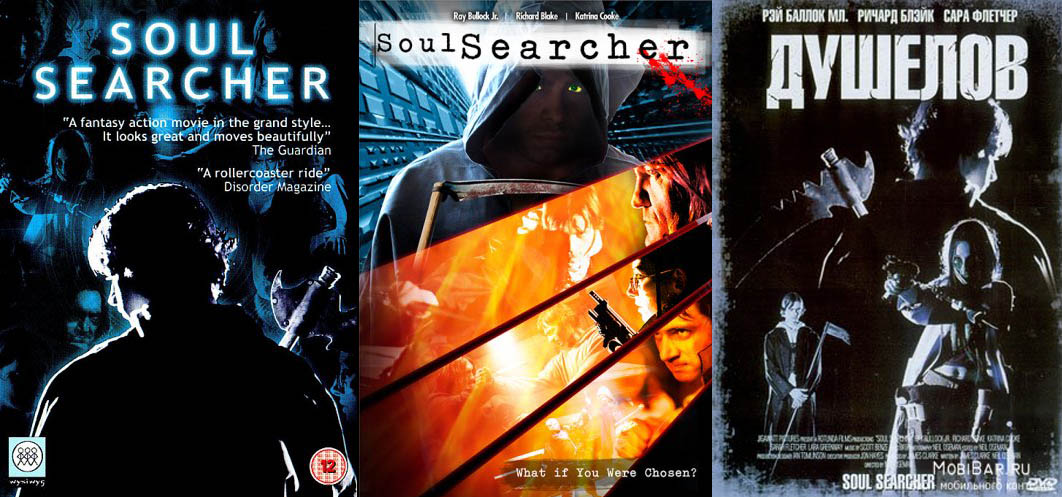
The cover of the official Russian DVD release of Soul Searcher

The cover of the official Russian DVD release of Soul Searcher

In this week’s FilmWorks masterclass one of the speakers mentioned a filmmaker whose work was the subject of repeated YouTube mash-ups. She was faced with a choice: invoke her rights and request YouTube take them down, or embrace these creative responses and re-interpretations of her work. She chose the latter, engaging with the mashers(?) and nurturing her fan community.

Following the DVD release of my 2005 feature film Soul Searcher, I became aware of numerous pirate copies floating about on the internet. My feelings were mixed. On the one hand, given the years of my life and the thousands of pounds I’d put into making the film, I was furious that people were ripping it off. On the other hand, I couldn’t help but be flattered that people had thought it worth pirating. One Russian pirate (arrrrrsky!) had even gone to the trouble of dubbing it into his language, albeit doing all the voices himself without any attempt to differentiate them or act in any way.

Having spent the last year crowd-funding Stop/Eject, I am all too aware of the importance of posting free content online – like this blog, or Stop/Eject’s behind-the-scenes videos – in order to promote myself and my current projects. But promote myself to what end? Like many filmmakers, my ultimate goal is to make feature films for a living, but how can I or anyone else making a living in a world where almost all media content ever produced can be obtained, free of charge, at the click of a mouse? In the last few years I’ve already witnessed the specific type of filmmaking it’s always been my dream to work in – the kind where movies are shot on real sets with real actors on real celluloid and exhibited on real celluloid – start to disappear. But is the industry as a whole doomed to oblivion by piracy?

Maybe not. Perhaps crowd-funding demonstrates a glimmer of hope. Even though some people would rather pirate Hollywood blockbusters than pay for them, some other people will pay for independent films that haven’t even been made yet. How can we account for this dichomoty? Community engagement. Sponsors of a crowd-funded film feel part of the project in a way that they never could with the latest Tom Cruise juggernaut. Perhaps if I could have talked to that Russian pirate (arrrsky! That will never get old.) while Soul Searcher was still in production I could have involved him in the project, making him the official translator or the online publicist for Asia or something. Co-operation rather than competition. Perhaps that is the way forward.

I’ll leave you with some highlights from the Russian bootleg of Soul Searcher.

  •   •   •   •   •
November 13, 2012 by neiloseman

Soul Searcher Press Kit

The cover of Soul Searcher's press kit

The cover of Soul Searcher's press kit

Although Stop/Eject is still a long way off being finished, we’ve started to give some thought to the press kit. I remember being in the last week or so of Soul Searcher’s sound mix, Neil Douek and I desperately trying to get the film finished in time for the premiere, and at the same time I was having to deal with designing the press kits and getting them printed. That’s why I’m keen to start early this time around. Speaking of Soul Searcher’s press kit, I’m posting it below so if you’re wondering what a press kit should have in it, wonder no more. Click the images for larger, legible versions. I have Chris Jones and his Guerilla Filmmakers’ Movie Blueprint to thank for knowing what to put in it.

Review quotes and short and long synopses

Review quotes, contact details and short and long synopses

Cast bios

Cast bios

Cast and crew bios

Cast and crew bios

Production notes (the making of the film)

Production notes (the making of the film)

Production notes cont'd and some extracts from the director's blog

Production notes cont'd and some extracts from the director's blog

Full credits

Full credits

Thumbnails, filenames and photographer credits for the accompanying CD of stills

Thumbnails, filenames and photographer credits for the accompanying CD of stills

  •   •   •   •   •
October 27, 2012 by neiloseman

Worcestershire Film Festival Coming Up

The first ever Worcestershire Film Festival takes place next weekend, and I’m delighted to be part of this cinematic celebration in my home county.

On Saturday (Nov 3rd) at 6pm my comedy documentary Video8 will be screened. Here’s the trailer:

And on Sunday (Nov 4th) at 3:30pm I’ll give a talk about the funding and making of both Stop/Eject and my 2005 feature Soul Searcher. Here’s the Soul Searcher trailer. You can watch the whole thing for free at neiloseman.com/soulsearcher

All the details can be found on the festival’s website. I hope to see some of you in Worcester next weekend.

  •   •   •   •   •
August 21, 2012 by neiloseman

The Power of Post

Ray Bullock Jnr. as Joe

Ray Bullock Jnr. as Joe, preparing to fight the marauding demon

As we search for an editor for Stop/Eject, here’s a demonstration of the power an editor wields.

A few weeks before the premiere of Soul Searcher, my fantasy-action feature about a trainee Grim Reaper, I showed the film to my flatmates of the time. One comment concerned a scene in which the trainee reaper, Joe (Ray Bullock Jnr.), fights a demon (Shane Styen) while drunken revellers cheer him on.

As scripted, the scene covers only the start of the fight – enough to show how cocky Joe has become in his new role. (On the day of shooting we decided to extend the scene to show Joe killing the demon, but after a couple of shots Shane injured himself, forcing us to revert to the shorter version.) My flatmate wanted to see Joe kill the demon, and I decided he was right.

I certainly wasn’t going to do a reshoot at that stage in the game, but nonetheless I was able to alter the scene to have the demon die. I did it in three steps, and these conveniently illustrate the three prongs of attack you can use in post-production to change and improve your story.

  1. Re-purpose existing footage. The demon knocks Joe’s scythe from his hand early in the scene, so my first challenge was to get the hero his blade back so he could strike the fatal blow. Fortunately I had left the camera running while shooting a series of takes of Joe’s scythe hitting the ground. Therefore I had also caught the scythe being picked up on camera. This was never intended to be used, but it worked a treat.
  2. Visual effects. I’m no fan of digital fixes, but there’s no denying they can get you out of a tight spot. The existing cut of the scene had a shot of Joe walking up to the demon, but now I needed to put the scythe into his hand, so I cut out the scythe from a freeze-frame of another shot and motion-tracked it to Joe’s movements.
  3. Sound. This is the most commonly-used tool for changing things in post. Any time in a movie that a line of exposition is delivered without the speaker’s mouth being clearly seen, chances are that it’s Additional Dialogue Recording (ADR). It’s far easier to get the actor into a recording studio to perform a new line than to go back to a location or a long-struck set and reshoot. But in this case all I needed to do was put in some slicing, crunching sounds and a grunt, which I ran over a handy shot of the drunken revellers.

Here is the original scene followed by the bits I changed and then the final version:

Remember that with great power comes great responsibility. I’ve heard of actors who’ve found themselves edited into scenes they’d never shot. If you’ve substantially changed the character with your tinkerings, or placed an actor into a sensitive or controversial scene, be sure to discuss it with them just as you would have done beforehand if it had been shot conventionally. The same goes for the writer if you’ve made a big change to their script.

Some might look at all this as cheating, and I confess I have mixed feelings about it myself. I believe in getting things right in-camera, but the reality is that all films are prototypes, and you’re often well into post-production – at least – before you really figure out what the best way is to make this particular movie.

  •   •   •   •   •