Inspiration and information for filmmakers everywhere
October 11, 2012 by neiloseman

Presenting Your Vision

Working on my Stop/Eject mood reel for FilmWorks last week got me thinking about the various methods with which a director can convey his vision for a film during the development process. Here are the ways I’ve used over the years, and the pros and cons of each.

The first ones are all static images, so they can be printed out and thus viewed without the need for any technology (no worries about whether the recipient will be able to open this particular file format) but are also small enough to be emailed. They’ll never grab someone’s attention as much as a moving image, but take less time to absorb and can produce an instant reaction.

If you have the skills or know someone who does, high quality CONCEPT ART can dazzle and excite. Choose dramatic moments and give the artist guidance on the colour palette and lighting you’re after.

The Dark Side of the Earth concept art by Ian Tomlinson

The Dark Side of the Earth concept art by Ian Tomlinson

Storyboards for The Dark Side of the Earth by David Ayling

Storyboards for The Dark Side of the Earth by David Ayling

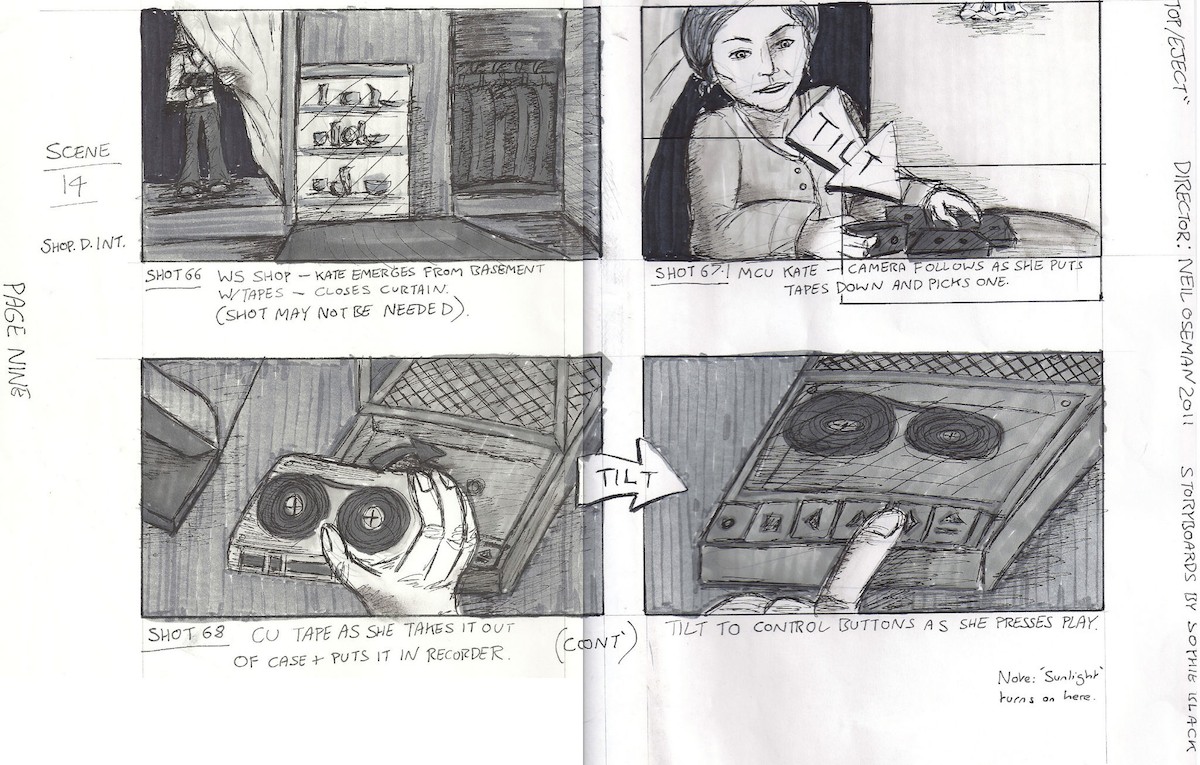
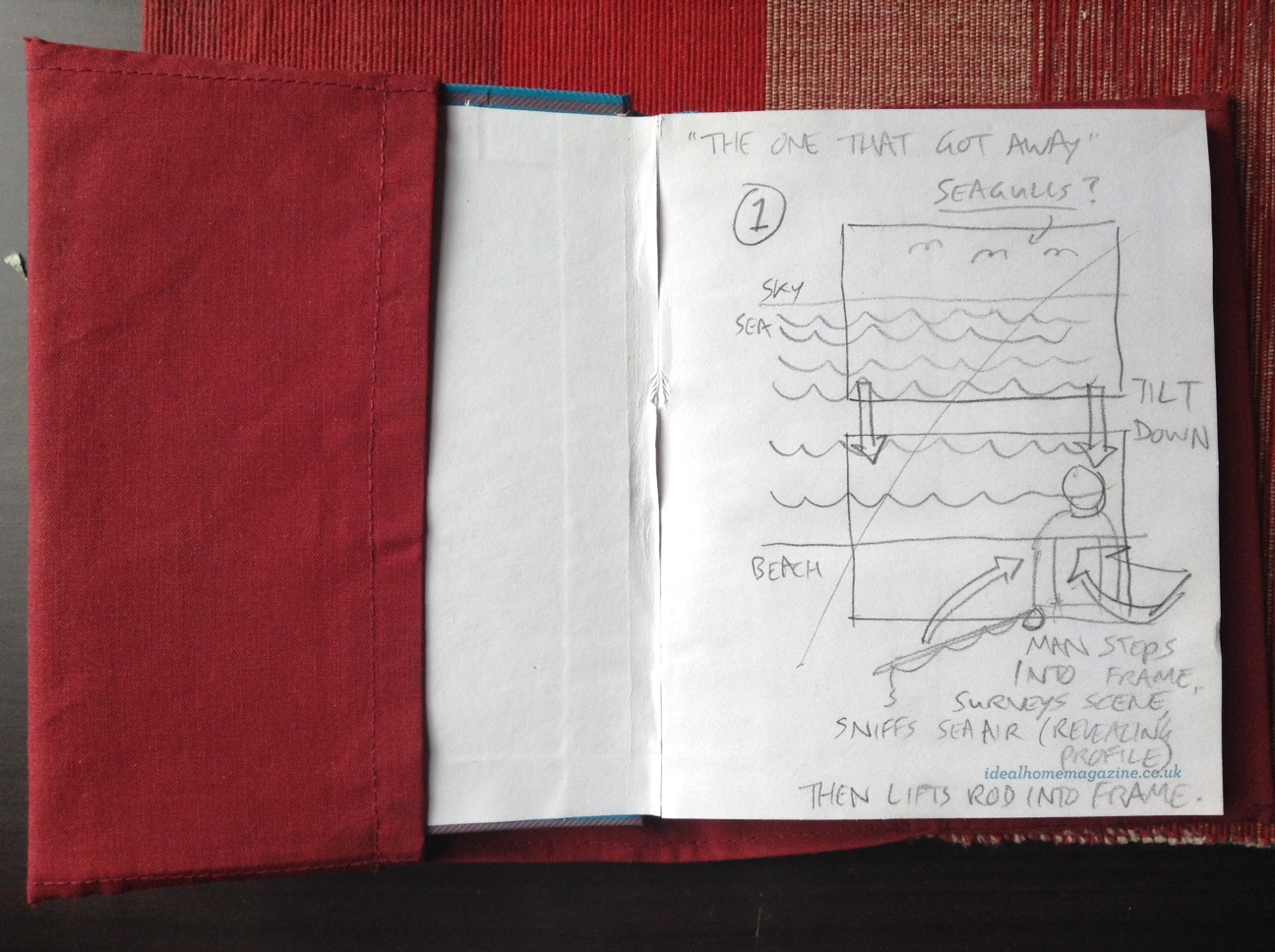
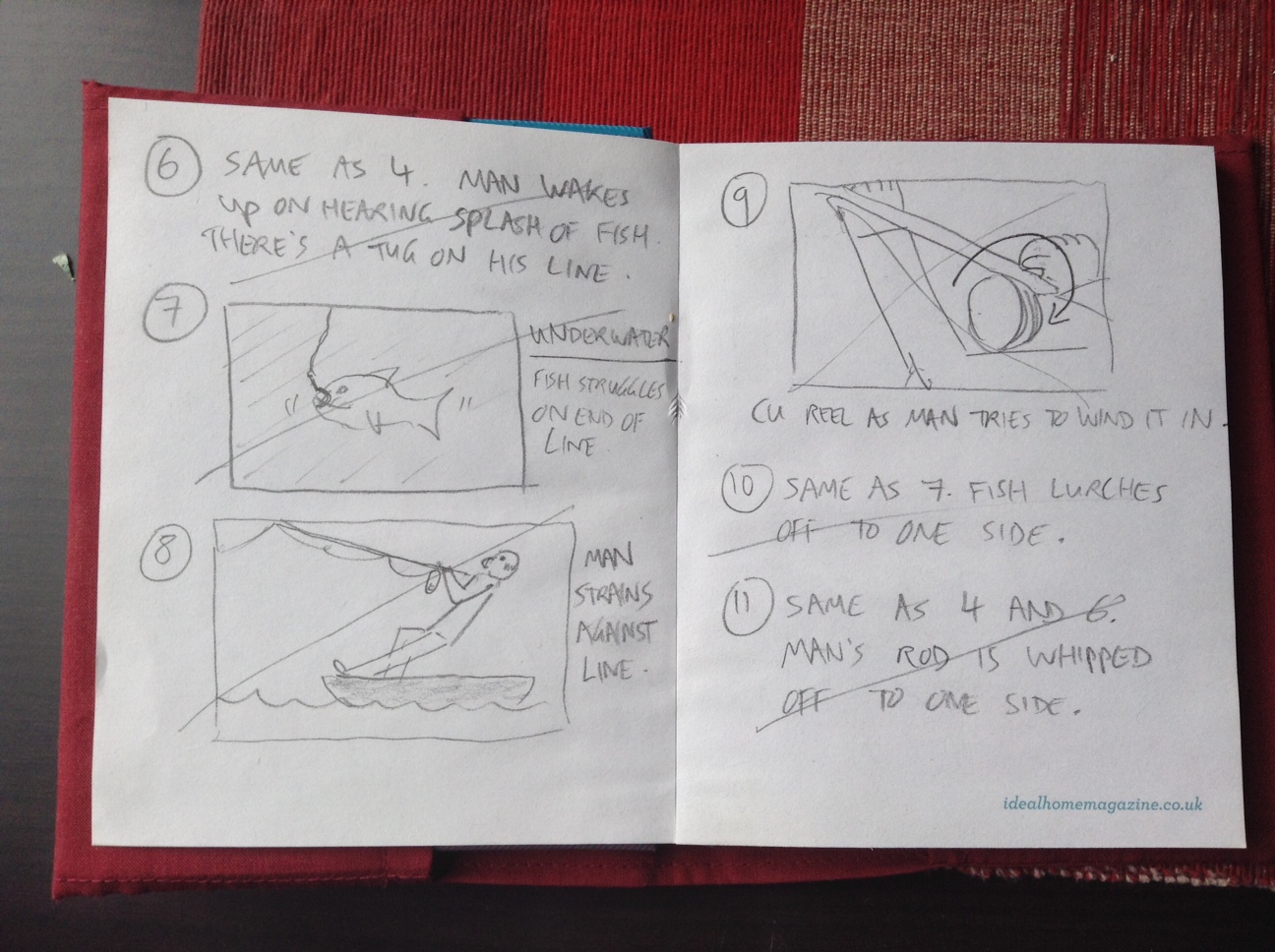
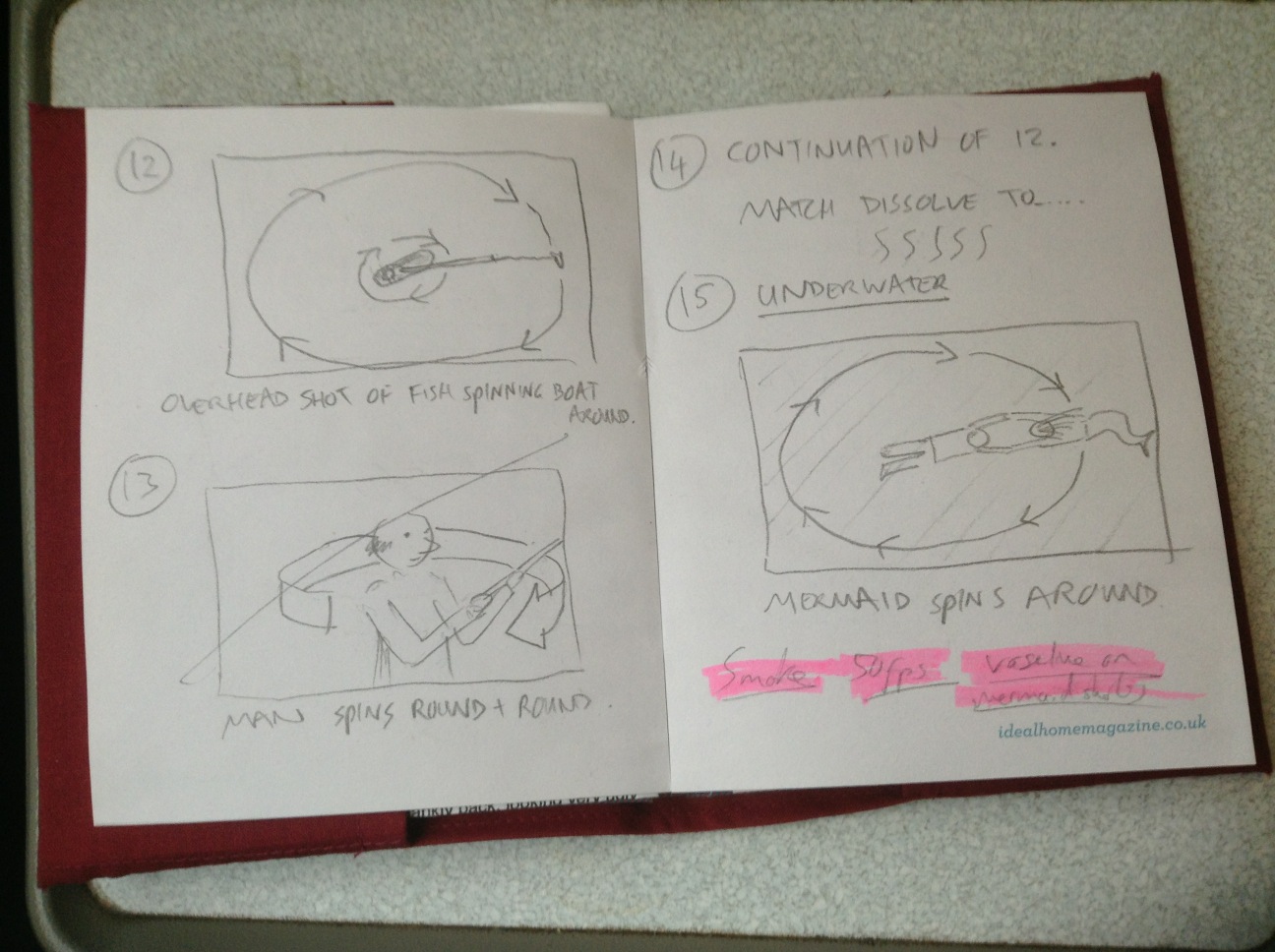
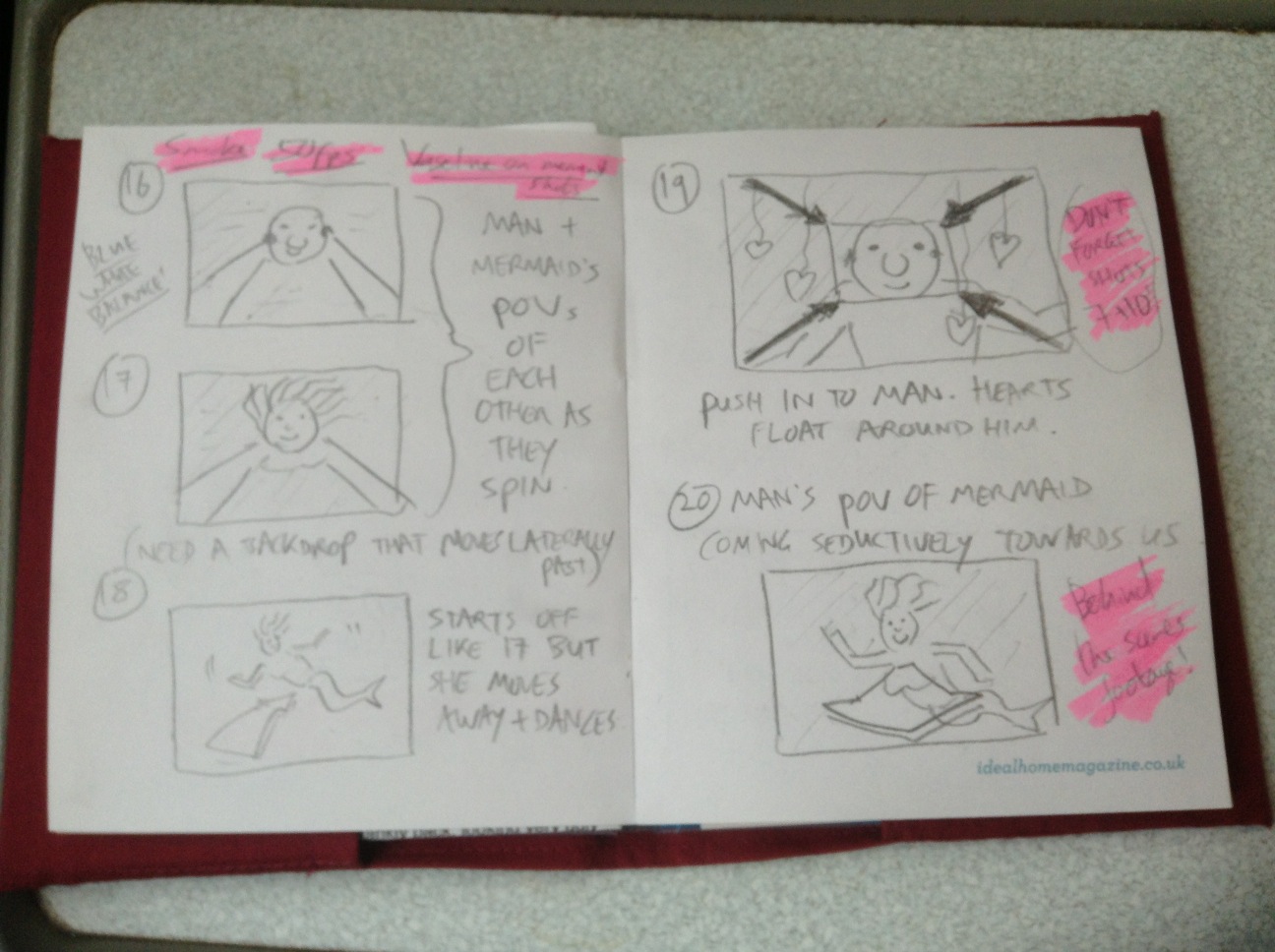
You wouldn’t get STORYBOARDS out at an initial pitch, but they’ll impress at a second or third meeting. They show you’ve thought carefully about the script and how you’re going to put it on screen. This is particularly valuable if you have complex action or FX sequences. Beware that if the person you’re pitching to thinks the script needs more work, they’ll see storyboards as jumping the gun. Get the script right first.

A MOOD BOARD is a scrapbook or montage of images from films and/or other artforms that represent the tone and style of your piece. Less skill is required to make one of these than concept art or storyboards, and although as a creative person you may balk at the implication that your film is unoriginal, execs will find it very useful to compare your project to previous ones. If you use images from a film that did poor box office, again expect tough questions about why your movie won’t fail too.

The Dark Side of the Leaflet, designed and executed by Ian Tomlinson

The Dark Side of the Leaflet, designed and executed by Ian Tomlinson

A variation on this is a BOOKLET which might contain some of the above, plus photos and biogs of attached or wish-list actors, a synopsis, a director’s statement and maybe even an outline budget. Ian Tomlinson, The Dark Side of the Earth’s incredibly talented production designer, came up with the period-style leaflets pictured at left to promote the project. In one of my Cannes video blogs you can see a bit of these leaflets. (Sadly they’re now all gone and they got quite time-consuming and expensive to produce.)

Now we’ll look at moving images. Nowadays these aren’t prohibitively expensive to produce, and can be distributed for next-to-nothing via the internet – but beware of techy problems on the other end. Even YouTube doesn’t always work. If the person you’re sending it to can’t open it, they’ll probably give up and move onto something else, perhaps without even telling you why. Frankly I reckon you’re always safer with a DVD. Playing it off a laptop, tablet computer or iPhone in a meeting is a bad idea. Execs are narrow-minded and will see your project as a cheap YouTube video rather than a big, cinematic venture. Plus the sound will be awful. In another of my Cannes vlogs I discussed the dilemma of whether it’s better to show your pilot with poor picture and sound or not at all.

A MOOD REEL or RIP REEL is a moving version of the mood board or scrapbook. Ripping all those DVDs and YouTube clips can be a technical nightmare, but if done well it can be very useful. Here’s one for a very different vision of The Hunger Games by director Kevin Tancharoen. The accompanying interview on Slashfilm.com is also well worth a read.

Beware that many of the above materials will start giving the recipient thoughts about the budget. If your materials make it look like your vision will be expensive, be prepared to answer tough questions about that.

TEASER TRAILERS can be very useful for raising crowd-funding, but my feeling is that they’re not great for attracting conventional financing. Unless you’re going to chuck a hell of a lot of money at it and get an experienced trailer editor to cut it, the danger that a teaser trailer will look amateur and backfire is significant. You’d be better off with a rip reel.

PILOTS can also backfire. You can’t shoot it on a DSLR with a few hundred quid, then screen it at your pitch meeting and say, “The film will look like this, only better.” You have to shoot it with the production values you want the full film to have. That’s why my pilot for The Dark Side of the Earth was shot on 35mm anamorphic, and why we insist that anyone wanting to view it attends a screening of the print, rather than watching a crappy little quicktime or even a DVD. When you’re in that darkened screening room with the 5.1 track rumbling away and the image looking jaw-droppingly beautiful, only then are you doing your film-to-be justice.

Consider making a stand-alone SHORT FILM instead. My greatest regret with the Dark Side pilot is that we didn’t do this; we just took a couple of scenes from the middle of the screenplay and added an introductory voiceover and concept art montage to explain the story so far. It’s far and away my best work, but no-one’s seen it! If only I could have entered it into film festivals. Even if that hadn’t helped get the feature funded, it would have been great exposure for me and perhaps could have led to another of my projects getting made.

Another thing I tried for Dark Side before making the pilot was PREVIZ. These are filmed or animated storyboards, normally created once a project is greenlit to help plan and budget for FX, but they may also have value as part of a pitch, particularly if you want to prove you’re on top of how the FX will be achieved. The Dark Sides previz was shot with action figures and cardboard models and I’d certainly never screen them in a pitch meeting; I did them mainly for my own benefit. If they’re for a pitch, get a good CG animator on the case.

Check out The Dark Side of the Earth: Previsualisation playlist on YouTube for more of these.

Finally, I once read about a filmmaker who created an AUDIO PITCH consisting of her own voice narrating the synopsis, mixed with music and sound effects. Whatever technology and skills you can access to best get your vision across, that’s what you’ve got to do. But remember, it has to be top quality or you’re just shooting yourself in the foot.

What methods have you used to get your vision across?

  •   •   •   •   •
February 29, 2012 by neiloseman

Wheels Within Wheels

One of the great things about DSLRs is that, being so small, you can put them in all kinds of unusual places and, being so light, you can rig them to things with relatively little hassle. Stop/Eject is not the sort of film where we’ll being doing a lot of this (unlike Act of Valor, which I strongly suggest you check out), but there is one shot that needs a custom rig…

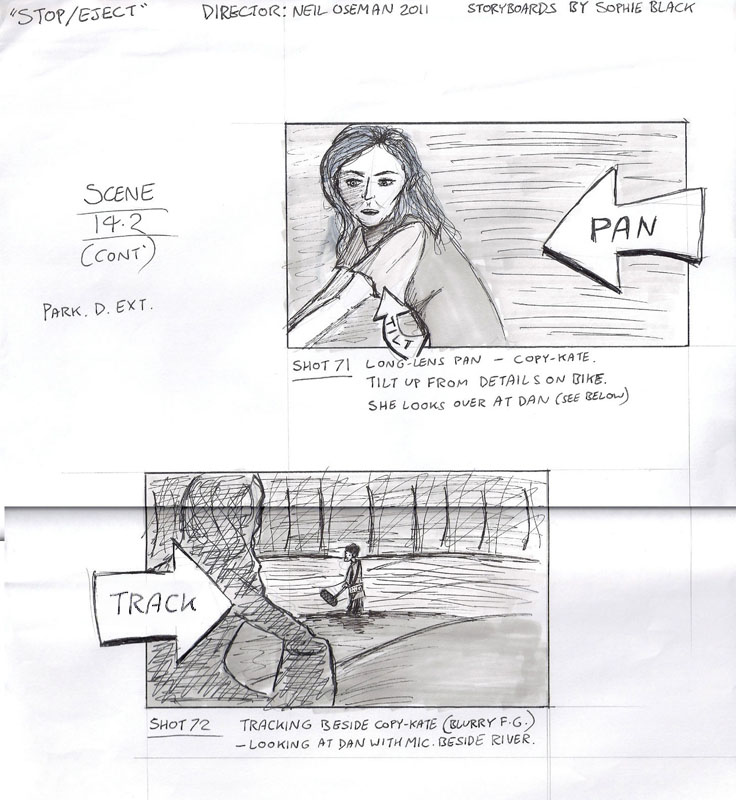
Shot 69, as drawn by Sophie Black

Shot 69, as drawn by Sophie Black

In this shot, the camera needs to be attached to the bike in some way so it moves with it, maintaining the same framing on the wheel throughout. This is part of the film’s visual theme of circles, which I discussed earlier this year on the blog.

Rigged for the rear wheel

Rigged for the rear wheel

If the shoot had gone ahead last October as originally planned, this shot would probably have got dropped or replaced with a similar but less effective version achieved by simply steadicamming along next to the bike. But one great advantage of a shoot being postponed is the opportunity to prepare so much better.

To that end, Colin and I borrowed his mum’s bike this morning to test the shot. Under the pressure of a low budget filming schedule, you can’t mess around trying to figure out a rig like this. You have to work it out in advance.

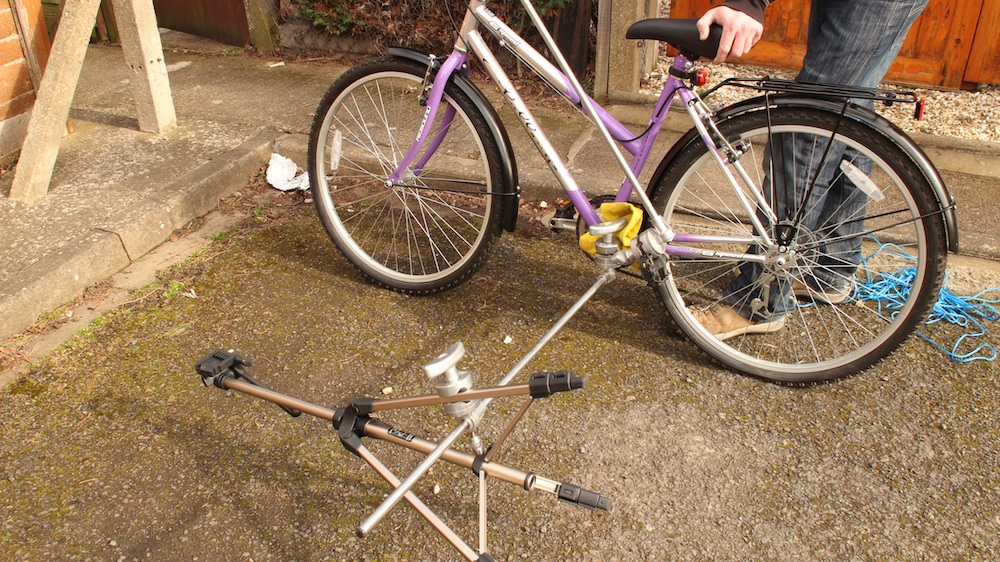
My plan was to use a C-stand arm and a cheap tripod to get the camera in the right place. First of all we tried clamping the arm to the frame of the bike, but it was too thick. So then we clamped it to the pedal (which meant roping or clamping the pedal to another part of the bike so it wouldn’t turn). The bottom of the tripod was clamped in turn to this arm. The handy thing about using a tripod, of course, is that you have a pan-and-tilt head for easy adjustments and a quick-release plate too.

Rear wheel shot

Rear wheel shot

Initially we filmed the rear wheel, but then I realised filming the front wheel would allow us to get a wider frame, since the pedals (which had to be framed out because the arm was clamped to one of them) were further away from the front wheel.

The rig worked out really well. We had to use a lens with an image stabiliser, and when we shoot it for real we’ll put someone on the bike to weigh it down and reduce the bumps further. I’d imagined we’d have to use a second clamp and bungee cords to keep the camera in place, but the sturdiness of the C-stand arm and the low weight of the camera made this unnecessary.

Yeah, we got a bit of the pedal in shot, not to mention Col’s feet. But those things are easily fixed.

Just before I sign off, I have to give you a link to Tony Hill Films, a site I came across while researching bike rigs. He’s built a number of unique and fascinating camera rigs which you can see in action on the site: http://www.tonyhillfilms.com/rigs

Front wheel rig

Front wheel rig

  •   •   •   •   •
January 10, 2012 by neiloseman

My Density Has Popped Me to You

"I am your density."

"I am your density."

At the risk of sounding like a Media Studies teacher, I’d like to talk a bit about the themes of Stop/Eject. Warning: this post contains spoilers.

I see themes as a way of making a film seem tighter and more cohesive. Let’s say you have a scene where a character is reading a book. As a writer, you ask yourself what book he should be reading. Firstly you’ll probably consider the plot: is it important to the storyline what book he’s reading? If not then you’ll consider the character (which you should always do anyway of course): what kind of book would this character be reading? This will doubtless narrow down the field but ideally you should now think about the themes. Can he be reading a book which somehow reflects the themes? For example, if the film has an environmental theme, could he be reading Watership Down?

I used to see putting themes into a film as giving myself extra work, but it actually makes it easier to reach decisions because it narrows down your options. And anyone who knows me knows I need all the help I can get with making decisions.

Okay, onto Stop/Eject. The first draft script had no themes at all that I was aware of. When I had to give my characters something to do while talking I chose things at random and kept them pretty generic. But the thing about themes is they’re always there – you just have to find them and tease them out.

Tape recorder

Tape recorder

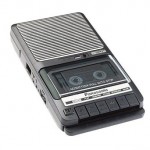
I chose a tape recorder as the vehicle for time travel in the film simply because it seemed like a cool idea. And I chose “hit by a car while trying to get mobile reception” for Dan’s demise just because I’m a grumpy old luddite who hates mobiles and I’ll take any chance I can get to portray them in a negative light. But then someone pointed out the link between these two things: audio.

So I chose to develop sound as a theme in subsequent drafts. How do you develop a theme? Easy. You just bung in more references to it.

So Dan’s hitherto-unspecified job became Sound Designer. Which in turn transformed an unoriginal scene of Kate working late to Dan’s chagrin to a more unique and thematic one in which Dan’s loud editing of some dialogue in his living room studio sparks the conflict.

Co-writer Tommy Draper and I had been struggling to come up with a satisfying “meet cute” (Hollywood parlance for the key scene in a romcom where the couple first meet). Dan’s new job soon provided the answer as we came up with a nice sequence in which Kate first sees him hovering around the weir with a big fluffy microphone recording sound effects.

We even tweaked little things to enhance the theme. So instead of Kate being woken up one morning by a beam of sunlight coming through a crack in the curtains, it’s an alarm clock: sound again. And instead of the driver who runs Dan over being distracted by writing a text, it’s tuning the radio that takes his eyes off the road.

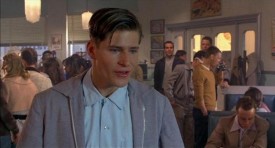
Stop/Eject‘s other theme is destiny, as Kate quickly discovers that although she can effectively travel back in time she can’t changed anything. This came in handy when trying to write Dan’s proposal speech; at the risk of it being too “on the nose” I had him tell Kate that she’s his destiny. (It doesn’t hurt that a certain George McFly may have uttered similar words.)

Belper's horseshoe weir (photo: Sophie Black)

Belper's horseshoe weir (photo: Sophie Black)

But the destiny theme is mainly developed visually. I picked the Derbyshire town of Belper to shoot in primarily for its aesthetic qualities, but as the script evolved I saw the thematic benefit of using Belper’s river wherever possible. A river flows continually, like time moving unstoppably forward… or like the tape in a cassette… which linked to another visual theme that had emerged: circles.

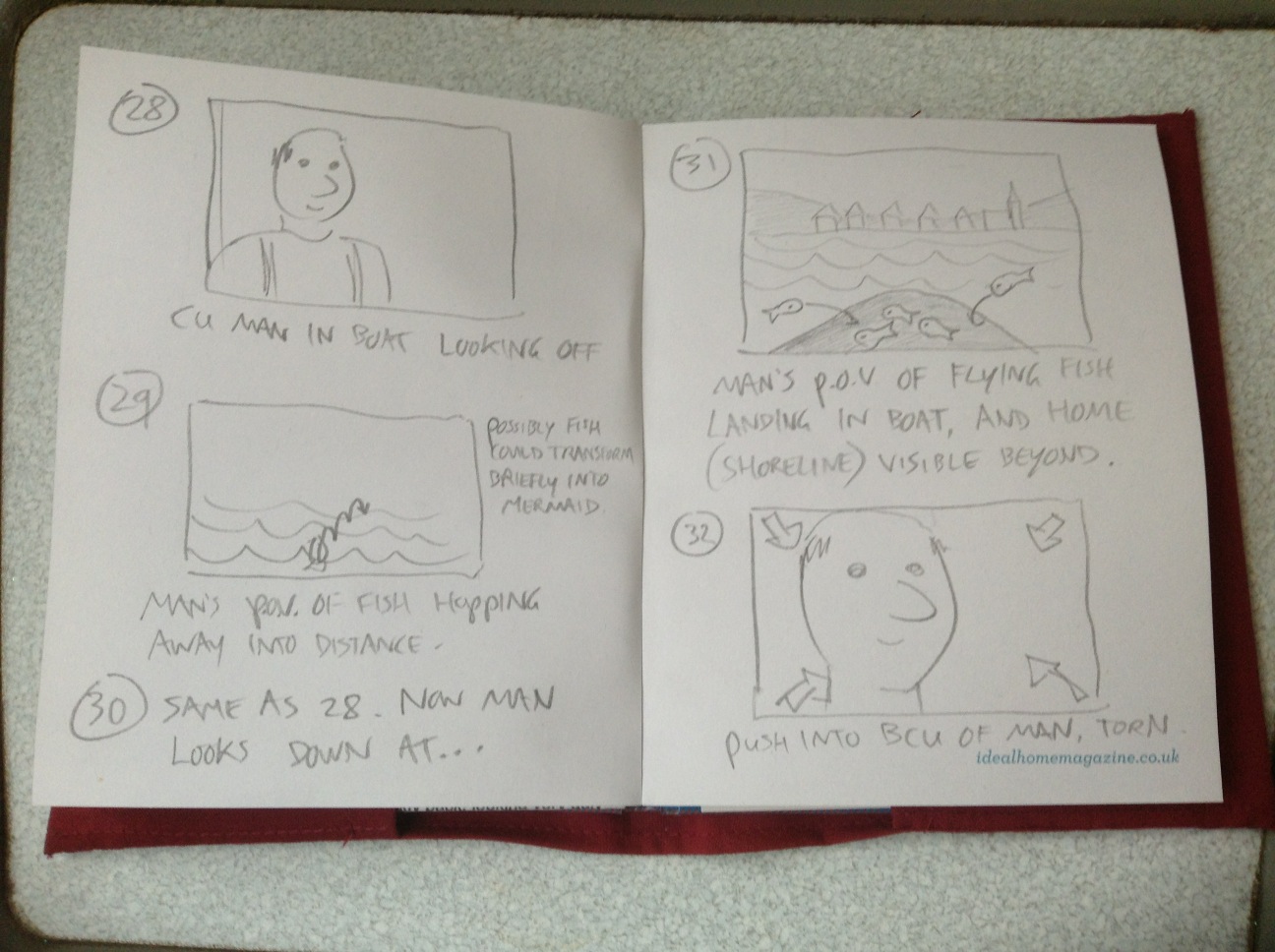
It was clear from early on that the film would feature many close-ups of the tape recorder, particularly the capstans (the bits that make the cassette spools go round). When storyboarding, I looked for places that I could echo this image to create a visual motif. The most obvious thing was to include a shot of a waterwheel in one of the river scenes. More subtly, I moved a scene to a bandstand so I could have Kate cycle around it. And when she microwaves a ready meal I conceived a shot looking straight down on it, inside the microwave, as it rotates. Aside from a visual continuity, hopefully these things will suggest the Circle of Life to viewers on some unconscious level – linking in to the destiny theme.

If you had told me in my A level Media Studies lessons, as Mr Clutterbuck paused Psycho for the twentieth time and pointed out some minor detail which I was convinced the director had not planned as deliberately as my teacher seemed to think he had, that I would one day put so much stock in cinematic themes I wouldn’t have believed you. But if you can take control of your film’s subtext I’m now convinced your audience will have a better time, even if they can’t put their finger on why.

If you’ve enjoyed this blog post and you’d like to see Stop/Eject get made, please contribute a few pennies at http://tinyurl.com/stopeject

  •   •   •   •   •
January 9, 2012 by neiloseman

Stop/Eject Visuals

Poster concept 1

Poster concept 1

On Friday morning Satnam Rana, arts correspondent for BBC Midlands Today, came and shot an interview with me about Stop/Eject. Two interviews in fact – one for radio, which went out just before 6pm that evening on BBC Hereford & Worcester – and one for TV, which was meant to go out that evening too, but subsequently got bumped back to tonight’s (Monday’s) show. Look out for it at 6:30pm in the West Midlands or on Sky channel 979.

Poster concept 2

Poster concept 2

The report should go on their website as well, so hopefully in my next post I’ll be able to bring you a link to that and I’ll also explain how I managed to get myself on TV.

There have been some visual developments with Stop/Eject in the last few days. Sophie has taken some of my crude storyboards and fleshed them out, while I’ve been taking photographs of cassettes and mangled tape and trying out some new poster concepts. The wrapped tape one has garnered the most response so far, some loving it, some hating it, but I’m interested to hear what you think.

  •   •   •   •   •
December 19, 2011 by neiloseman

Stop/Eject: Writing and Storyboarding

Here’s the latest podcast. Only six days left now to sponsor Stop/Eject if you want to claim access to the exclusive new documentary about the financials ins and outs of Soul Searcher.

  •   •   •   •   •