Interview: KT Roberts and 3 Blind Mice

20131111-215247.jpg

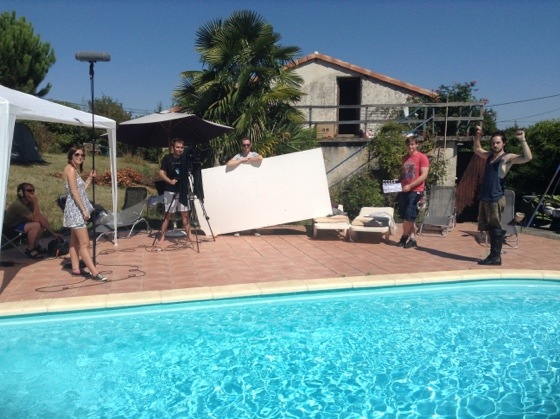
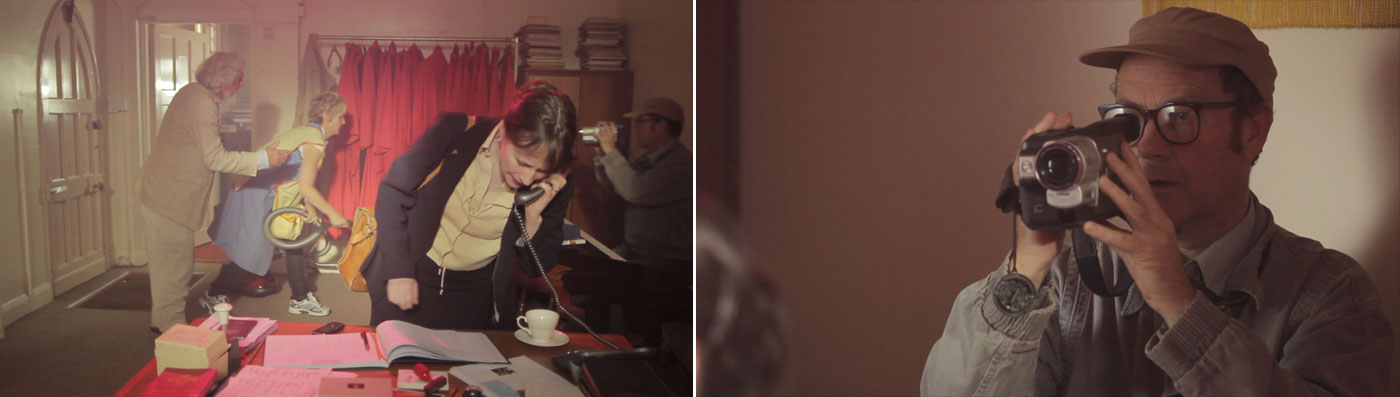
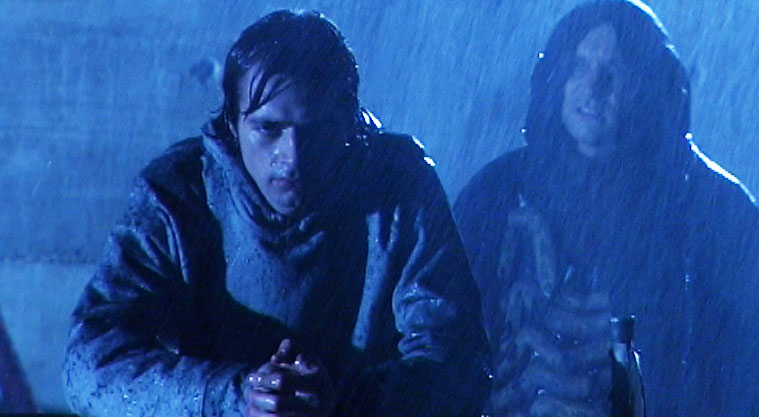
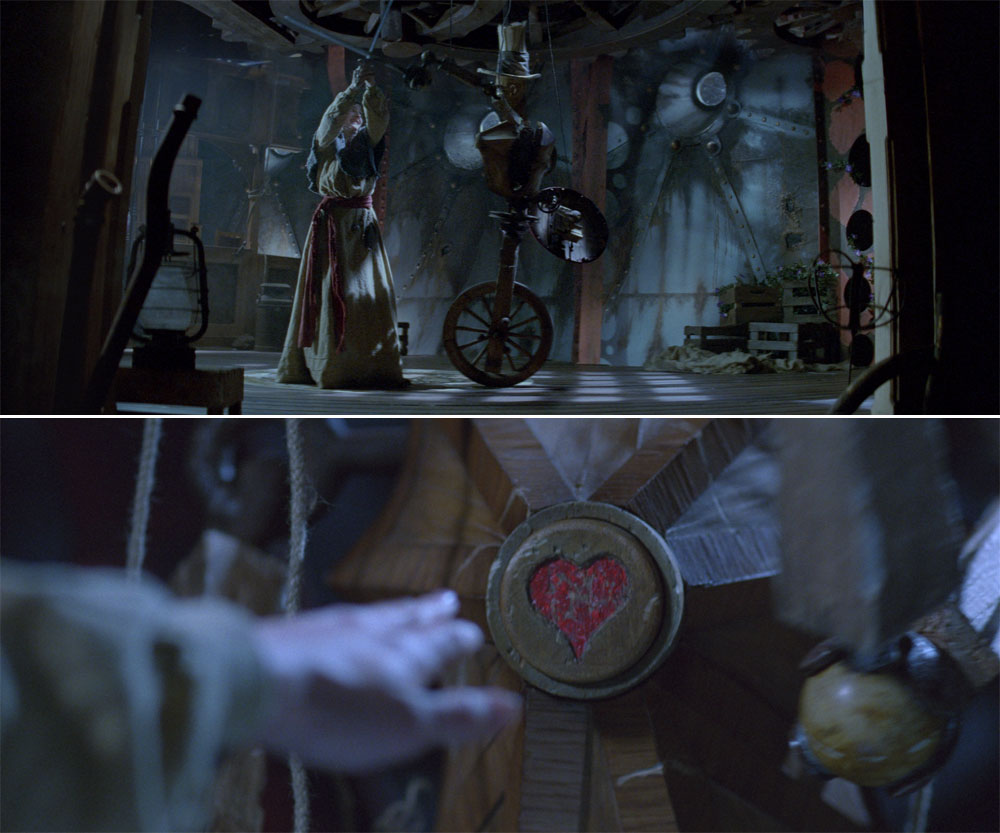
Earlier this year I met young filmmaker KT Roberts on a shoot in South Wales, and I remember her telling me all about her idea for a time travel feature film. This got my attention (a) because I love time travel movies and (b) because I always like to hear about low budget filmmakers who are not afraid to tackle a sci-fi or fantasy story. But before KT embarks on this feature, she’s making a short film called 3 Blind Mice. She asked me to help out and before I knew it I was the director of photography and drawing up an equipment list for Panalux.

KT, where did the concept for 3 Blind Mice come from?

I wrote two thirds of 3 Blind Mice on a plane back from a diving trip in Lanzarote – I’d had the ideas rattling around in my head for a while, but hadn’t yet put pen to paper but on that plane journey it came spilling out rather quickly. This is actually the first short film I’ve ever written that I like enough to want to take to the shooting stage. I have this writing thing all backwards in that I’ve already written a feature and have another in the pipeline, but I find it much harder to write short films as there’s so little time to explore anything in any detail. Paradoxical as it may seem, features are easier for me to write (though not necessarily to write well – only time will tell!) because they give you time to explore, examine and dissect your characters: a deep sea dive in the Caribbean as opposed to pressing your nose against the glass in an aquarium.

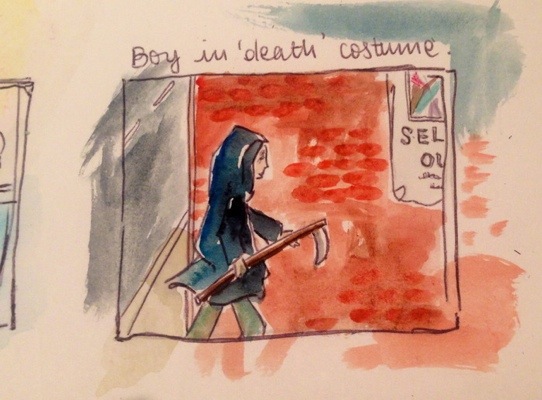
With this in mind I didn’t want to focus on just one character as I didn’t feel I’d be able to do them justice, or tell the sort of story I wanted to tell, in the shortened format of a short film. Instead I decided I wanted to make a film about a single idea and examine it in depth from different angles and perspectives – through the eyes of different people. I’m not entirely sure what drew me to death – no-one I know has died, not even a pet, so I’m not drawing directly from my own experience on that front. However I have had a massively overactive imagination since a very young age (I was one of those hyper children battling dragons with wooden sticks) – and I’m fascinated by the very human tendency to tell ourselves stories to help us deal with things we don’t understand. The stories we tell ourselves about death – from concepts of heaven and hell, to ghosts, the supernatural and the grim reaper- allow us to categorise and quantify this great unknown and thereby make it less scary. All three stories depict someone struggling with death and making up an imaginary companion to help them through it – each is coming from a different perspective and has a different outlook on what death means, but each of them must come to terms with it. I hope I have managed to convey the idea that while death can be scary and sudden and confusing, there are other, brighter facets to it if you look in a certain way.

How does 3 Blind Mice fit into your plans for future filmmaking?

I’m really looking forward to making this short and hope it will mark the start of a career which sees some of my bigger projects realised. Ultimately I would like to make one of my feature films, and my producer Julia and I have already discussed how we might film the opening to use as a pilot to try and raise the necessary funds. My work is slightly tricky in that I almost always have a science fiction, fantastical or supernatural angle in my writing, which can be difficult to bring to the screen for obvious reasons! However my work isn’t fiction in the same vein as something like Star Wars – it normally has just one element (for example my finished screenplay, Timelines, revolves around people who live in our world, but who can move through time). This means that with clever camera work and minimal special effects, my stories can be realised without the multi-million pound budgets that most science fiction films made today need. I’m not aiming to make art house films and I am very much aiming to entertain not preach, but if I can sneak in themes and perspectives that interest me or I feel strongly about then the story is always better for it, even if many people watching don’t realise it’s there. I want people to work to understand the storyline and the characters, not just sit back to watch mindless fluff.

So if I could look forward 20 years, I hope I’ll be writing and/or directing that sort of film and be able to look back on 3 Blind Mice as the first step on my way.

Right now KT and her dedicated production team are in the middle of a crowd-funding campaign to cover the modest costs of making 3 Blind Mice. Myself, Colin and the rest of the cast and crew are volunteering our time, but there are some costs you can’t escape. This is an all-or-nothing campaign, so if we don’t reach the target we get none of the money and cannot make the film. So please head on over to the Kickstarter page, contribute what you can and help get KT on the road to achieving her dreams.

Interview: KT Roberts and 3 Blind Mice

Period Cinematography

White "daylight" (a 2.5K HMI outside the window and a Kinolfo Barfly behind the actor) and warm "candlelight" (a Dedolight off camera right)
White “daylight” (a 2.5K HMI outside the window and a Kinolfo Barfly behind the actor) and warm “candlelight” (a Dedolight off camera right)

The First Musketeer was my first period production as DP. It’s a genre that brings its own set of challenges and opportunities, most obviously for sets and costumes, and also sound (we spent a lot of time waiting for cars and planes to pass by), but for cinematography too. The first thing that hit me was the restrictiveness of it. Back in the day there were only three sources of light: the sun, the moon and fire. And maybe, at a pinch, starlight.

Blue "moonlight" and orange "firelight" - in this case both created by gelled Dedolights
Paul McMaster as Ghislain. Blue “moonlight” and orange “firelight” – in this case both created by gelled Dedolights

I kept colour temperatures simple by deciding that daylight would always appear white, moonlight would be +2,400K (blue) and firelight would be -2,400K (orange). In practice this meant that daylight scenes were white-balanced at 5,600K using natural light, HMIs and kinoflos, with ungelled redheads or dedos for candlelight, while night scenes were typically white-balanced at 3,200K which turned HMIs and kinos blue for moonlight/starlight, with redheads or dedos gelled with full CTO to turn them orange on camera.

This night exterior shot of Lazare (Tony Sams) and Athos (Edward Mitchell) was shot with a white balance of 3,200K, turning the HMI backlight blue, while the warm light around the taven entrance was provided by CTO-gelled Dedos and redheads.
This night exterior shot of Lazare (Tony Sams) and Athos (Edward Mitchell) was shot with a white balance of 3,200K, turning the HMI backlight blue, while the warm light around the tavern entrance was provided by CTO-gelled dedos and redheads.

Occasionally I used straw gels to give “firelight” more of a yellow hue than an orange one, and in one scene involving a church I introduced strongly yellow light and some pink backlight, the theory being that stained glass windows could be held accountable.

A 2.5K provides the frontal keylight here, while a redhead sporting Minus Green gel provides the pink backlight. A second redhead double-gelled with Light Straw uplights the figure of Christ on the back wall, and finally a 1.2K HMI at the rear of the building illuminates the stained glass window.

I think it’s very important to soften the images when shooting a period piece digitally. Initially we hoped to do this by using Cooke lenses, but they proved unobtainable on our budget. It was too late to look into filters by this point, so instead I relied on smoke in most scenes to diffuse and age the image.

Like everyone, I continue to learn with every project that I do. Reviewing the rushes towards the end of the shoot, I realised (a little too late) that texture was the key to making the period convincing. There was bags of it in front of me – in the stone walls of the locations, in the beautifully-aged costumes, in the detailed set dressing. It was an era before smooth surfaces. I can now see that my cinematography was most successful when the lighting brought the textures out.

A 1.2K HMI outside the door cross-lights the stonework, while smoke volumizes this light, resulting in a very satisfying depth and texture. The only other light sources are two kinoflo Barflies hanging from polecats above the bench at the back of shot. This backlight is reflected back at the foreground characters by a sheet of silver foamcore beneath the camera.
A 1.2K HMI outside the door cross-lights the stonework, while smoke volumizes this light, resulting in a very satisfying depth and texture. The only other light sources are two Kinoflo Barflies hanging from polecats above the bench at the back of shot. This backlight is reflected back at the foreground characters by a sheet of silver foamcore beneath the camera.

Contrast the shot above with the one below. This location had equally nice stonework, but because I didn’t cross-light it it looks flat and artificial, like a cheap panto set.

A 2.5K HMI supplies the backlight here, while a blue-gelled redhead out of the top right of frame is aimed down the steps to pick out the characters as they descend. An orange-gelled Dedo creates a pool of light around the candle, and everything else is natural bounce off the surrounding stonework. A second blue-gelled redhead at the foot of the stairs firing across the stonework would have made all the difference to the believability of the environment, but hindsight is 20/20.
A 2.5K HMI supplies the backlight here, while a blue-gelled redhead out of the top right of frame is aimed down the steps to pick out the characters as they descend. An orange-gelled Dedo creates a pool of light around the candle, and everything else is natural bounce off the surrounding walls. A second blue-gelled redhead at the foot of the stairs firing across the stonework would have made all the difference to the believability of the environment, but hindsight is 20/20.

So that’s an important lesson I’ve learnt to take forward to the next season. Next time around I also want to play more with different colours of daylight, using more straw, amber and pink gels to stretch out the colour palette and suggest different times of day.

And then there’s the whole candlelight thing – but I’ll save that for my next post.

All images copyright 2013 The First Musketeer. Find out more about the series at www.firstmusketeer.com

Period Cinematography

Black Magic Cinema Camera Review

Throughout September I got a crash-course introduction to the Blackmagic Cinema Camera as I used it to shoot Harriet Sams’ period action adventure web series The First Musketeer. The camera was kindly lent to us by our gaffer, Richard Roberts. Part-way through the shoot I recorded my initial thoughts on the camera in this video blog:

Here’s a summary of the key differences between the Blackmagic and a Canon DSLR.

Canon DSLR Blackmagic Cinema Camera
Rolling shutter (causes picture distortion during fast movement) Rolling shutter (though not as bad as DSLRs)
Pixels thrown away to achieve downscaling to 1080P video resolution, results in distracting moiré patterns on fabrics, bricks walls and other grid-like patterns Pixels smoothly downscaled from 2.5K to 1080P to eliminate moiré. Raw 2.5K recording also available
On-board screen shuts off when external monitor is connected On-board screen remains on when external monitor is connected
Some models have flip-out screens which can be adjusted to any viewing angle and easily converted into viewfinders with a cheap loupe attachment On-board screen is fixed and highly reflective so hard to see in all but the darkest of environments
Maximum frame rate: 60fps at 720P Maximum frame rate: 30fps at 1080P
50mm lens is equivalent to 50mm (5D) or 72mm (other models) full-frame lens 50mm lens is equivalent to 115mm full-frame lens
10-11 stops of dynamic range 13 stops of dynamic range
Recording format: highly compressed H.264, although Magic Lantern now allows for limited raw recording Recording format: uncompressed raw, ProRes or DNXHD
Battery life: about 2 hours from the 600D’s bundled battery in movie mode Battery life: about 1 hour from the non-removable internal battery
Weight: 570g (600D) Weight: 1,700g
Audio: stereo minijack input, no headphone socket Audio: dual quarter-inch jacks for input, headphone socket

Having now come to the end of the project, I stand by the key message of my video blog above: if you already own a DSLR, it’s not worth upgrading to a Blackmagic. You’d just be swapping one set of problems (rolling shutter, external monitoring difficulties, aliasing) for another (hard-to-see on-board screen, weight, large depth of field).

The BMCC rigged with a lock-it box for timecode sync with the audio recorder, on a Cinecity Pro-Aim shoulder mount

The depth of field was really the killer for me. Having shot on the 600D for three years I’m used to its lovely shallow depth of field. With the Blackmagic’s smaller 16mm sensor it was much harder to throw backgrounds of focus, particularly on wide shots. At times I felt like some of the material I was shooting looked a bit “TV” as a result.

The small sensor also creates new demands on your set of lenses; they all become more telephoto than they used to be. A 50mm lens used on a crop-chip DSLR like the 600D is equivalent to about an 72mm lens on a full-frame camera like the 5D Mark III or a traditional 35mm SLR. That same 50mm lens used on the Blackmagic is equivalent to 115mm! It was lucky that data wrangler Rob McKenzie was able to lend us his Tokina 11-16mm f2.8 otherwise we would not have been able to get useful wide shots in some of the more cramped locations.

As for the Blackmagic’s ability to shoot raw, it sounds great, but will you use it? I suggest the images you get in ProRes mode are good enough for anything bar a theatrical release, and are of a far more manageable data size. You still get the high dynamic range in ProRes mode (although it’s optional), and that takes a little getting used to for everyone. More than once the director asked me to make stuff moodier, more shadowy; the answer was it is shadowy, you just won’t be able to see it like that until it’s graded.

The colour saturation is also very low, again to give maximum flexibility in the grade, but it makes it very hard for the crew huddled around the monitor to get a sense of what the finished thing is going to look like. As a cinematographer I pride myself on delivering images that looked graded before they actually are, but I couldn’t do that with the Blackmagic. But maybe that’s just a different workflow I’d need to adapt to.

The biggest plus to the BMCC is the lovely organic images it produces, as a result of both the down-sampling from 2.5K and the high dynamic range. This was well suited to The First Musketeer’s period setting. However, I think next season I’ll be pushing for a Canon C300 to get back the depth of field.

I’ll leave you with a few frame grabs from The First Musketeer.

Note: I have amended this post as I originally stated, incorrectly, that the BMCC has a global shutter. The new 4K Blackmagic Production Camera does have a global shutter though.

Black Magic Cinema Camera Review

Tous Pour Un et Un Pour Tous

The calm before the storm of the last day of shooting

Eleven years ago, on returning home from a three week feature film shoot in New York, I wrote this on my blog: “Whenever you do a big shoot, you spend several weeks working intensively with a bunch of people who you end up utterly adoring, then the shoot ends and you NEVER see them again. Which is horrible, totally horrible.”

This week I’m going through the same depressing experience again, having returned home from the month-long French shoot for season one of The First Musketeer, a project which has knocked the New York feature off the top spot and now ranks as The Best Shoot I’ve Ever Been On.

It was a tough, tough shoot, make no mistake: lots of night shooting (for which I’m entirely to blame), long hours, rain, insufficient food, fatigue and – given the ambitious nature of the show – a miniscule budget and a tiny crew. Only one day off was scheduled, although two others emerged out of last-minute necessity.

But how often do you get to shoot in castles? At night? With sword-fighting actors in stunning period costumes? How often do you get to work with horses, or film in a medieval city carved into the cliff-face of a huge gorge? It was an awesome experience.

Art assistant Denise Barry's photo of the cast and crew shortly after arriving in France
Art assistant Denise Barry’s photo of the cast and crew shortly after arriving in France

What really made it though was the people. I’ve never met such a lovely bunch or bonded so strongly with a group. We went into a bubble, seeing no-one else but our fellow cast and crew, day in day out, staying in the same chalets as them, enduring the same hardships, developing private jokes (Gerard Depardieu), rocking out to the same eighties tunes on RFM as we drove the long, windy roads to location, cooking for each other, drinking with each other, helping each other through the cold nights on set with chocolate, sweets, coffee and hugs. Departmental barriers quickly broke down, with the sound recordist driving the lighting-camera van, he and his boom op helping us every day with our lighting set-ups and our tear-downs, and all the tech crew pitching in to help the art department reinstate locations after wrapping.

I hope this time that I will see everyone again, not just for a wrap party but for further seasons of the show as well. I doubt we will ever recreate the magic of this year’s experience, but we’ll always have Gerard Depardieu.

Tous Pour Un et Un Pour Tous

Know Your Lights

Whilst prepping for The First Musketeer here in the south of France I was able to record this video blog showing the lighting kit we’ll be using and what it all does. If you don’t know your kinos from your dedos, or can’t can understand why a 2.5K HMI is SO much better than a 2K blonde, this vlog will shed some light [groan].

The first week of the adventure is drawing to a close, although we only started shooting two days ago, the rest of the week having been taken up by travel and prep.
After picking up the lighting kit from Panalux and Filmscape on Monday, we set off in a convoy of five vehicles first thing on Tuesday morning from High Wycombe. After a noon crossing from Dover to Dunkirk we drove all afternoon and most of Wednesday to get to Puy L’eveque, the medieval town in which we’re based.
The main task on Wednesday was to test the workflow of the Black Magic Cinema Camera kindly lent to us by gaffer Richard. This is my first time working with the BMCC and I’ll share my thoughts on it in a forthcoming vlog.
Shooting began on Thursday, coinciding with a storm which broke the sweltering hot spell and has seen pretty much continuous rain become the dominant weather since then. There were challenges with horses, generators and (as ever) time, but as of this writing we’re on schedule and everyone seems to be very happy with the footage acquired.
I’m not sure how much I’m allowed to reveal about the series and the details of what we’ve been shooting, so I’ll leave it there. Stay tuned for more video blogs.

20130908-133955.jpg

Know Your Lights

The First Musketeer

This week I’m off to France for a month to lens Harriet Sams’ ambitious web series The First Musketeer. The show is a prequel to the famous Alexandre Dumas novel, and as such features horses, candlelight and swordfights galore, all against a gorgeous backdrop of historical locations. As Athos arrives in Paris, on the run from his tragic past, a chain of events leads him to the other Musketeers, and into an adventure that will seal their fates as brothers and heroes for the rest of their lives.

A promotional image from the teaser shoot

I doubt I’ll have time while there to do much other than shoot and sleep, but I’ll try my best to do a few video blogs. Subscribe to my YouTube channel to make sure you don’t miss them, and for general updates on the project visit The First Musketeer’s Facebook page.

The First Musketeer

Depth Cues in Cinematography

One of the most important jobs of a director of photography is to help the viewer’s brain decode the image. Just as a sound mixer must get the cleanest possible dialogue and ensure that ambience, music and effects don’t distract from it or drown it out, so a cinematographer must ensure the eye is drawn to the character and not distracted by the surroundings.

Depth is a key part of creating this clarity. Christopher Nolan once said: “95 percent of our depth cues come from occlusion, resolution, color and so forth, so the idea of calling a 2-D movie a ’2-D movie’ is a little misleading.”

This week, on The Deaths of John Smith, I photographed a shot that used every trick in the book to create depth. Why? Because it was a one-shot scene, a flashback taken out of context, and the audience needed to “get it” quickly.

When I first set the camera up and we stood John (played by Roy Donoghue) in position, his dark suit melted into the dark wood panelling behind him, so there was clearly some work to do. Once lit, as you can see from these frame grabs, he stands out sharply.

Kirsty Minchella-Storer (Sarah) and Roy Donoghue (John) in The Deaths of John Smith, directed by Roger Harding, copyright 2013 Two Hats Films
frame2 frame3 Kirsty Minchella-Storer (Sarah) and Roy Donoghue (John) in The Deaths of John Smith, directed by Roger Harding, copyright 2013 Two Hats Films

Let’s look at the depth cues going on here.

  1. DEPTH OF FIELD. Although I’m shooting at f1.8, on a 20mm lens nothing is massively out of focus, so that isn’t helping much.
  2. SMOKE. There is more smoke between the camera and a distant object than between the camera and a close object, and therefore smoke aids depth perception.
  3. CONTRAST. The foreground is darker than the background, helping the eye to distinguish between the various layers. In particular, the smoke picks up the light from the windows at the back of the room, creating a blue-white haze against which John’s dark suit stands out clearly, as does Sarah’s silhouette.
  4. COLOUR CONTRAST. The foreground is lit with warm orange, while the background is a cool blue, again enhancing the separation between the layers. (Imagine you’re standing on a hill and looking at another hill in the distance. That distant hill looks much bluer than the one you’re standing on, due to atmospheric haze. The smoke and colour contrast mimic this effect.) For most of this film I kept all the light sources within about 1,500K of each other, but in this scene I deliberately allowed more like 3,000K of difference between warm and cool sources to give the flashback a more stylised look.
  5. BACKLIGHT. John has a little edge-light on his righthand side, ostensibly from the wall sconces, but in reality from a hidden Dedo. This helps to cut him out from the background.
  6. FRAMING. The doorway frames the image, adding an extra layer of depth.
  7. PARALLAX. This is the optical phenomenon whereby, when you move your head (or a camera) things closer to you appear to move more than things further away. By dollying slightly into the room behind Sarah we create a dramatic parallax effect as the doorway grows on camera much more than John and the room behind him.

I’ll leave you with my (retrospective) lighting plan for this scene. Be sure to check out the film’s official website at www.thedeathsofjohnsmith.com

Lighting plan
Lighting plan
Depth Cues in Cinematography

How to Speed Up Your Shoot

Director under pressue. Photo: Paul Bednall

Tomorrow the film I’m currently DPing, The Deaths of John Smith, has an extremely packed schedule. This has got me thinking about how a filmmaker can keep themselves on schedule when faced with a seemingly impossible amount of material to get through.

The most effective action is of course to take out a big red pen and start cutting down the script. I know personally I find this very difficult, particularly if I’m both the writer and the director, because I’ve convinced myself by this point that everything in my shooting draft absolutely has to be there. Even though I know that, when I get to the edit, some scenes will inevitably get deleted and some dialogue will get trimmed. The challenge is to identify those trims now, on set, and save myself the trouble of shooting them.

Beware that simply cutting some dialogue is unlikely to have a signficant effect on your schedule, because most of your time on set is spent not shooting or even rehearsing, but setting up. Take a long, hard look at your shotlist or storyboards. Do you really need all that coverage?

Consider a Single Developing Shot (SDS). This means shooting an entire scene in just one set-up, with some camera movement and perhaps some dynamic blocking to maintain interest. The danger here is of doing a ridiculous number of takes of this one set-up because you know you have nothing to cut to if it’s not perfect (a trap I’ve fallen into more than once). I would advise qualifying your SDS with a cutaway or two to claw back a bit of flexibility in the edit and ease the pressure on the master shot.

A developing wide shot covers a large chunk of a scene from The Deaths of John Smith (copyright 2013 Two Hats Films). A safety cutaway (right) is shot to get the editor out of any tight spots.

If you can’t see a way to reduce the number of shots you need, consider ways to make those shots quicker to film. The most time-consuming shots for a director of photography to light are reverses, where the camera flips around to shoot in the opposite direction to all the previous angles, meaning every light has to be moved, along with the video village and all the piles of idle equipment in the background. Can you get away without a reverse, by changing the blocking a little? That character who has their back to camera – could they cheat their profile towards us a bit? It’s cheesy and not very realistic, but TV shows often achieve this by having one character talk to another’s back.

Ye olde person-talking-to-other-person's-back shot in Soul Searcher, obviating the need for a shot-reverse.
Ye olde person-talking-to-other-person’s-back shot in Soul Searcher, obviating the need for a shot-reverse.

Down-the-line close-ups are also quick to do. This means that, after doing your wide, you leave the camera more or less where it is (and, crucially, the lights too) and put on a longer lens to get your close-ups. Watch your continuity carefully, because down-the-line cuts will really show up any errors.

An example of a down-the-line close-up from Stop/Eject

If all else fails, the wrap time is looming and you’ve still got half a dozen set-ups to get, it’s best if those set-ups are close-ups or even cutaways. Because you and a skeleton crew can come back another day, maybe to a different location, maybe with a stand-in for your lead actor, and shoot tight pick-ups. Clearly this isn’t going to work with a wide master shot, for which you would need your whole cast and crew back, and the same set/location.

In this scene from The Dark Side of the Earth, the insert shot was filmed in a pub function room with a skeleton crew, four months after principal photography.

Finally, when working as a DP I have occasionally been asked to speed up the shoot by not lighting it. It is usually at this point that I feign hearing problems. Yes, not lighting stuff will speed up the shoot enormously. But you’re no longer making a professional film; you’re making a home video with an expensive camera. Don’t ask your DP to do this – you’ll only offend them. Instead, perhaps ask what camera angle would require the least re-lighting.

What tricks and techniques have you used to speed up your shoots?

How to Speed Up Your Shoot

How to Light a Church

Roger Harding (left) and Jeremy Heynes in The Deaths of John Smith.
Roger Harding (left) and Jeremy Heynes in The Deaths of John Smith. A 1.2K HMI punches through the window on the right, while a fluorescent softbox illuiminates the arches on the left. Background light comes from two 500W halogen work-lights rigged to a dimmer, while fill (given that it was getting dark outside at this point) comes from a blue-gelled 1K Arrilite behind and to the left of camera.

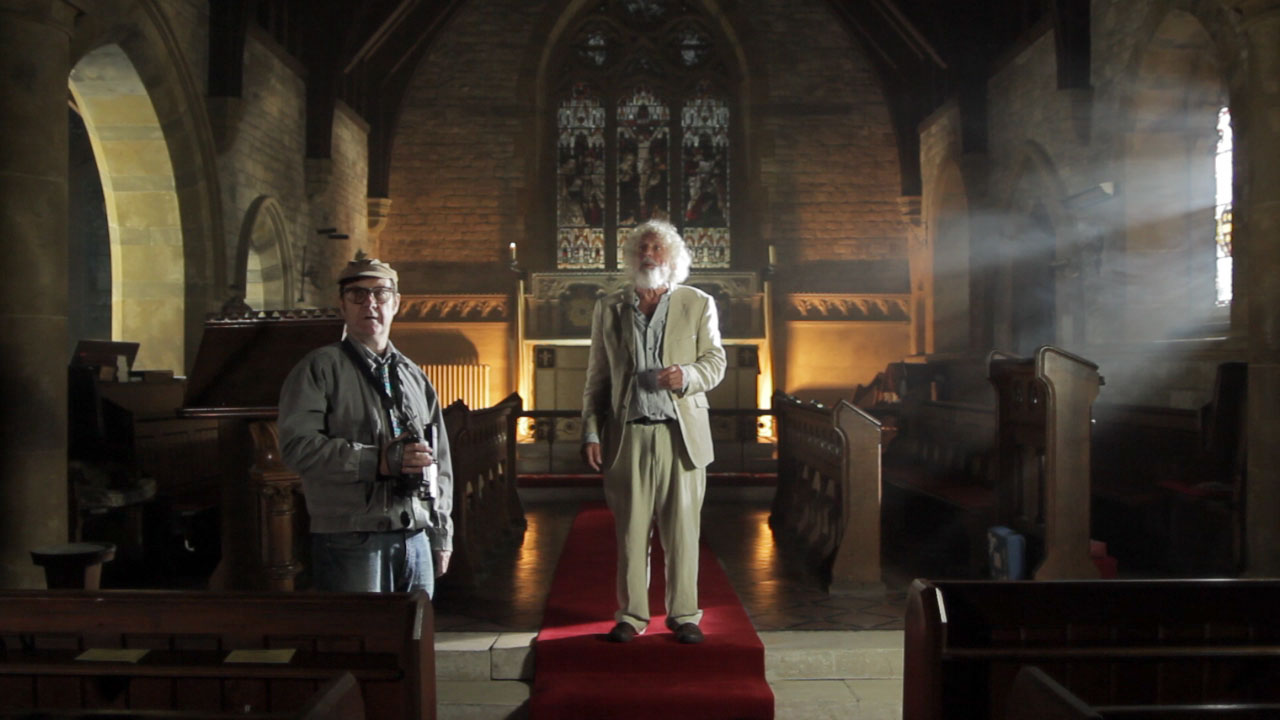
This weekend shooting began on Roger Harding and Darren Scott’s feature-length comedy The Deaths of John Smith. As director of photography I was called on to light a beautiful rural church on a limited budget. Here are some tips for ecclesial cinematography:

  • Hire HMIs – powerful, daylight-balanced lamps. Without at least one you will never have enough light to illuminate anything but the tiniest of churches. As a backlight on a mezzanine level, a 2.5K HMI will illuminate most churches. Better still, put them outside the windows and create artificial sunbeams. (A blue-gelled blonde or redhead outside a stained glass window is pretty much useless; those windows cut out so much light.)
  • Use smoke. A £50 disco smoke machine is perfectly sufficient – use it to volumize the light and emphasise the depth and scale of the building. If you’re struggling to expose a bright enough image, smoke helps there too – because it catches the backlight and lightens up the shadows.
  • Candlelight is a good way to introduce colour contrast into your scene. Dedos are the best lamps to fake candelight with, as they can produce a small circular pool of light. Failing that, any tungsten source will do, ideally rigged to a dimmer board for a bit of flickering.
  • Assuming you’ve got your HMIs punching directly in through all the windows on one side of your church (that’s the side the “sun” is on), you now need soft light coming in through the opposite windows. Ideally these would be larger HMIs playing off bounce boards, but you might get away with soft boxes or bounced tungsten sources (gelled blue, of course) hidden behind pillars inside the building.
  • Sellotape together some old bits of coloured gel and rig them in front of a fresnel to simulate daylight through a stained glass window. Note that this doesn’t really work with unfocused lamps like redheads.
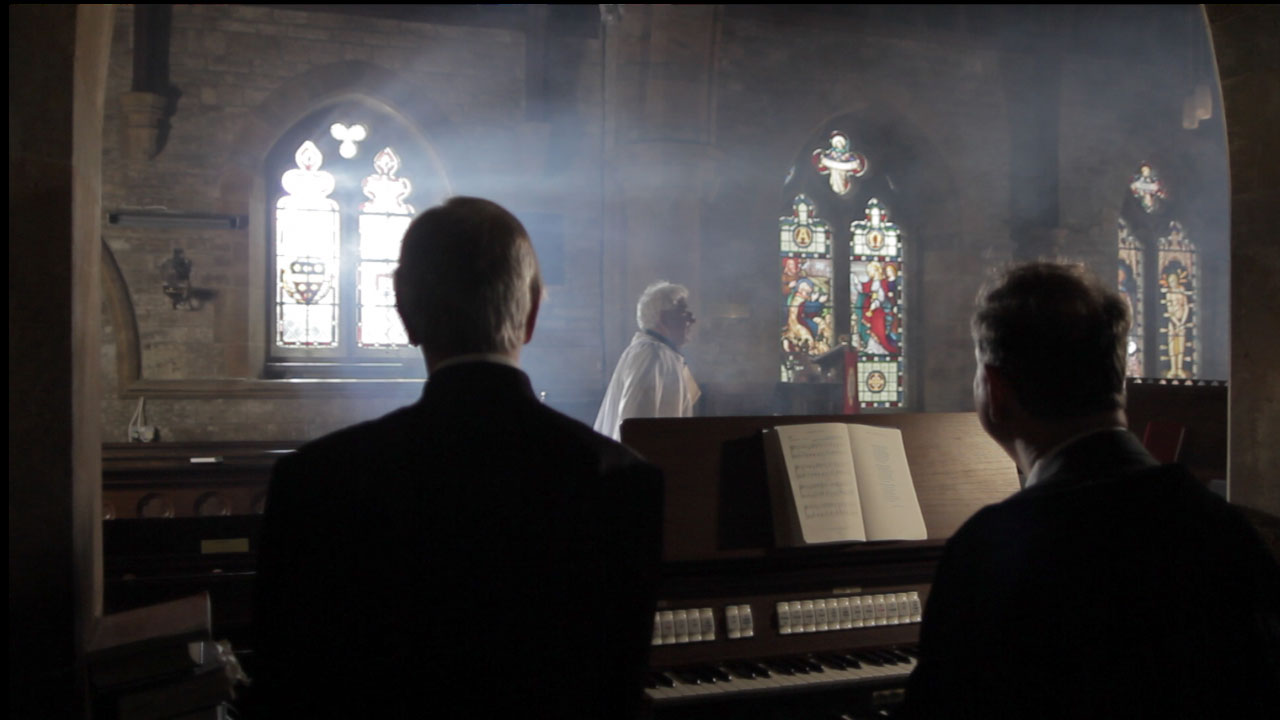
Left to right: David Draper, Bryan Ferriman and Adrian Moore.
Left to right: David Draper, Bryan Ferriman and Adrian Moore. Our single HMI shines through the lefthand window, suitably volumized with smoke, leaving natural light to deal with the other two. A blue-gelled 1K Arrilite off to the right of frame creates the edge-light on the righthand side of each character. An existing halogen spotlight over the organ was gelled with half CTB to cool it down a little. I chose to leave the nearside of the characters dark to contrast the foreground with the brighter background.

On The Deaths of John Smith I only had access to one HMI, so for every shot I needed to carefully choose which window to put it outside of for the maximum impact. I relied on natural light as well as blue-gelled redheads and fluorescent softboxes just out of frame for fill light. Nonetheless, I’m very pleased with the results. Next weekend we have to repeat the performance with a large congregation….

All images copyright 2013 Two Hats Films. Visit the Facebook page or the official website for more info on The Deaths of John Smith.

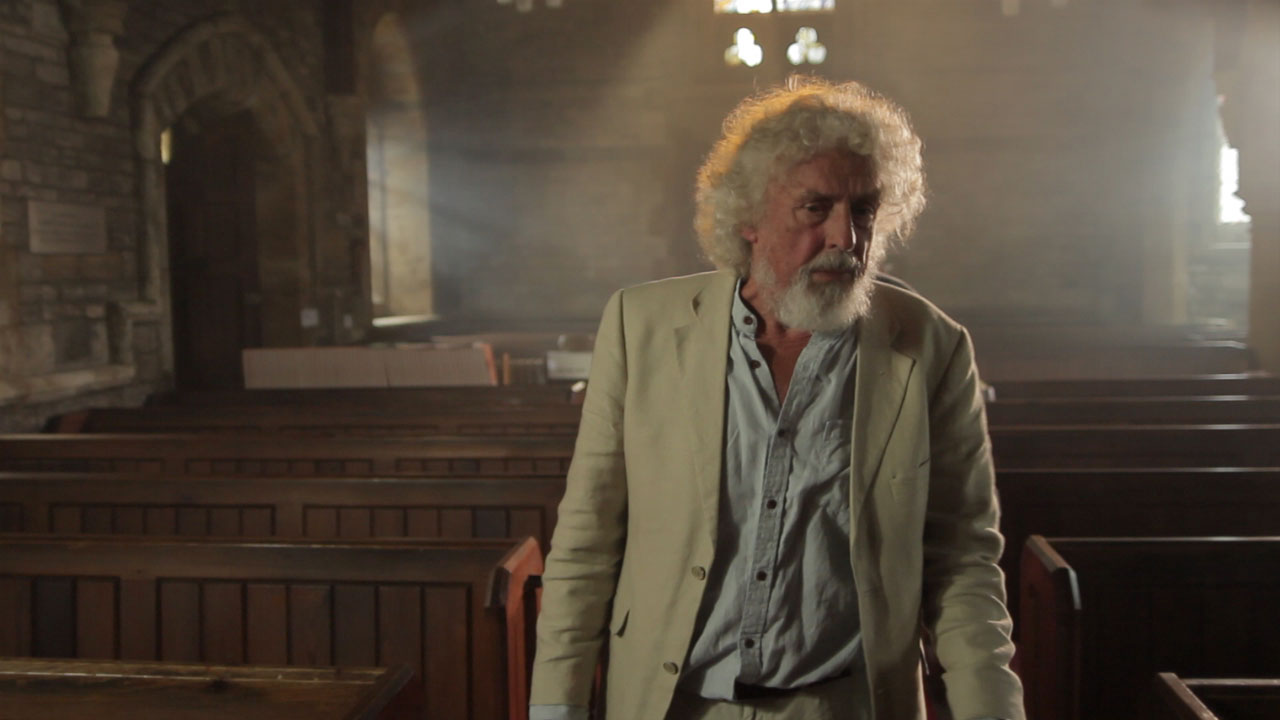
Here the "sun" (HMI) is outside of the lefthand background window.
Here the “sun” (HMI) is outside of the lefthand background window, but I couldn’t resist cheating a little and pushing a 1K Arrilite through a nice yellow stained glass window in the top centre background. Additional backlight comes from a blue-gelled Arrilite off frame right, while a softbox behind and to the left of camera illuminates the actor’s face.
How to Light a Church