Know Your Lights

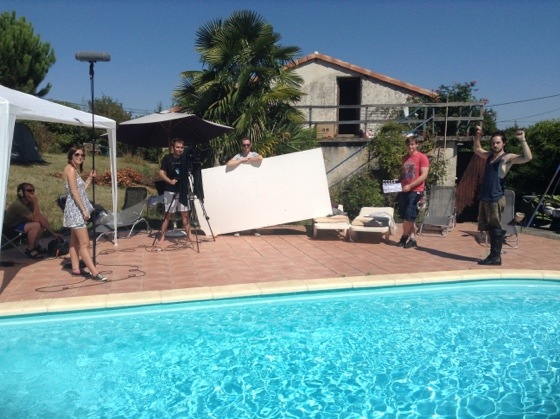
Whilst prepping for The First Musketeer here in the south of France I was able to record this video blog showing the lighting kit we’ll be using and what it all does. If you don’t know your kinos from your dedos, or can’t can understand why a 2.5K HMI is SO much better than a 2K blonde, this vlog will shed some light [groan].

The first week of the adventure is drawing to a close, although we only started shooting two days ago, the rest of the week having been taken up by travel and prep.
After picking up the lighting kit from Panalux and Filmscape on Monday, we set off in a convoy of five vehicles first thing on Tuesday morning from High Wycombe. After a noon crossing from Dover to Dunkirk we drove all afternoon and most of Wednesday to get to Puy L’eveque, the medieval town in which we’re based.
The main task on Wednesday was to test the workflow of the Black Magic Cinema Camera kindly lent to us by gaffer Richard. This is my first time working with the BMCC and I’ll share my thoughts on it in a forthcoming vlog.
Shooting began on Thursday, coinciding with a storm which broke the sweltering hot spell and has seen pretty much continuous rain become the dominant weather since then. There were challenges with horses, generators and (as ever) time, but as of this writing we’re on schedule and everyone seems to be very happy with the footage acquired.
I’m not sure how much I’m allowed to reveal about the series and the details of what we’ve been shooting, so I’ll leave it there. Stay tuned for more video blogs.

20130908-133955.jpg

Know Your Lights

The First Musketeer

This week I’m off to France for a month to lens Harriet Sams’ ambitious web series The First Musketeer. The show is a prequel to the famous Alexandre Dumas novel, and as such features horses, candlelight and swordfights galore, all against a gorgeous backdrop of historical locations. As Athos arrives in Paris, on the run from his tragic past, a chain of events leads him to the other Musketeers, and into an adventure that will seal their fates as brothers and heroes for the rest of their lives.

A promotional image from the teaser shoot

I doubt I’ll have time while there to do much other than shoot and sleep, but I’ll try my best to do a few video blogs. Subscribe to my YouTube channel to make sure you don’t miss them, and for general updates on the project visit The First Musketeer’s Facebook page.

The First Musketeer

Depth Cues in Cinematography

One of the most important jobs of a director of photography is to help the viewer’s brain decode the image. Just as a sound mixer must get the cleanest possible dialogue and ensure that ambience, music and effects don’t distract from it or drown it out, so a cinematographer must ensure the eye is drawn to the character and not distracted by the surroundings.

Depth is a key part of creating this clarity. Christopher Nolan once said: “95 percent of our depth cues come from occlusion, resolution, color and so forth, so the idea of calling a 2-D movie a ’2-D movie’ is a little misleading.”

This week, on The Deaths of John Smith, I photographed a shot that used every trick in the book to create depth. Why? Because it was a one-shot scene, a flashback taken out of context, and the audience needed to “get it” quickly.

When I first set the camera up and we stood John (played by Roy Donoghue) in position, his dark suit melted into the dark wood panelling behind him, so there was clearly some work to do. Once lit, as you can see from these frame grabs, he stands out sharply.

Kirsty Minchella-Storer (Sarah) and Roy Donoghue (John) in The Deaths of John Smith, directed by Roger Harding, copyright 2013 Two Hats Films
frame2 frame3 Kirsty Minchella-Storer (Sarah) and Roy Donoghue (John) in The Deaths of John Smith, directed by Roger Harding, copyright 2013 Two Hats Films

Let’s look at the depth cues going on here.

  1. DEPTH OF FIELD. Although I’m shooting at f1.8, on a 20mm lens nothing is massively out of focus, so that isn’t helping much.
  2. SMOKE. There is more smoke between the camera and a distant object than between the camera and a close object, and therefore smoke aids depth perception.
  3. CONTRAST. The foreground is darker than the background, helping the eye to distinguish between the various layers. In particular, the smoke picks up the light from the windows at the back of the room, creating a blue-white haze against which John’s dark suit stands out clearly, as does Sarah’s silhouette.
  4. COLOUR CONTRAST. The foreground is lit with warm orange, while the background is a cool blue, again enhancing the separation between the layers. (Imagine you’re standing on a hill and looking at another hill in the distance. That distant hill looks much bluer than the one you’re standing on, due to atmospheric haze. The smoke and colour contrast mimic this effect.) For most of this film I kept all the light sources within about 1,500K of each other, but in this scene I deliberately allowed more like 3,000K of difference between warm and cool sources to give the flashback a more stylised look.
  5. BACKLIGHT. John has a little edge-light on his righthand side, ostensibly from the wall sconces, but in reality from a hidden Dedo. This helps to cut him out from the background.
  6. FRAMING. The doorway frames the image, adding an extra layer of depth.
  7. PARALLAX. This is the optical phenomenon whereby, when you move your head (or a camera) things closer to you appear to move more than things further away. By dollying slightly into the room behind Sarah we create a dramatic parallax effect as the doorway grows on camera much more than John and the room behind him.

I’ll leave you with my (retrospective) lighting plan for this scene. Be sure to check out the film’s official website at www.thedeathsofjohnsmith.com

Lighting plan
Lighting plan
Depth Cues in Cinematography

How to Speed Up Your Shoot

Director under pressue. Photo: Paul Bednall

Tomorrow the film I’m currently DPing, The Deaths of John Smith, has an extremely packed schedule. This has got me thinking about how a filmmaker can keep themselves on schedule when faced with a seemingly impossible amount of material to get through.

The most effective action is of course to take out a big red pen and start cutting down the script. I know personally I find this very difficult, particularly if I’m both the writer and the director, because I’ve convinced myself by this point that everything in my shooting draft absolutely has to be there. Even though I know that, when I get to the edit, some scenes will inevitably get deleted and some dialogue will get trimmed. The challenge is to identify those trims now, on set, and save myself the trouble of shooting them.

Beware that simply cutting some dialogue is unlikely to have a signficant effect on your schedule, because most of your time on set is spent not shooting or even rehearsing, but setting up. Take a long, hard look at your shotlist or storyboards. Do you really need all that coverage?

Consider a Single Developing Shot (SDS). This means shooting an entire scene in just one set-up, with some camera movement and perhaps some dynamic blocking to maintain interest. The danger here is of doing a ridiculous number of takes of this one set-up because you know you have nothing to cut to if it’s not perfect (a trap I’ve fallen into more than once). I would advise qualifying your SDS with a cutaway or two to claw back a bit of flexibility in the edit and ease the pressure on the master shot.

A developing wide shot covers a large chunk of a scene from The Deaths of John Smith (copyright 2013 Two Hats Films). A safety cutaway (right) is shot to get the editor out of any tight spots.

If you can’t see a way to reduce the number of shots you need, consider ways to make those shots quicker to film. The most time-consuming shots for a director of photography to light are reverses, where the camera flips around to shoot in the opposite direction to all the previous angles, meaning every light has to be moved, along with the video village and all the piles of idle equipment in the background. Can you get away without a reverse, by changing the blocking a little? That character who has their back to camera – could they cheat their profile towards us a bit? It’s cheesy and not very realistic, but TV shows often achieve this by having one character talk to another’s back.

Ye olde person-talking-to-other-person's-back shot in Soul Searcher, obviating the need for a shot-reverse.
Ye olde person-talking-to-other-person’s-back shot in Soul Searcher, obviating the need for a shot-reverse.

Down-the-line close-ups are also quick to do. This means that, after doing your wide, you leave the camera more or less where it is (and, crucially, the lights too) and put on a longer lens to get your close-ups. Watch your continuity carefully, because down-the-line cuts will really show up any errors.

An example of a down-the-line close-up from Stop/Eject

If all else fails, the wrap time is looming and you’ve still got half a dozen set-ups to get, it’s best if those set-ups are close-ups or even cutaways. Because you and a skeleton crew can come back another day, maybe to a different location, maybe with a stand-in for your lead actor, and shoot tight pick-ups. Clearly this isn’t going to work with a wide master shot, for which you would need your whole cast and crew back, and the same set/location.

In this scene from The Dark Side of the Earth, the insert shot was filmed in a pub function room with a skeleton crew, four months after principal photography.

Finally, when working as a DP I have occasionally been asked to speed up the shoot by not lighting it. It is usually at this point that I feign hearing problems. Yes, not lighting stuff will speed up the shoot enormously. But you’re no longer making a professional film; you’re making a home video with an expensive camera. Don’t ask your DP to do this – you’ll only offend them. Instead, perhaps ask what camera angle would require the least re-lighting.

What tricks and techniques have you used to speed up your shoots?

How to Speed Up Your Shoot

How to Light a Church

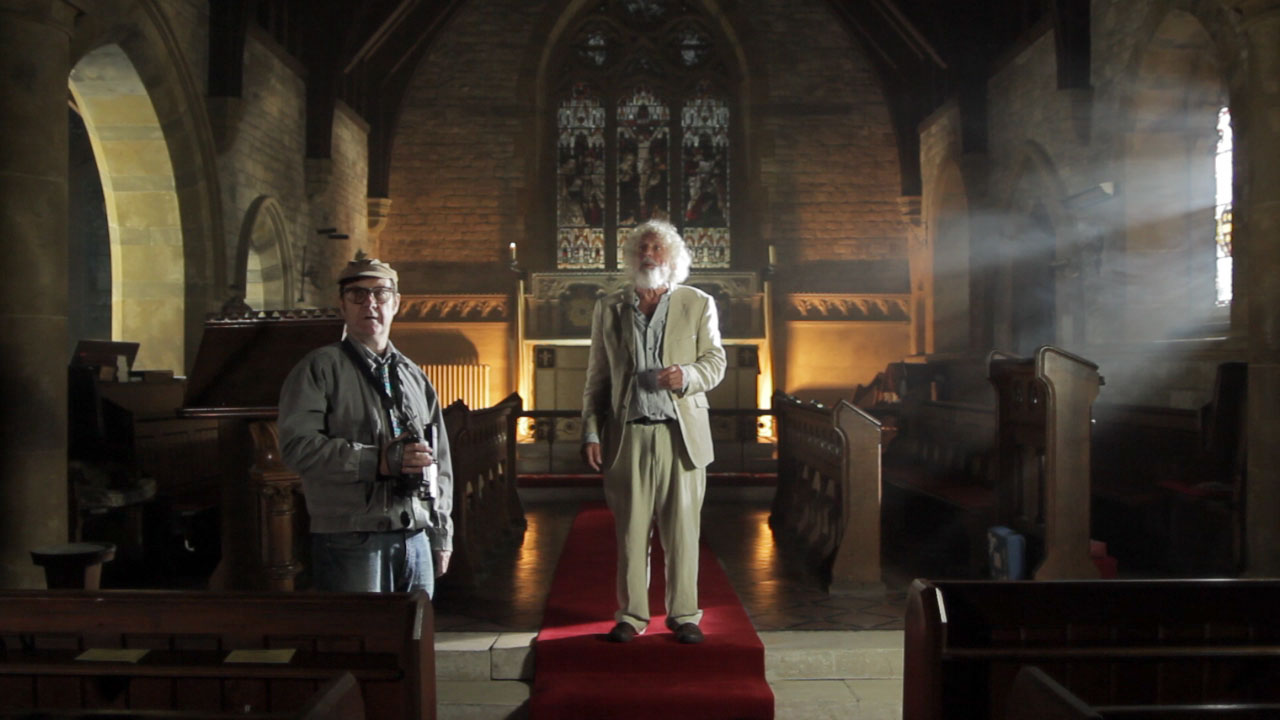
Roger Harding (left) and Jeremy Heynes in The Deaths of John Smith.
Roger Harding (left) and Jeremy Heynes in The Deaths of John Smith. A 1.2K HMI punches through the window on the right, while a fluorescent softbox illuiminates the arches on the left. Background light comes from two 500W halogen work-lights rigged to a dimmer, while fill (given that it was getting dark outside at this point) comes from a blue-gelled 1K Arrilite behind and to the left of camera.

This weekend shooting began on Roger Harding and Darren Scott’s feature-length comedy The Deaths of John Smith. As director of photography I was called on to light a beautiful rural church on a limited budget. Here are some tips for ecclesial cinematography:

  • Hire HMIs – powerful, daylight-balanced lamps. Without at least one you will never have enough light to illuminate anything but the tiniest of churches. As a backlight on a mezzanine level, a 2.5K HMI will illuminate most churches. Better still, put them outside the windows and create artificial sunbeams. (A blue-gelled blonde or redhead outside a stained glass window is pretty much useless; those windows cut out so much light.)
  • Use smoke. A £50 disco smoke machine is perfectly sufficient – use it to volumize the light and emphasise the depth and scale of the building. If you’re struggling to expose a bright enough image, smoke helps there too – because it catches the backlight and lightens up the shadows.
  • Candlelight is a good way to introduce colour contrast into your scene. Dedos are the best lamps to fake candelight with, as they can produce a small circular pool of light. Failing that, any tungsten source will do, ideally rigged to a dimmer board for a bit of flickering.
  • Assuming you’ve got your HMIs punching directly in through all the windows on one side of your church (that’s the side the “sun” is on), you now need soft light coming in through the opposite windows. Ideally these would be larger HMIs playing off bounce boards, but you might get away with soft boxes or bounced tungsten sources (gelled blue, of course) hidden behind pillars inside the building.
  • Sellotape together some old bits of coloured gel and rig them in front of a fresnel to simulate daylight through a stained glass window. Note that this doesn’t really work with unfocused lamps like redheads.
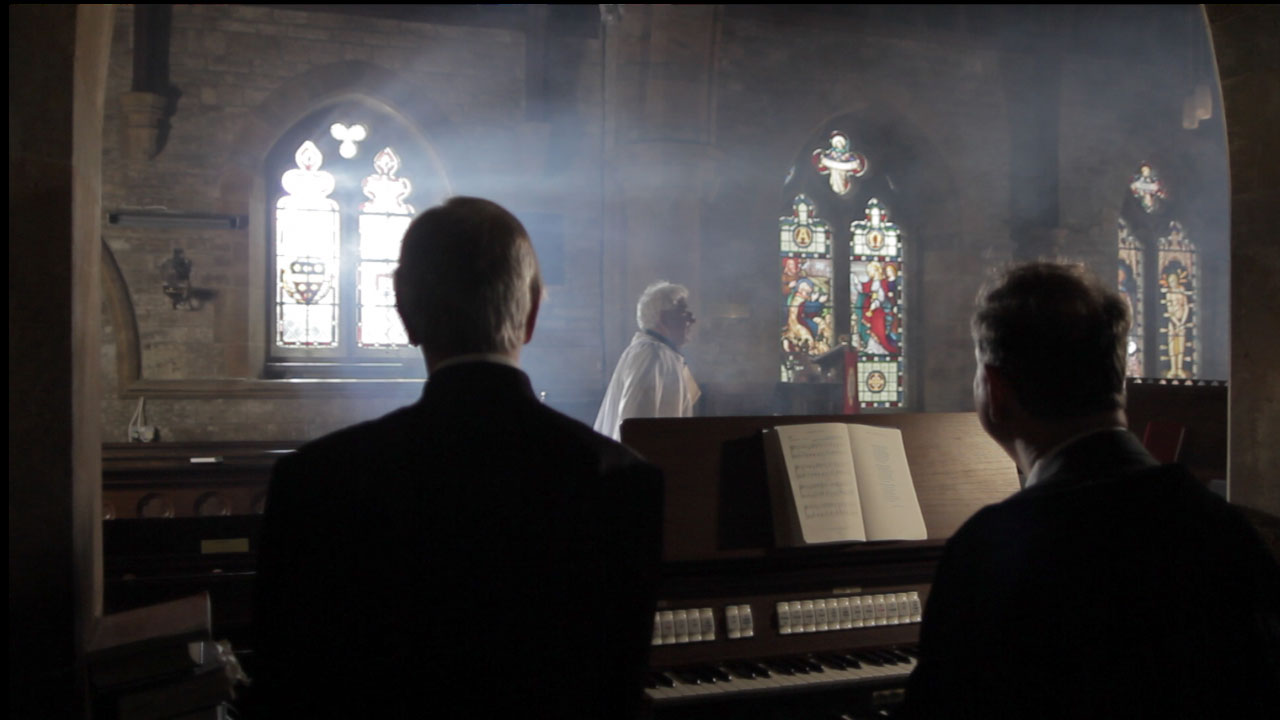
Left to right: David Draper, Bryan Ferriman and Adrian Moore.
Left to right: David Draper, Bryan Ferriman and Adrian Moore. Our single HMI shines through the lefthand window, suitably volumized with smoke, leaving natural light to deal with the other two. A blue-gelled 1K Arrilite off to the right of frame creates the edge-light on the righthand side of each character. An existing halogen spotlight over the organ was gelled with half CTB to cool it down a little. I chose to leave the nearside of the characters dark to contrast the foreground with the brighter background.

On The Deaths of John Smith I only had access to one HMI, so for every shot I needed to carefully choose which window to put it outside of for the maximum impact. I relied on natural light as well as blue-gelled redheads and fluorescent softboxes just out of frame for fill light. Nonetheless, I’m very pleased with the results. Next weekend we have to repeat the performance with a large congregation….

All images copyright 2013 Two Hats Films. Visit the Facebook page or the official website for more info on The Deaths of John Smith.

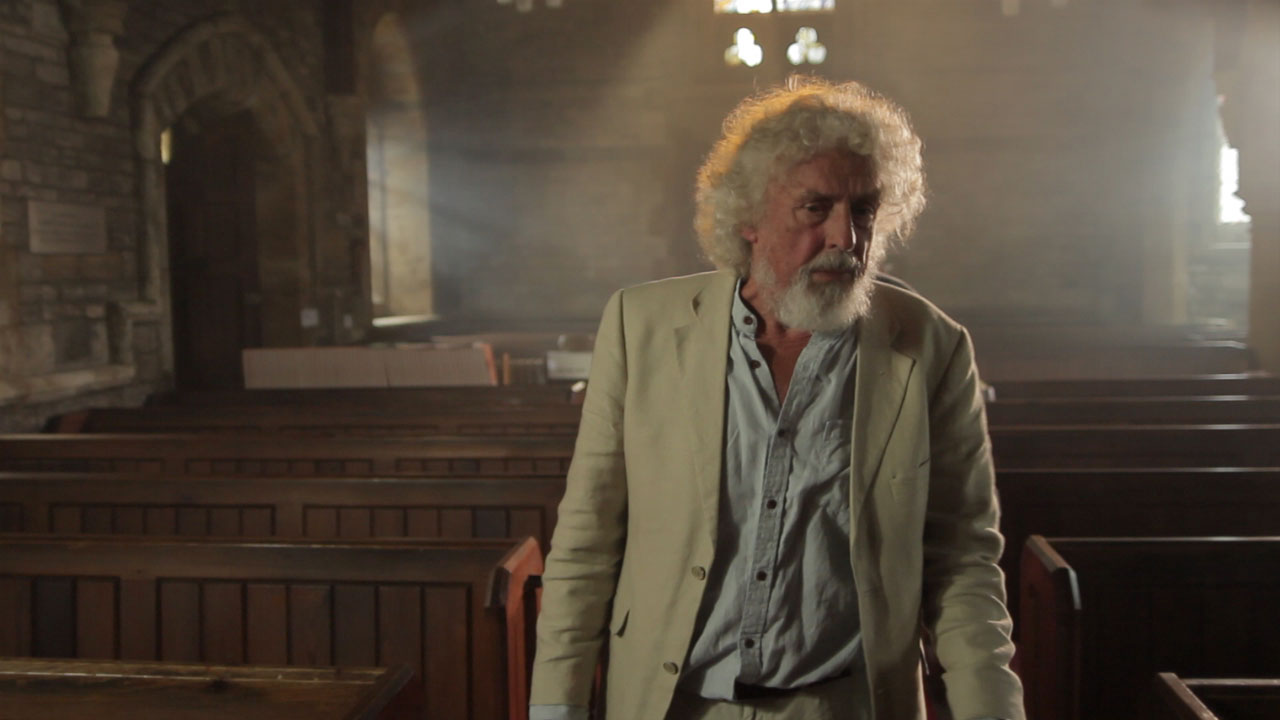
Here the "sun" (HMI) is outside of the lefthand background window.
Here the “sun” (HMI) is outside of the lefthand background window, but I couldn’t resist cheating a little and pushing a 1K Arrilite through a nice yellow stained glass window in the top centre background. Additional backlight comes from a blue-gelled Arrilite off frame right, while a softbox behind and to the left of camera illuminates the actor’s face.
How to Light a Church

Ren Launch Event

Kate Madison’s live launch event for her web series Ren is happening right now. (See my previous post for more info.)

Update: if you missed the live version you can watch a recording of it by clicking the play button above. I was meant to make a guest appearance in it but they ran out of time.

Visit the website and support the project at www.rentheseries.com/crowdfunding

P.S. My puppet film The One That Got Away is released online on Monday – watch this space.

Ren Launch Event

An Evening of Entertainment from the Makers of Born of Hope

Back in 2008 I helped out briefly on a feature-length Lord of the Rings fan film called Born of Hope. Directing this epic production, producing it, financing most of it, and even acting in it, was the extremely tenacious Kate Madison. “It’s incredible to see what craftsmanship, sensitivity and attention to detail is being brought to bear on this ambitious project,” said Weta Workshop chief Richard Taylor. Check the film out below – it’s an impressive achievement. And it’s had a staggering 23 million views.

Kate is now embarking on a new project, a fantasy web series called Ren, and to mark the launch of its crowdfunding campaign she’s hosting a special webcast this Saturday night. The evening of entertainment will start at 8pm with a Born of Hope screening with live commentary from cast members. There will also be a live Q&A where they’ll answer your questions about BoH or Ren or whatever you’d like to ask. There will also be fun giveaways, live link-ups, special guests (including Yours Truly), and much more.

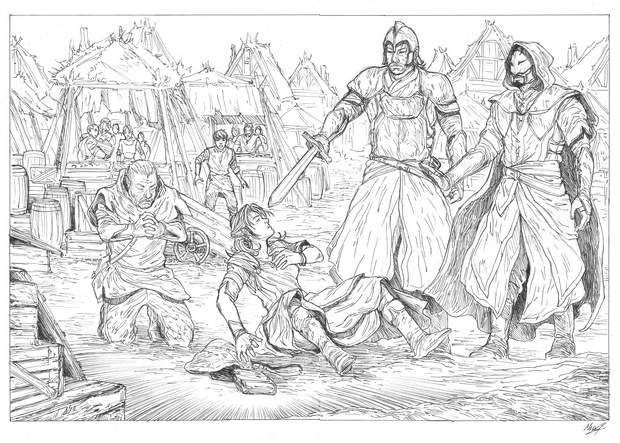
Ren encounters the Masked Man, the leader of the Kah'Nath - Concept art by Max von Vier
Ren encounters the Masked Man, the leader of the Kah’Nath – Concept art by Max von Vier

“I’ve been keen to get another project on the go and have been contemplating various formats,” Kate says. “Web series have become a popular medium for independent filmmakers and I find that the potential for shaping an ongoing storyline for, and with, the fans is very appealing”.

The series is named after its lead character, who lives a quiet life in a small village until dramatic events, involving an ancient powerful spirit and the ruling warrior order of the Ka’Nath, force Ren to leave her safe existence and find the truth behind the web of lies she’s believed in all her life.

“The inspiration for the show is very much rooted in great fantasy stories like The Lord of the Rings, but epic books and TV series like Game of Thrones and the more lighthearted Legend of the Seeker have also influenced me in the creation of Ren,” says Kate. She adds that one of the most important features of Born of Hope was the fan base that helped finance, design and even act in the film and that she is keen to involve the fans even more in this project. “The series is in the very early stages, with only the first season written, so we will look to the online fan community to influence what happens… and yes, even be in it!”

To watch the live event and to support Ren visit www.rentheseries.com/crowdfunding
An Evening of Entertainment from the Makers of Born of Hope

Girl and a Scar: Using Lighting to Help Tell a Story Arc

Whatever position you occupy on a film crew, you are always a storyteller. Everyone is working to build and enhance the narrative and emotional threads which will engage the audience.

Cinematography is certainly no exception, and on the recent shoot for Dave Cave’s dark fantasy Girl and a Scar, my task was to take the lighting of an interior location on a journey which mirrored that of the titular Girl (Ileana Cardy), starting from a place of heightened realism, building to a crescendo of crazy and then finally returning to normality. It was a great visual script, describing candelight, daylight seeping in through cracks in boarded-up windows, wind and lightning, so there was plenty to get my creative juices flowing.

(Check out Girl and a Scar’s Facebook page. Lighting package courtesy of Dave Morgan.)

Stage 1 of the lighting arc. Copyright 2013 Fever Films
Copyright 2013 One For All Productions and Yellow Fever Films

Above is the wide shot from the opening scene. I’ve used a classic cool/warm colour contrast between the moonlight and the candlelight. The windows of the house were supposed to be boarded up, so the barn doors of the 650W tungsten fresnel (gelled with full CTB) off camera right are fairly narrow to create the streak of light on the back wall. A second blue-gelled 650W fresnel is behind the frosted door on the left, providing a bit of depth and suggesting another window or hole in the roof.

The candlelight is provided by an orange-gelled 300W fresnel hidden behind the corner of the fireplace to the left of screen. The difficulty with candlelight is always matching the angle the light should be coming from, and in particular hiding the shadow of the candle itself, which in reality would not exist. We solved the problem in this instance by splattering dark wax over the shadow on the top of the cabinet. A dimmer was used to flicker the 300W appropriately.

Stage 2 of the lighting arc. Copyright 2013 Fever Films
Copyright 2013 One For All Productions and Yellow Fever Films

Above is the third interior scene, and one of my favourite shots in the film. To kick up the stylisation a notch I’ve used flags to make the streak of light on the back wall a little harder-edged.

This shot is a good example of how effective side lighting can be. There are no light sources on the camera side of the subject at all; it’s all coming on from the side and slightly behind, leaving the camera side of her in darkness. We call this dark side of a subject the “down side”, and it’s always more interesting to have this side be the one facing camera.

Stage 3 of the lighting arc. Copyright 2013 Fever Films
Copyright 2013 One For All Productions and Yellow Fever Films

Above is the scene which represents the height of weirdness in the story. There are two things I’ve done to make the lighting more stylised. Firstly I’ve introduced some green light, motivated by an off-screen doorway. This combines with the make-up and a fantastic performance from the actress to enhance the character’s sickness. Secondly I’ve adjusted the blue-gelled 650W fresnel that was behind the frosted door in the first scene. It’s no longer bouncing off the wall in that back room – instead it’s pointed directly at the talent with the door now open. This creates a strong, steely backlight. Combined with a dutched handheld camera, the overall effect is suitably unsettling.

Stage 4 of the lighting arc. Copyright 2013 Fever Films
Copyright 2013 One For All Productions and Yellow Fever Films

The scene ends with the curtains of the room’s main window opening to bathe the Girl in light as she comes out of the other side of her dark journey. To enhance the natural light that would come in when the curtains were opened, I bounced a fresnel off the ceiling and ran it through a dimmer board so it could be faded up as the curtains parted. Another 650W was placed outside the window, positioned exactly behind the talent’s head to give her a halo of light and create lens flares when she moved her head to reveal the light. (The lamp itself can’t be made out on camera because it’s so bright.)

So that’s an example of how cinematography can serve narrative and character. How have you used light to tell the story?

Girl and a Scar: Using Lighting to Help Tell a Story Arc

Shadows and Ashes

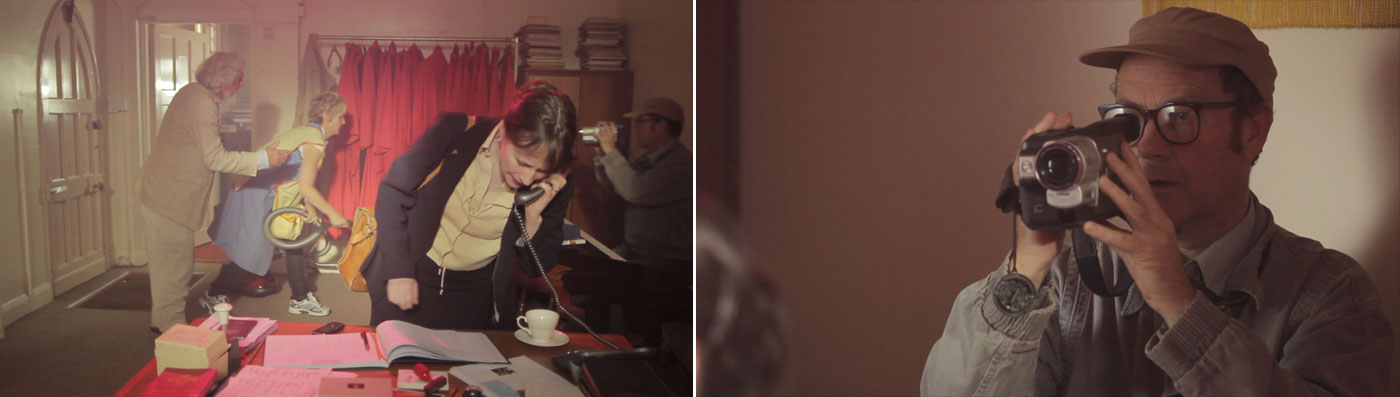
Colin Smith lines up the Super-8 camera as director Sophie Black pans the mirror.

After an unseemly delay, here’s the third and final part of my series about lighting Ashes, Sophie Black‘s dark fantasy drama. Read part one here and part two here.

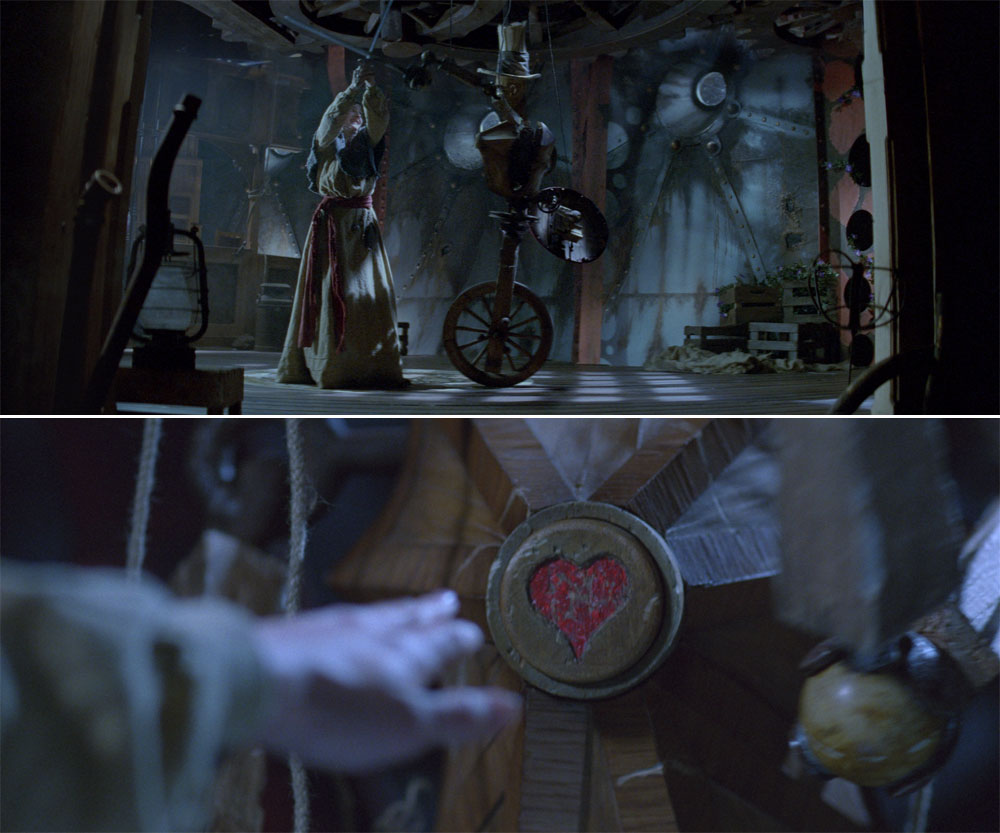
For the fantasy world dubbed “Toybox” by the production team, Sophie wanted a gritty, grainy, comfortable look. She was keen to shoot the scene on Super-8 and wanted to make full use of that high contrast celluloid look with harsh spotlighting, deep shadows and vignetting.

The biggest problem for me was how to get a spotlight effect in a fairly small room with an ordinary daylight fresnel. To get a circle of light small enough to fit entirely within the camera’s frame required the lamp to be much further from the subject than was possible within the space. I suggested shooting at night and putting the light outside the window, but the schedule couldn’t accommodate that.

The problem was solved by bouncing the light off a circular mirror. This masked the light into a relatively sharp circle, because the lamp was the entire length of the room away from the mirror. (The closer a mask is placed to a lamp, the fuzzier the edge of the mask will appear when thrown on the subject, so simply cutting a circle out of cardboard and placing it in front of the lamp would have given us a blob of light instead of a defined circle, because there wouldn’t have been enough space to put the cardboard far enough away from the lamp.)

Bouncing a redhead off a circular mirror. Photo: Sophie Black
Bouncing a redhead off a circular mirror for the sweeping light effect. Photo: Sophie Black

Not only did the mirror allow us to achieve a key shadow puppet shot which Sophie had conceived, it also enabled us to create a sweeping light effect for other parts of the sequence. Inspired by one of Lana del Rey’s music videos, Sophie wanted the effect of headlights passing by outside a window. We were able to do this simply by panning a redhead across the mirror.

The Toybox scene was shot both on Super-8 (by Col) and on my Canon 600D as a back-up. I set the ISO to 1600 on the DSLR to bake in a grainy look. I won’t do this again, however, because I failed to take into account the effect of the camera’s H.264 compression. The grain looked fine on the viewfinder, but once compressed and recorded there were lots of blocky artifacts. I hoped that the Super-8 film would come out well so this sub-standard digital material wouldn’t have to be used, but alas there were some focus issues and several of the shots were inexplicably missing from the reels when they came back from the lab. Fortunately the day was saved by a talented VFX artist who applied a very convincing Super-8 look to the 600D footage, which hides the compression artifacts.

Ashes is nearly finished now and we’re all very excited to see how it’s turned out. Meanwhile, here’s the trailer:

Shadows and Ashes