A new Stop/Eject behind-the-scenes video has been released, featuring an interview with leading man Oliver Park.
Thanks to Sophie for editing this video. You can visit Oliver’s website at oliverpark.co.uk and remember you can watch the trailer for Stop/Eject and help the film get completed over at stopejectmovie.com
Earlier this week I DPed Sophie Black’s short film, Ashes. The script contained three fantasy scenes which were really fun to light because they didn’t have to be in any way realistic. All the scenes took place in the same bedroom, so here was a great opportunity to light the same space in three completely different and pretty whacky ways (plus in a more down-to-earth way for the “real world” scenes).
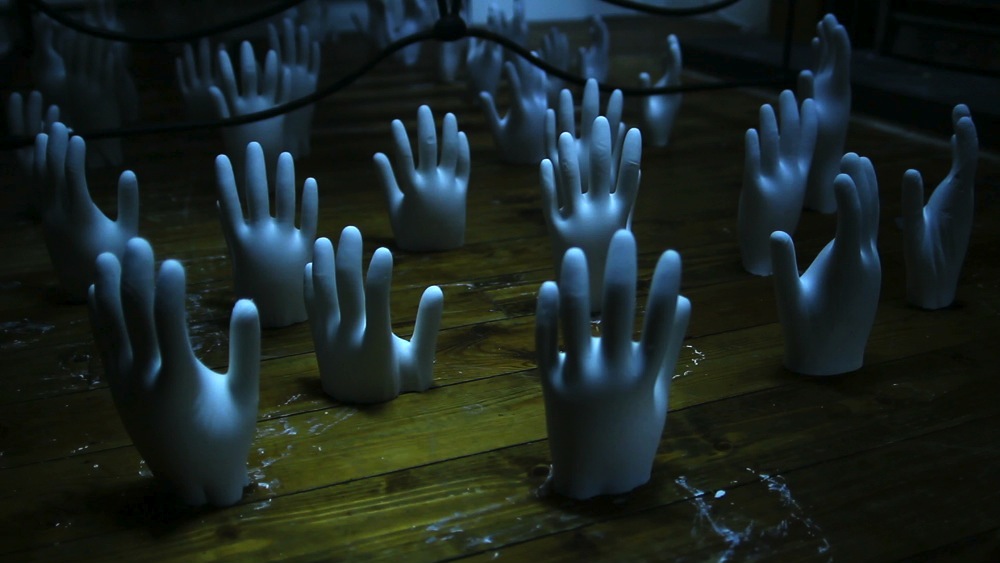
In lighting the fantasy scenes I drew inspiration from techniques covered in some of the blogs I listed in my top five last week. Sophie’s vision for one fantasy scene was of the lead character, played by Sarah Lamesch, on a bed adrift on a sea of hands. The hands were moulded in plaster and spread all over the floor, and it was my job to create the impression of water through lighting. So I turned to The Underwater Realm’s website, recalling a video blog they posted last year when their DP Eve Hazelton began testing lighting techniques for dry-for-wet photography (around six minutes in).
The silver wrapping paper on the ceiling
Big thanks to Realm Pictures for posting this blog. Although Eve ultimately rejected the technique in favour of something more realistic, it was perfect for Ashes. I had Sophie buy several rolls of silver wrapping paper, which we pinned loosely to the ceiling. I placed a 1.2K Arri Daylight Compact on the floor in the corner, pointed up at the paper. As we rolled, Sophie aimed a desk fan at the paper to create rippling, watery reflections.
I knew I wanted to do something special with Sarah’s incredibly striking eyes in this scene, to complement the make-up. I started off by having Colin rig a DIY lamp above her, surrounded by black wrap and card with only a slit of light coming through to highlight her eyes. Unfortunately I discovered that the light from DIY lamps just isn’t focused enough for this kind of effect, so I abandoned it.
Instead I created Sarah’s eye-light using a string of white Christmas lights taped to a piece of black card. This was inspired by Galadriel’s eye-light in The Lord of the Rings – a reference Sophie gave me. As it turns out, I think the starry reflections you see in Sarah’s eyes here are more from the silver paper than the fairy lights.
Sarah Lamesch as Sarah
This scene was also interesting from a grip point of view. We’d borrowed a jib, which we mounted on my dolly so that we could boom up from the hands on the floor, over the footboard and track to Sarah’s face. This was a real team effort. Colin handled the dolly and jib movement, while first assistant director Chris Newman operated the camera to begin with. As soon as the camera had cleared the footboard I jumped up onto the bed and took over from Chris for the rest of the shot.
In my next couple of posts I’ll look at the other fantasy scenes and we’ll see how Shane Hurlbut’s blog and a Lana Del Rey video inspired the cinematography in those.
Here’s one from the archives. This is one of the featurettes from The Beacon‘s long-forgotten DVD in which I break down a crude but effective VFX shot.
Compositing elements shot against black in my living room was an MO I heavily expanded on when I made my next feature, Soul Searcher, and you can see the extensive break-downs for that film by renting or buying the deluxe package below.
Having shone a light on this site’s resources in my last entry, today I’m turning the spotlight outwards and sharing my five favourite filmmaking blogs (in no particular order).
Chris Jones is the author of The Guerilla Filmmakers’ Movie Blueprint, the director of The London Screenwriters’ Festival and has made three indie features and a great short film called Gone Fishing. His blogs focus mainly on writing and distribution, those book-ends of the filmmaking process so often glossed over in favour of the fun bits in the middle. Most new developments in the indie filmmaking scene I find out first from Chris’s blog, and he’s always looking ahead to new models of distribution and giving advice on essential peripheral activities like developing a social media presence.
Danny Lacey is relatively new to filmmaking, but he dived in head-first and will soon be premiering not one but three short films. He’s committed to documenting his “Filmmaker’s Journey” through his written and video blogs, many of which are very useful tutorials. Only the other week he published a video bordering on the revolutionary, explaining how to make your own Digital Cinema Package for free.
The Underwater Realm is a weekly video blog following the making of a quintet of short films. Not interested yet? Did I mention that these films are all set largely underwater? And that they raised $100,000 through crowd-funding? And that a couple of weeks ago they filmed a scene on a Spanish Galleon set built on a homemade gimbal? And that they’re premiering at Raindance next month?
Hurlblog is the internet home of Shane Hurlbut ASC, the DP behind Terminator: Salvation and Act of Valor [sic]. If you’re at all interested in the art and technique of cinematography, you should be reading this blog. After all, where else are you going to find a Hollywood DP breaking down his lighting set-ups? Of all the bloggers on this list, Shane should be most applauded for finding the time to share his knowledge, which is extensive to say the least. My Stop/Eject lighting breakdowns were very much inspired by Shane’s.
They Never Went to the Moon gives a unique and fascinating perspective on the making of Duncan Jones’ fabulous indie sci-fi thriller, Moon, through the eyes of Duncan’s concept designer and righthand man, Gavin Rothery. Gavin was involved in all stages of the project – creating artwork and previz, working on the set build around the clock, doubling for Sam Rockwell and producing rough VFX shots and grades. Although this blog is no longer running, a browse through the archives will reward you with numerous amusing anecdotes and you’ll come away with an even greater respect for what the men behind Moon accomplished.
Are you getting the most out of this site? Here are some things you might not have known were on neiloseman.com…
Firstly, this blog goes right back to March 2001. It covers the making of my two micro-budget features, The Beacon and Soul Searcher, from development through to completion and distribution, and the development of my next feature project The Dark Side of the Earth, plus all stages of making that project’s pilot (demo sequence), a large-scale 35mm production starring Benedict Cumberbatch. Over those eleven years I’ve tried to share all the emotional ups and downs, everything I did right and (more frequently) everything I did wrong. There’s plenty for any low budget filmmaker to learn from my experiences, good and bad, and I hope they’ll inspire you as well.
At the time of writing there are 73 videos on my YouTube channel, most of them informative behind-the-scenes or “how to” featurettes. These are organised into playlists according to the film project they relate to, but now for the first time I’ve compiled a list (below) according to subject matter.
With the exception of the ones in italics, these videos are all free to watch. And remember that every time the total raised for Stop/Eject‘s post-production passes a hundred pound mark we’re releasing public rewards, many of which are behind-the-scenes podcasts. So head on over to stopejectmovie.com and make your donation if you want to see this list grow.
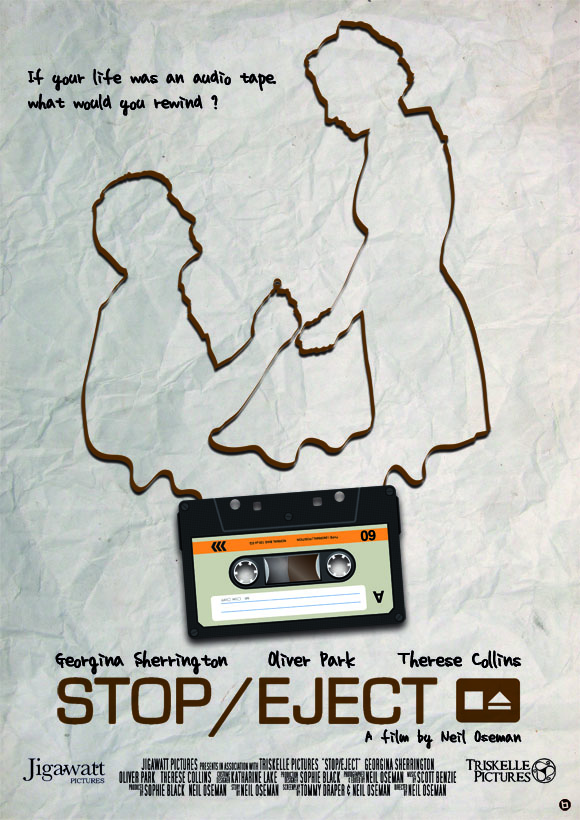
Stop/Eject‘s poster competition closed yesterday, and I’m delighted to reveal the winning design:
Winning poster by Alian BossuytRunner up: Jesse Peraza
This design is by Alain Bossuyt of Le Plan B. Sophie and I felt it would really stand out amongst other movie posters. We loved the retro colour scheme, very similar to that which we used in the movie, and the clever way of combining the romance with cassette-based intrigue.
Alain wins two tickets to the premiere and a signed copy of the DVD. His poster will be used to promote the film from now on.
Choosing the winner was tough, and there was one design which was just pipped to the post by Alain’s. It’s Jesse Peraza’s entry (right). We thought it would make a great DVD cover, so we’ve awarded it second place. Jesse wins a DVD too.
There were other great entries, but we felt these two best represented the tone of the movie. Thanks to everyone who took part.
This image of the stairs gives you a flavour of Magpie’s building-site-ness. Photo: Colin Smith
Stop/Eject‘s post-production crowd-funding campaign has been stuck at £440 for a little while now. As gentle encouragement to anyone out there who hasn’t contributed yet, or intended to but has forgotten or just not got around to it yet, here’s a taste of what we went through to make this film. What follows is a record of what it was like to stay and work in Magpie, Stop/Eject’s main location. Lest we forget.
First off, let me say thank you once again to Matt Hibbs, who was extremely kind in letting us use his premises not only as a location but as crew accommodation too. I don’t think I’ve ever met such a helpful and laid-back location owner, and without his positive attitude the shoot would have been much more challenging. So nothing that follows should be construed as a complaint. We knew what we were getting into, and we certainly got far more from Matt & co. than we had any right to expect.
Magpie once occupied just the ground floor of a four storey Victorian building. At the time of our shoot (late April), Matt had just purchased the upper floors, formerly a B&B, and was in the process of expanding his shop into them. So while the ground floor remained a working shop (and our key location), the rest of the place was a building site. Most of the refurbishment was taking place on the first floor, with the second and third storeys being used, prior to our arrival, for storage of tools and stock.
Katie loads the van at the back of Magpie. Photo: Colin Smith
The first thing I noticed when we arrived there the day before the shoot was that it was a lot dustier than I remembered from the recce. Everything was coated in brick dust, which made noses itch, throats dry and eyes water throughout the shoot. Sleeping in the building probably wasn’t very wise from a health point of view, even after Katie had hoovered.
Besides Katie and I, Col, Rick and Johnny were staying there too – four nights for most of us. We set up airbeds and sleeping bags in some of the second floor rooms. The first couple of nights there was loud music pumping out of the bar next door. And it was cold. The only radiator we ever found working was on the ground floor, at the back of the shop. Everywhere else was damn chilly by 3am.
Not to mention dark. Many of the light fittings had no bulbs in, and torchlight was usually required to find your way around at night.
Ablutions were another issue. Matt and his builders had kindly reconnected the plumbing in the second floor bathroom, so in theory we could shower, although stepping out of it into the freezing bathroom was not fun. But after the first night the hot water was found to be leaking into the shop, so Matt had to disconnect it. So it was cold showers, strip-washes or trips to Sophie’s place after that.
Deborah Bennett makes up Libby Wattis in our kitchen-cum-HMUW-cum-Colin’s-bedroom. Photo: Katie Lake
We brought a fridge with us, lent by Nic Millington, and a microwave and toaster, and Col’s hot plate, so we were able to make rudimentary meals. There was no potable water in the building, so we had to use bottled stuff from Sainsbury’s.
We were all very glad when Tuesday arrived and we could shift camp to Sophie’s house. Apart from Johnny, who claimed he got a better night’s sleep at Magpie. There’s no pleasing some people.
I encourage you to see our sadomasochistic sojourn at Magpie as a sponsored suffering. For example, you could sponsor us £5 a night for living in the conditions I’ve just described – that’s £20 total – and you’d get a digital download and an invite to the premiere. Sound like a good deal? Head on over to stopejectmovie.com and make your donation so we can complete Stop/Eject and make living in Magpie worthwhile.
Magpie’s upper floors (formerly a B&B) extended above the neighbouring bar, Twenty Ten. Photo: Colin Smith
Over the last few weeks, four test screenings of Stop/Eject have been held, at Hereford College of Art, at a friend’s house, at a book club and at The Rural Media Company‘s youth filmmaking group Shoot Out. Thanks to all the hosts and audiences for making these possible.
Test screening report form
Although these screenings were all small in scale, none of them having more than a dozen attendees, it’s still a large number of screenings, certainly more than I’ve ever done before for a short or even a feature. That fact reflects the level of difficulty in editing Stop/Eject. It’s probably the toughest thing I’ve ever edited. It has very little in the way of plot, but instead relies on a single character arc to propel the film forward. So the audience is dependent on very subtle cues – facial expressions, shot juxtapositions, music – to follow what’s going on. Get one of those wrong and they won’t follow it, and they won’t engage emotionally.
The Stop/Eject screenings revealed the usual things – which scenes were unnecessary or slow, and which moments were confusing. One thing that caught me completely by surprise is that a few people thought one cameo female character was male, which gave them an utterly incorrect interpretation of that scene.
That’s when you need to put yourself to the test / And show us a passage of time.
The passage of time is something else that the test audiences have struggled to pick up on; many people thought the film was set over a few days. It transpired that seasonal costumes, Christmas lights in the background of a scene and a shot of autumn leaves falling into the river were not sufficient cues. With each successive screening I added more and more cues, and people still weren’t getting it. In the end it was clear that I either had to flash up a title card (“Three months later…”) or take the advice of Team America and use a montage.
As this song suggests, montages are pretty cheesy, but to my mind they’re less of a cop-out than a title card. Plus a montage allowed me to incorporate shots from deleted scenes, and I always get a kick out of finding new and unexpected ways to use otherwise discarded footage.
Photo: Paul Bednall
The montage was inserted for the final test screening, and it must have worked, because no-one thought the events of the film happened over too short a time span.
But many of the issues that arose in the screenings were very much foreseen because they came up at script stage. Clearly they weren’t addressed adequately enough back then. One day I’ll learn that you can’t get away with ignoring any problems in your script. They will all come back to bite you in post.
Anyway, the edit as it currently stands is pretty good, and I think all involved in the project would be proud of it if I went ahead and locked it now and turned it over to the sound, music and VFX guys.
But I don’t think it’s reached its full potential. I think it could be even better, and so does Stop/Eject’s brand new executive producer, Carl Schoenfeld (who will be known to my long-term followers as the producer of The Dark Side of the Earth). So we’re now on the hunt for another editor who can take the film to the next level. This means post-production will take longer than anticipated; the film won’t be finished in 2012, but it will be the best it can possibly be, and that’s the most important thing.
Always fade out at the end of a montage /If you fade out it seems likemore time has passed in a montage….
As promised, here is the VFX breakdown for the main shot of the ghost train in my recent Virgin Media Shorts entry, showing how a crude model shot can work a treat, given the right compositing:
Due to the looming nature of the competition deadline, this was a pretty quick and dirty shot. Having said that, my VFX skills are pretty limited and I doubt I could have significantly improved it even if I’d had more time. It took a couple of hours to set up and shoot the miniature, and no more than an hour to do the compositing you see above. (I re-used smoke footage shot for Soul Searcher.)
As always, my approach was low-tech, avoiding any CG elements, and I did all the compositing work in Final Cut Pro. Soul Searcher had loads of shots that utilised this low-tech method, creating effects with everything from indoor sparklers to milk being poured into a fish tank. You can see a breakdown of all those effects as part of the Deluxe Package rental of Going to Hell: The Making of Soul Searcher. And remember, if you embed this video on your own site, you get a cut of any sales made through it.
Keeping lights – especially their stands – out of shot can be a real challenge in some locations. If you’re filming in an office or other type of commercial building, you probably won’t be allowed to screw into the walls or ceilings – but there is another way to hang lamps.
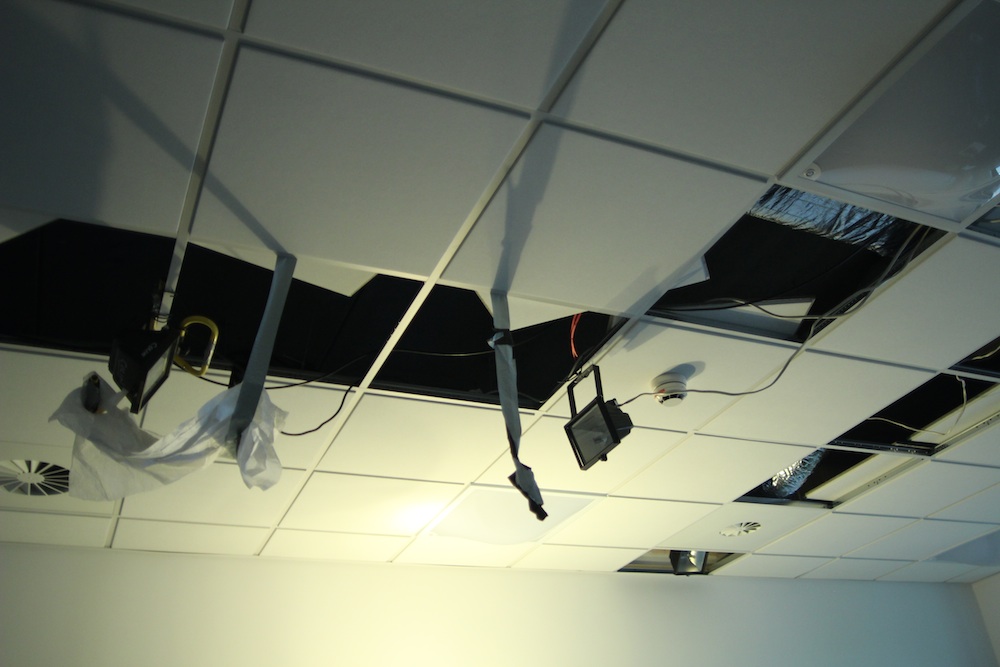
If your location has a false ceiling, the kind where polystyrene tiles sit on a metal grid, you can pop some of the tiles out and use heavy duty wire to attach lamps to the metal. I’ve done this on two shoots now, most recently Get It On for Catcher Media, where we had a tight schedule and the director wanted lots of roving handheld shots. Col very kindly lent us his DIY work-lights, which are ideal for this sort of thing because they’re not too heavy.
The ceiling of our Get It On location – a kitchen in the Performance Hub of Wolverhampton University
I’d advise you to run separate cables from each lamp to whatever point in the room is least likely to be seen on camera, and from there down to a power socket. Make sure you can unplug any given lamp without having to get up on a ladder, because that will slow down shooting.
When you wrap, just untie the wire, unplug the extensions, slide the tiles back into place and no-one will ever know you were there.
Diffuser and a flag (the latter just fell down) hang from gaffer tape between the lights