Beyond Recollection

Some of the crew, plus our makeshift dolly and our transport

Exactly a decade ago today, I flew out to New York to serve as director of photography on Tom Muschamp’s microbudget thriller Beyond Recognition. It’s the story of Geoffrey Mills, the world’s best plastic surgeon, who gets ensnared in dangerous machinations when he refuses the mafia’s request to alter their don’s face.

To this day it remains my favourite of all the shoots I’ve been on. I was 22, I’d made The Beacon (an experience which largely led to me getting the job, I think) but I’d never DPed a feature for another director, and I’d never been to the States before.

Director Tom Muschamp in The Star Building

Tom, a Brit, had met an American producer who offered to source all the locations in upstate New York and host the cast and crew at her mother’s house, which was massive in a way that only American houses can be. There is something quite post-modern about the fact that, although I was there to make a film, I was seeing and experiencing things which had hitherto been confined to films for me, like screen doors, root beer and morbid obesity.

My bed for three weeks

The gaffer, the first assistant director and the runner (Tom’s cousin Ed Reed, who later production-managed Soul Searcher) travelled from the UK with Tom and I, but the cast and the rest of the crew were American. For the most part the atmosphere was fantastic. We were all young and enthusiastic and bonding over the trials of shooting an ambitious script with minimal resources in roasting temperatures – in fact “Hot in Here” by Nelly became the anthem of the shoot. Michelle Branch’s “Everywhere” and Avril Lavigne’s “Complicated” also have strong associations with Beyond Recognition for me, as one or other of those songs seemed to be playing on the radio every time we piled into our hired minibus to go to the next location.

Part of The Star Building becomes a plastic surgeon's reception
Part of The Star Building becomes a plastic surgeon’s reception

I’d sent a wish-list of lighting equipment to the production team ahead of time, including several large HMIs and a whole bunch of other kit. When I arrived in New York they said, “Er… well, we’ve got the gels you asked for…” A quick trip to Home Depot was called for. I think that was my first experience of lighting with halogen work-lights, otherwise known as DIY lights. Later Tom splashed out on a set of four Arrilites, which he kindly let me keep at the end of production, and most of which I still have and use to this day.

Many scenes were shot in what became known as The Star Building – a small, disused factory in the grounds of the house we were staying in. It was full of junk, which we were constantly shifting around to enable us to film in different corners. The toilets didn’t work properly, and I distinctly remember an incident in which the first AD disappeared for a bowel movement, and shortly afterwards some suspiciously brown water started dripping from the ceiling.
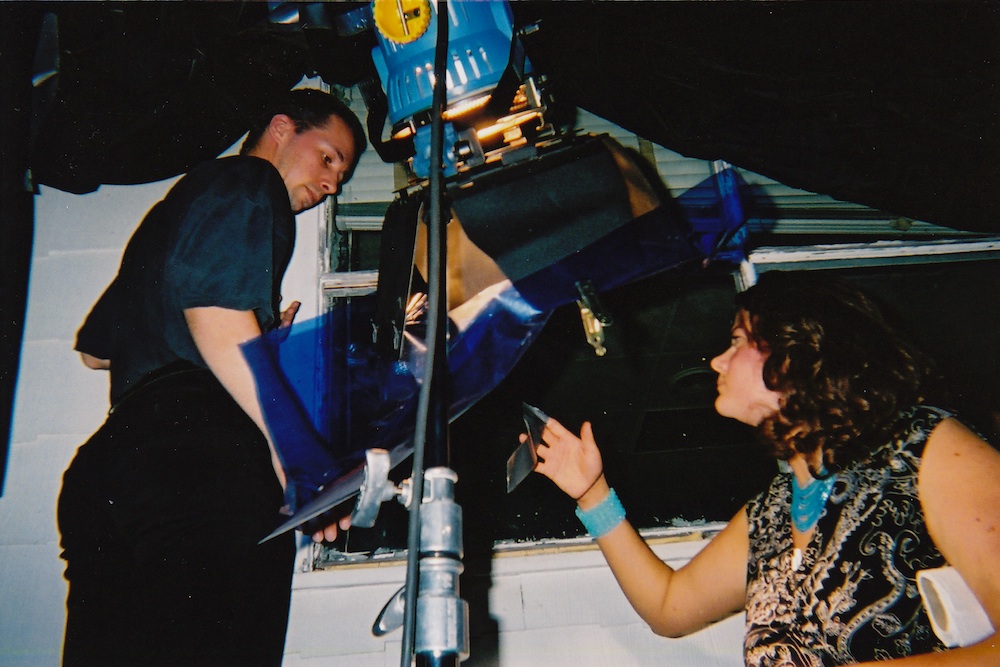
Blacking out a window

There was a lot of night shooting, which was great experience for me and helped me develop the Cameron-esque blue look that would define Soul Searcher. When it came to interiors, my memory is that daytime scenes were typically shot at night and vice versa, though God knows why. We were forever blacking out windows or setting up artificial suns.

The lead actor
The lead actor

One key thing I learnt from Beyond Recognition is the importance of having your cast and crew sign contracts before you start shooting. The lead actor was very unreliable, but made all kinds of demands once the film was in the can and Tom needed his signature on the dotted line. The lead actress was a bit ditzy as I recall, repeatedly plugging in her hair-drier at a hotel location and blowing the fuse every time because of all the lights we were running. And then there was the actor who, when we needed a bug detector as a prop, said “I’ll bring mine,” and was sent to prison a few years later when he was caught defrauding hundreds of thousands of dollars from a hide-out in the basement of the World Trade Centre. And you think I’m kidding.

Crew-wise, we seemed to splinter into two factions towards the end of the three week shoot – those who were happy to do whatever it took to get the movie made, and those who just wanted to moan and slack off (I will never understand why these people sign up to unpaid shoots in the first place). The hours were very long and there wasn’t a single day off in those three weeks, but I’m afraid that’s what micro-budget filmmaking is like. I loved it.

Like many Brits returning from the US (especially New York) for the first time, I was quite depressed afterwards and for a few months could think of little other than wanting to return to New York and how much cooler everything is over there.

But principal photography on Beyond Recognition was not over when the New York stuff wrapped. Part of the film is set in Italy, and Tom had lined up locations in the picturesque Fai della Paganella in the Dolomites. So on September 29th I was back on a plane, this time to Verona. The crew line-up had changed a bit; strangely the members of the second faction mentioned above were not invited back, and a couple more Brits joined us including Simon Ball and Max Van de Banks, both of whom I’d worked with before and who would go on to work on Soul Searcher. Ed Reed, meanwhile, had been promoted to first AD.

The Italian leg of the shoot ran smoother than the US leg, as far as I remember, although we were not popular in the town by the end of the shoot. This was mainly due to the unruly actors, who tended to help themselves to alcohol from the hotel bar (leaving money for it, I should add) and generally act like they owned the place.

I finally got my HMIs in Fai. Tom hired two 4Ks from Arri in Milan, which I used to light the town square. I also got to film a craning shot up in the mountains from a cherry-picker.

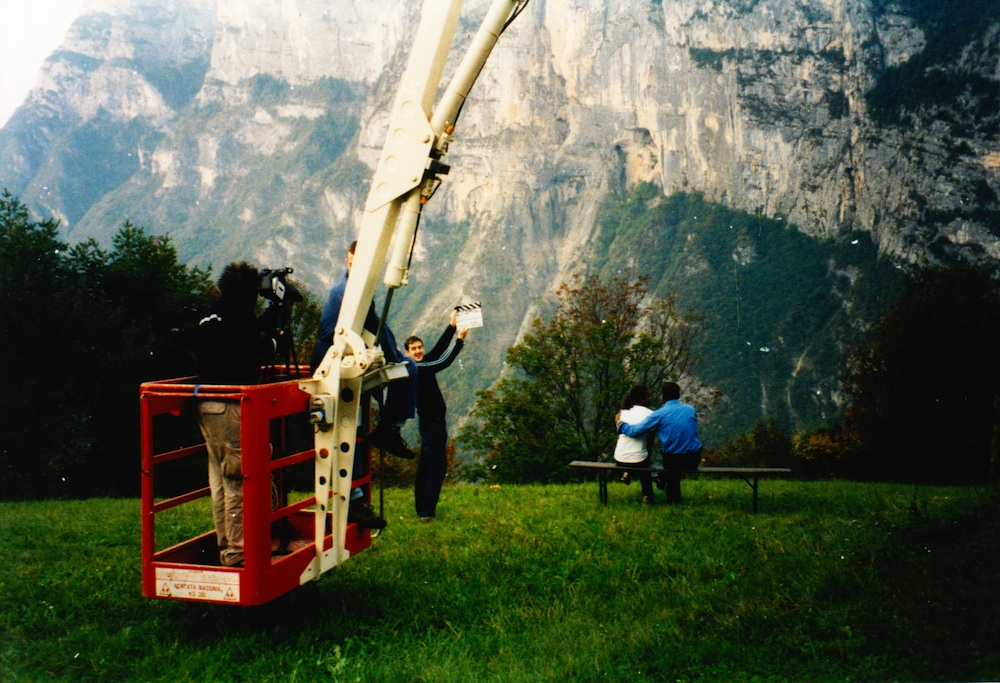
All in all, the project was an amazing experience for me, and left me with a burning desire to work far more regularly as a DP on indie films, an ambition I sadly still haven’t succeeded in. But besides helping shape Soul Searcher, both in terms of its look and Tom’s distribution experiences which I drew on when selling my film, it did lead to other work and in 2007 to my DPing Tom’s second feature, See Saw, on which I met my wife Katie.

Beyond Recognition was released on DVD in the US and other territories, but is only available in the UK as an import. I’ll leave you with the trailer.

P.S. You can read my original blog entries from the 2002 Beyond Recognition shoot here, here, here and here.

Beyond Recollection

Acetate, String and Gaffer Tape

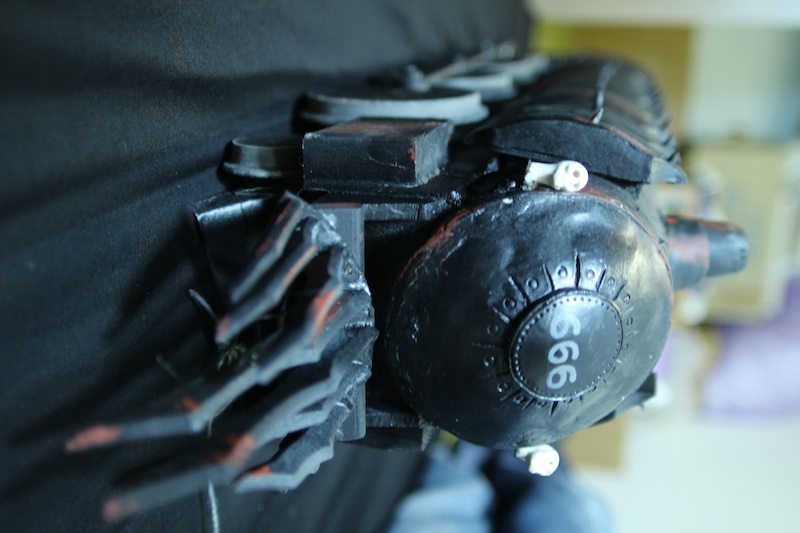
Shooting the train against black

Last weekend I recorded the model shots for Ghost-trainspotting. The script was written with the train miniature from my 2005 feature film Soul Searcher in mind.

This model was built by Jonathan Hayes, with the wheels and linkages by my uncle and my late grandfather, and even some detailing by Yours Truly. If you’ve seen Going to Hell: The Making of Soul Searcher you’ll know what an absolute pain in the arse this train was to shoot back in the autumn of ’04. You can also check out the key blog entries here, here and here to experience the pain.

I’m pleased to report that filming the train this time around was considerably easier. The model has been sitting in my parents’ loft conversion for the last eight years, and that’s where I filmed it. All I had to do was rig some black drapes and line up the camera angles to the live action plates.

In the past, whenever I’ve needed to shoot a VFX element that had to match another, pre-existing element, I’ve used acetate. I would play back the existing element, typically a live action plate from principal photography, on a TV or monitor. I’d tape a sheet of acetate – the stuff teachers used to use on overhead projectors – over the screen and draw around the important landmarks with a felt-tip. Then I’d plug the camera into the same TV and adjust the camera angle until it matched the lines on the acetate. Low-tech, but effective.

Express Train to Hell

Thanks to Magic Lantern – a firmware hack for the Canon HD-DSLRs – there’s now a more elegant solution. Magic Lantern provides a large number of handy features that Canon themselves were too tight or too lazy to include, but there are only two I regularly use: manual white balance, which lets you dial in the colour temperature in degrees kelvin, rather than relying on presets or holding up a white sheet of paper, and crop marks.

On Stop/Eject I used the crop marks to show us the  2:35:1 widescreen aspect ratio we were framing to, but you can actually overlay any monochrome image on the viewfinder by simply creating a .BMP image of the correct specifications on your computer and saving it to your SDHC card. So for Ghost-trainspotting, I loaded still frames from the two live action plates into Photoshop, and outlined them with the paint tool. After saving these outlines to the memory card as bitmaps, I could superimpose them on the Live View image on my Canon 600D’s flip-out screen. This made it a doddle to line up the shots.

Left: live action plate. Right: overlay for Magic Lantern

So, the model shots are now in the can and yesterday I incorporated them into the film. I also tightened up the edit – finally getting it down to 2’20 exactly, including credits – mixed the audio and graded the images. The film is very nearly finished now; I’m just trying to decide whether to change the ending….

If you’re lucky, there may be a little VFX breakdown of the train shots coming in the next week or so. Meanwhile, here’s a nickel’s worth of free advice about shooting miniatures:

Acetate, String and Gaffer Tape

Moulding Natural Light

Today I’m going to take a brief look at what you can do to shape natural light when you’re filming outside and you don’t have the budget for big HMIs or massive silks hanging from cranes.

Firstly, choose the right direction to shoot in. Work out where the sun is going to be at the time you need to film the scene and decide whether you want to shoot into the light, with your back to it or at an angle. There are iPhone apps that will tell you where the sun’s going to be if you’re too lazy to figure it out for yourself. Remember the sun moves left to right across the sky in the northern hemisphere.

Amateur photographers are often told not to shoot towards the sun. This is simply because amateurs will be using auto-exposure, which will close the iris right up as soon as the sun flares into the lens and leave you with a silhouette. As a professional, you’ll be setting your camera manually, so you can expose for the shadows and let the backlight from the sun blow out beautifully.

Here’s a shot from Stop/Eject where we made the most of this effect, and really lucked out with the reflections in the water:

All the evidence you need that shooting towards the sun is good.
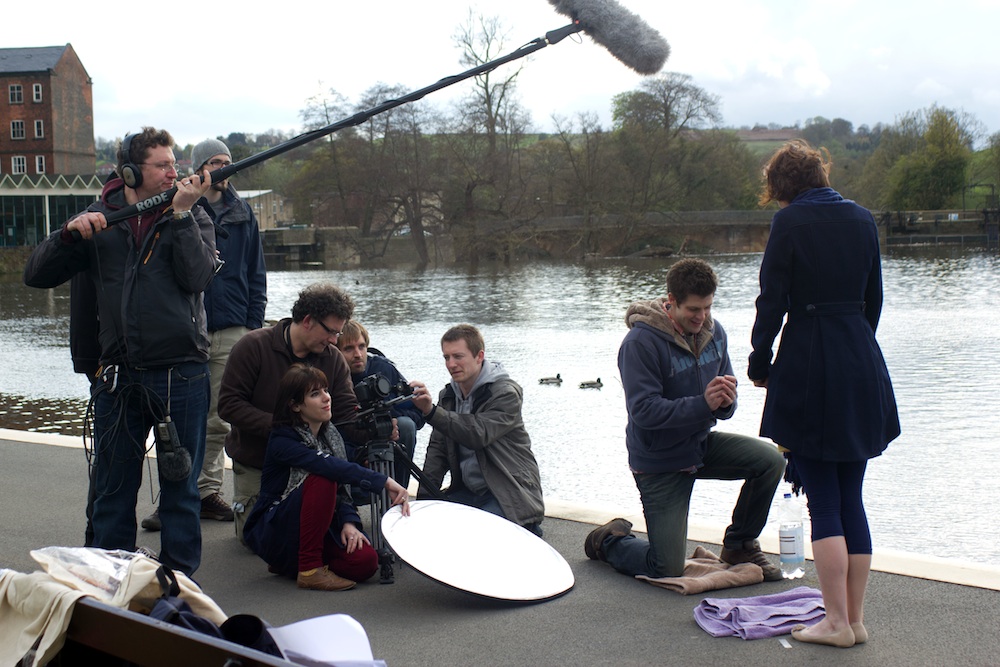
Using a reflector on the banks of the Derwent. Photo: Paul Bednall

Out the bottom of frame is a reflector, bouncing some of the sunlight back at the actors – and it’s being wiggled by a crew member to suggest it’s a watery reflection.

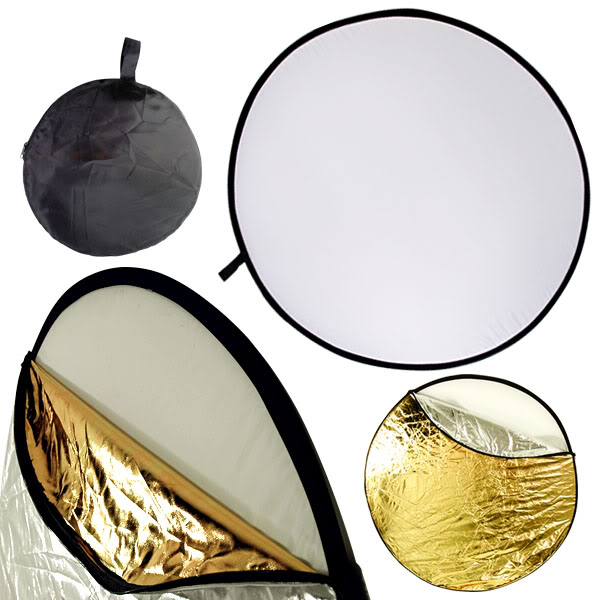
Collapsible reflector

If you don’t have a reflector you should drop what you’re doing and order one now off Amazon. They’re less than £10 and have a reversible zip-off cover giving the options of white, silver or gold surfaces to reflect off, or black to block light. If you remove the cover entirely you’re left with a translucent white disc which can be used to diffuse light, as we’ll see shortly.

If you choose to shoot with your back to the sun, you won’t be able to affect the light in your wide shots without big-budget gear, but you can transform your close-ups.

Let’s look at another example from Stop/Eject, before we did anything to the light:

Before
Before

Georgina Sherrington (“Kate”) is facing directly towards the sun, which is behind and above camera. As you can see, the light is incredibly harsh and the shadows are so dark that you can’t see her eyes; an effect that would only have got worse had I stopped down to prevent the highlights blowing out.

Two reflectors were required to sort this out. The first, with cover removed, was held over her head so that the sunlight hitting her face would have to pass through the translucent material and be diffused. (The diffusion is actually less significant than the amount of light the material blocks.) A second reflector was held out of the bottom of frame, bouncing sunlight back into the shadows on her face and putting a sparkle in her eyes.

After
After

A much nicer image.

If it’s a cloudy day – and let’s face it, this is the overwhelming likelihood here in the UK – the above techniques will still work, but much more subtly. If you have access to a power supply, try to set up a lamp to get some eye-sparkle and fill in your actors’ faces.

In 2008 I DPed a short set entirely in a forest: Into the Woods, directed by Matt Taabu. I knew that getting light into people’s eye sockets was going to be a major challenge, so I insisted on hiring a battery-powered 200W daylight par. We put a layer of tough-spun diffuser on this and the gaffer hand-held it for most shots, aiming it into the talent’s face. You can see the eye-sparkle it produced in this production still:

Branko Tomovic in Into the Woods (2008, dir. Matt Taabu). Photo: Alex Bender

So if you’re DPing a daylight exterior, don’t think that means you can rest on your laurels. It’s still up to you to create the right mood and make the talent look their best.

Moulding Natural Light

Poster Design Competition

One of the key things this week’s Stop/Eject publicity surge has done for us is to enlarge our online community of fans and followers. I’m sure there are loads of creative and talented people in this community, and now I want you to prove me right. To that end, we’re launching a competition to design the film’s poster.

To tell you all about it, here is some bloke we dragged in off the street.

Download the photos here: stopejectmovie.com/poster.zip

Upload your design to facebook.com/stopejectmovie by noon on 28/7/12.

P.S. I can now announce the name of the £500 Mystery Reward: Science with Georgina Sherrington and Oliver Park.

Poster Design Competition

Publicity Bonanza

Like three buses coming at once, this week has been a manic one for Stop/Eject publicity.

On Monday afternoon I was interviewed and photographed for the The Hereford Times. (I’m not sure when this will be published. Probably not this week.)

A few hours later and 100 miles away, Sophie was interviewed by BBC East Midlands Today. The report was broadcast that same evening (just after a piece about The Dark Knight Rises filming in Nottingham), featuring huge swathes of the trailer, the web address on screen for ages and of course Sophie brilliantly talking the whole thing up. If you missed it, a friend filmed it off his TV screen…

On Tuesday, the Herefordshire Media Network held their regular meeting, at which they kindly allowed me to screen the trailer and pitch video for Stop/Eject and to say a few words about my experiences of crowd-funding. It went down very well, with many people saying complimentary things afterwards.

After the meeting I arrived home to find my inbox stuffed with YouTube notifications of new subscribers to my channel. I soon realised this was due to Indy Mogul – a fantastic YT channel for low budget filmmakers – featuring one of the Stop/Eject podcasts (Katie’s tutorial on how to make a lighting sandbag) on their weekly Moguler Made playlist.

Huge thanks to Indy Mogul for this exposure, which has almost doubled my number of subscribers. If any IM viewers have found their way to this blog – welcome! I hope you enjoy the heady mix of filmmaking trials and tribulations, breakdowns, evaluations, “how to”s and occasional self-indulgent rants.

As a result of all this exposure, the post-production fundraising total now stands at £430. That means the £400 public reward has been released: a podcast about the first day of shooting.

Very shortly we’ll be announcing the title of the £500 public reward – our first mystery reward.

We’ve also topped 100 likes on Stop/Eject’s Facebook page, as a result of which we’ll be launching something special in the next few days…

Publicity Bonanza

Ghost-trainspotting in the Can

In what must rank as one of the smoothest-running and most enjoyable shoots I’ve ever helmed, my Virgin Media Shorts entry Ghost-trainspotting was filmed yesterday.

With an entirely exterior script, weather was the biggest concern, but it rained for less than five minutes all day and was generally quite lovely. The camera started rolling earlier than planned, we moved at a good pace all day and we wrapped early. What’s not to like?

Actors Rob Ashman and George McCluskey got on like a house on fire. Rob in particular looked brilliant in his trainspotter outfit, as you can see from this photo which Katie took:

I’ve already started editing the film, and like last year it’s going to be challenging to get it down to the required length of 140 seconds. Unlike last year, there are model shots to film, which I hope to do this weekend. Stay tuned.

Ghost-trainspotting in the Can

The Value of a Full Crew

A rare moment to consult the script. Photo: Sophie Black

Col constantly ribs me about the lack of a first assistant director on Stop/Eject, and the consequent lack of adherence to the schedule. But as I edit the film, I’m appreciating more and more the other duties of a first AD and the consequences of those duties going undischarged.

Because part of the first’s job is to literally assist the director – to help them keep track of things which can easily get forgotten amidst the chaos of filming. Things like crossing the line, getting enough coverage and not missing out bits of the script. (Two other crew members that a big budget production will have who will also be looking out for those things are the script supervisor and the editor – because the editor will be cutting the material the day after you shoot it, and may be able to tell you before you leave a location that you need an extra shot.)

So here are some examples of the moronic cock-ups I made, which might well have been avoided if I’d had a first and/or a script supervisor looking out for me:

  • Tommy Draper wrote a great stage direction in one scene: “She opens the fridge. It’s as empty as her life.” Unfortunately I chose to shoot it in a way that made it impossible to tell the fridge was empty, because I didn’t pay close enough attention to the script during filming.
  • In another scene, I wrote that the cellophane is torn off an object before it is used. I included that detail in the script because, as a writer, I knew that otherwise the audience would not necessarily understand the important point that the object was brand new and unused. Somehow this got dropped from the scene during rehearsals, and it wasn’t until I saw the film edited together that I realised how crucial the cellophane was.
  • In scene seven, the most complex of the film, we decided during rehearsals to alter the timing of an incident. One side effect of this – which again I didn’t notice until I saw the edit – was that the shots I had storyboarded (and thus the shots that I filmed) no longer established satisfactorily the whereabouts of one of the characters at a critical moment.
  • In scene 24 I crossed the line. You can see this at the very end of the trailer.
The Dark Side of the Earth's 1st AD Andrew McEwan (right) on set
The Dark Side of the Earth’s first AD Andrew McEwan (right) on set. Photo: Richard Unger

The omission of things in the script are particularly annoying (a) because I co-wrote the bloody thing and should have noticed, and (b) because any good writer takes care to be economical with words and only put in things which are important.

Some of these things can be fixed with pick-ups. For example, I filmed a close-up of my wife’s hands unwrapping the cellophane in our flat recently. But others have no solution beyond a major reshoot, which would be very hard to justify. So what you end up with is a subtle erosion of the quality of the film, and this is one of the reasons that a more expensive film looks more expensive. A bigger crew does mean more attention to detail and thus higher production values in every respect.

I share these thoughts with you not because I’m any less proud of Stop/Eject or feel like I need to make excuses for it, but simply to pass on a lesson the project has taught me. It’s very easy to think of a first assistant director as merely a time-keeper, but if you work without one you should appreciate that there are other strings to their bow, and your project may suffer more lasting effects than just a tired cast and crew.

The Value of a Full Crew

Ghost-trainspotting

Rob Ashman in The Beacon

As part of my effort to actually make more films, and thereby make up for the six years I wasted trying to get The Dark Side of the Earth financed, in 2011 I started entering Virgin Media’s annual short film competition. Last year’s entry, The Picnic, didn’t get anywhere in the competition but did get randomly bought by an exam board.

This year I’ve written a script called Ghost-trainspotting, after wracking my brains to think of a location as convenient as the ruins over the road we shot The Picnic in, and finally hitting on the disused railway line a couple of blocks away. We’re shooting this Sunday with actors Rob Ashman (last seen in a Neil Oseman film as the prime minister in The Beacon) and George McCluskey, Colin Smith as DP, Sophie Black as designer, Ian Preece on sound and Katie Lake ADing and catering.

We fully expect to get rained on all day.

Ghost-trainspotting

Microwave Shot

Blue Peter microwave

Shot 104 on my Stop/Eject storyboards has been loitering for a long time. Originally slated for the last day of principal photography, it got dropped and has been bothering the back of my mind ever since. It’s a bird’s eye view of a ready meal turning slowly in a microwave… if the hypothetical bird flew into the microwave before Kate shut it, and survived long enough to look down on anything. (The shot is part of the circles theme that runs throughout the film, which I blogged about earlier in the year.)

Back in the autumn we bought an old microwave, my intention being to rip the top off for the shot. Even though I was clearly not planning to turn the thing on after dismembering it so, safety concerns were voiced and thoughts turned to mocking up a microwave interior.

I finally filmed the shot this morning, and I don’t think anyone – including me – expected it to be achieved in the incredibly low-tech fashion it was. I folded up a piece of old foam board and punched a hole in the middle of it, and gaffer-taped an allen key to the bottom of the circular plate so I could rotate it through the hole from underneath.

So that’s another shot ticked off the list.

Final shot
The final shot

If you’re in Hereford, come along to the test screening tomorrow (Wednesday June 20th) at 3pm. It’s in the downstairs lecture theatre at Hereford College of Art’s Media Centre on Bath Street. Non-students are welcome; just sign is as visiting Christabel Gingell. I need all the feedback I can get to finesse the edit.

Microwave Shot