Stop/Eject According to Therese

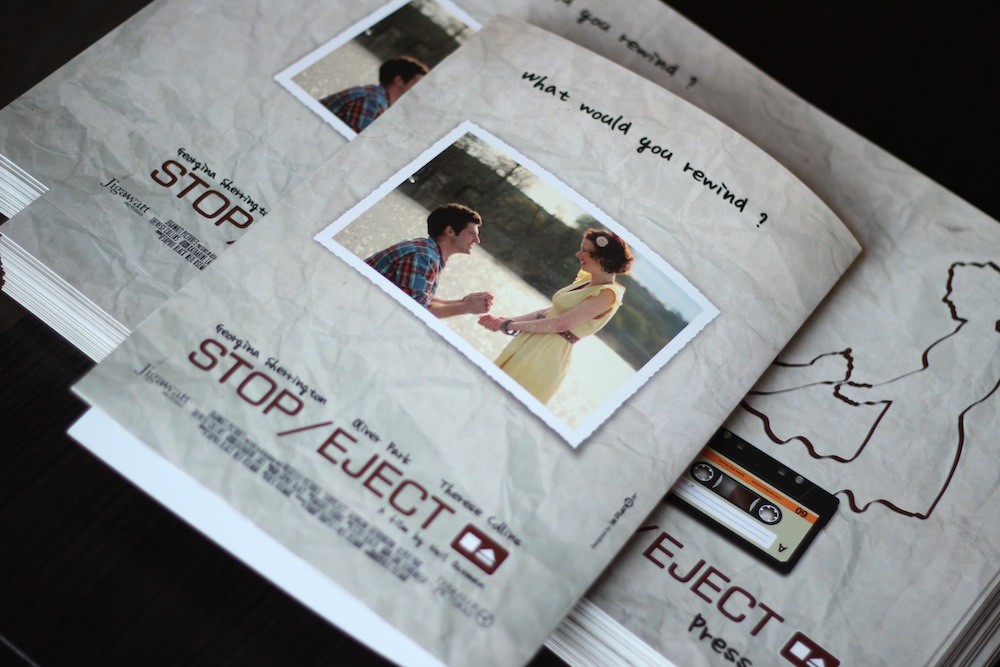
When we shot Therese Collins‘ behind-the-scenes interview for Stop/Eject, back in March last year, it proved … shall we say… challenging to get a sensible answer out of her. Here are some of the surreal and hilarious out-takes. Therese plays Alice, the mysterious shopkeeper who knows more than she’s telling about the time-travelling cassette recorder.

If you want to see the more sensible bits, plus interviews with all the rest of the cast and crew, you need to snap up one of the last few Blu-ray copies of Stop/Eject. They’re loaded with extra material including a half-hour “making of” documentary, featurettes on crowd-funding, the Belper locations and post-production sound, commentaries, bonus shorts, an extended rough cut and an interview with Georgina Sherrington about her time on The Worst Witch.

Go to stopejectmovie.com to get your copy before our campaign ends at 6pm BST this Sunday (13/4/14).

Stop/Eject According to Therese

Stop/Eject Postproduction Budget Breakdown

Back in November 2012 I posted and analysed the preproduction and production budget for my short film Stop/Eject, a 17 minute fantasy-drama which was shot on a DSLR. Now I’m going to do the same for the postproduction budget, including distribution and marketing. We’re currently selling Blu-rays and digital rentals of Stop/Eject, to raise money for further film festival entries, so please support us by buying a copy if you find this blog useful.

Download the budget here as a PDF (35kb).
As you can see, we had almost £2,000 available to us in post, some of which was left over from production, but most of which came from a crowd-funding campaign. You can read my evaluation of that campaign in an earlier post.

Mixing Stop/Eject at Alchemea College in Islington
Sound mix

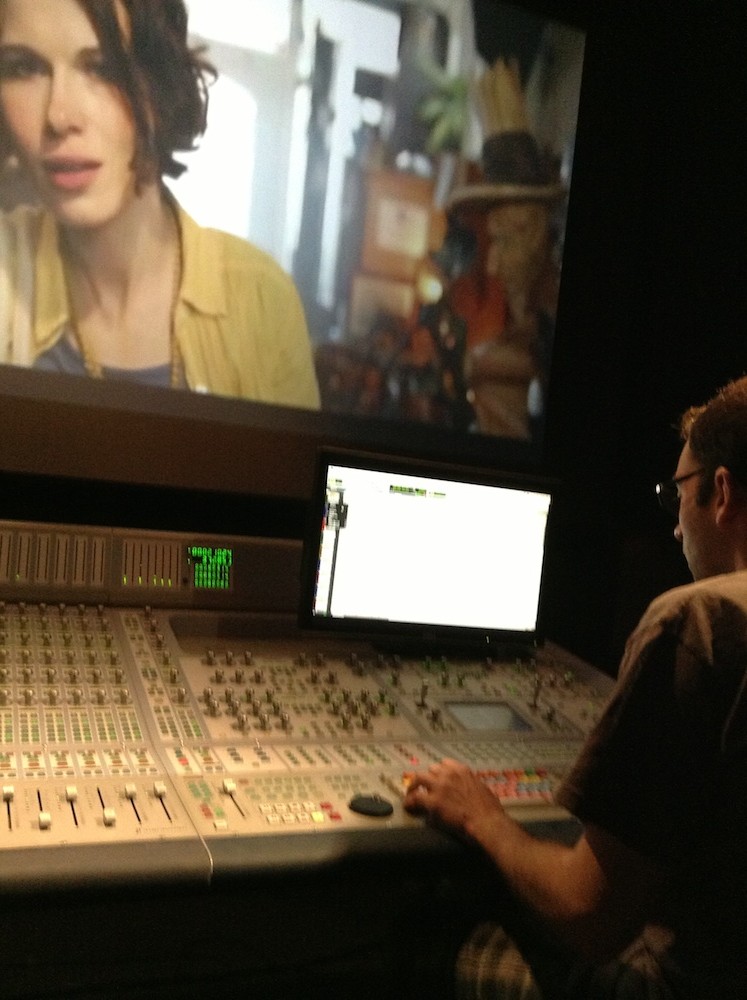
None of the cast or crew were paid at any stage of making Stop/Eject, and indeed I tried not to spend anything at all on postproduction. The VFX artists worked on their home computers, editor Miguel Ferros used his own Mac-based Avid system, colourist Michael Stirling used his company‘s DaVinci Resolve projection grading suite, sound editor and designer Henning Knoepfel used his own Mac for the audio work and pulled in a favour to get a free studio day for the ADR, and re-recording mixer Jose Pereira used the studio at the college where he lectures. Scott Benzie composed the music in his home studio and we recorded it for free with four live players at Worcester Tech College.

Georgina does some ADR
ADR

So except for a suite of clock sound effects, which Henning convinced me were necessary to help the audio tell the story, the main costs in postproduction were those incurred by people travelling so that we could be in the same room for some of the work, and eating lunch on those occasions. It’s important to at least make sure people are fed when you can’t pay them a fee. The most expensive of these days was the ADR session, which involved me and two lead actors travelling from Hereford, Birmingham and Bath respectively to the studio in east London.

Even in today’s digital world, some files are just too damn big to send online, and such was the case with the Avid media output by Miguel ready for the grade. I therefore purchased a USB hard drive, which ended up being couriered across London a couple of times to get to where it needed to be. After the film was completed, I used the same drive to archive all of the Stop/Eject assets and project files.

In order to run the crowd-funding campaign, which lasted for most of postproduction, we needed to build our own website and cut a trailer using library music. We also attended several events to promote the campaign and the film in general, one of which charged an entry fee.

Glossy script book
Glossy script book

The £79.47 spent on producing the crowd-funding rewards (a.k.a. perks or gifts) was racked up mostly by the hardback glossy script books, costing about £25 each (ex. VAT). The sponsorship level required to qualify for one of these books was £100, and since you also got a DVD, Blu-ray and premiere invite for that amount, there can scarcely have been £60 left of the donation for us to spend on actually making the film! It just goes to show that you should carefully cost up your rewards before you offer them.

DVDs & Blu-rays
DVDs & Blu-rays

That £79.47 isn’t the whole story though, since the next three items listed – the screening venue hire, Blu-ray stock and dupes – were all partly for sponsors as well. (A £10 donation got you an invite to the premiere, £30 got you a DVD and an invite, and £50 got you a Blu-ray, a DVD and an invite.)

£25.61 bought me fourteen blank Blu-ray discs, most of which I got through in trial and error as I authored and tested my first ever BD. The £265.30 spent on dupes got us 60 DVDs and 50 BDs, all with full colour on-disc artwork, inlays and cases. 20 of those discs went to sponsors and approximately 50 to cast and crew, with the rest being reserved for press and festivals.

I deliberately completed the discs in time for the premiere so that I could hand many of them out in person and reduce postage costs. For those that I did post, I used only pre-loved jiffy bags which I had been collecting for some time.

All in all, I’d say almost 11% of the £1,584 raised through crowd-funding was spent on creating and delivering rewards, a little more than I would have liked. Ideally you want to spend no more than 10% of your budget on rewards.

Stop/Eject press kit

As detailed in another post, I created Stop/Eject’s Digital Cinema Package at home using free software, but did have to buy a hard drive for it and a flight case, since I intended to ship it to international festivals for screenings.

To promote the film at festivals and beyond, we had 50 full colour folders printed, each containing five single-sided monochrome pages of text. We also paid £10 to submit Stop/Eject to The London Film Review, the hope being that good reviews would increase our chances of festival selection.

And that only really leaves the festival entry fees themselves. We’ve entered 25 to date, and the money we’re raising now should allow us to enter another 20 or so. In a future post I’ll provide a list of the festivals entered, their deadlines and fees, and the selection results.

Stop/Eject Postproduction Budget Breakdown

Stop/Eject Available Now

Georgina Sherrington as Kate in Stop/Eject. Photo: Paul Bednall

Stop/Eject, “a charming, fairytale-like film” (Unsung Films) in which Georgina Sherrington “steals the show with an emotional performance of the highest merit” (The London Film Review), is now available to buy from stopejectmovie.com. But hurry, because DVD and Blu-ray copies are VERY limited in number, and will only be available for two weeks.

You can also “rent” Stop/Eject (i.e. get a month’s access to an online streaming version) or Memoirs of the Worst Witch, an exclusive interview with Georgina Sherrington about her time playing Mildred Hubble in the cult ITV series.

Or, if none of that’s enough for you, you can buy the bumper pack which contains a Stop/Eject Blu-ray, press kit and genuine cassette prop used in the film, plus DVD copies of my previous films Soul Searcher and The Dark Side of the Earth: Making the Pilot.

This is being run as an all-or-nothing crowd-funding campaign, so we need to hit our £400 funding target in order for anyone to get their copies. All money raised will be used to enter the film into more festivals around the world.

Head on over to stopejectmovie.com to order your copy now.

Stop/Eject Available Now

Stop/Eject Available to Buy from Sunday

DVDs & Blu-rays
Stop/Eject DVDs & Blu-rays are available from Sunday March 30th

Since completing the magical and moving fantasy-drama Stop/Eject last year, a number of people have contacted me asking where they can see the film or how they can buy a copy. Great news – from this Sunday, for two weeks only, a limited number of DVD and Blu-ray copies of Stop/Eject will be available to buy. Both discs are loaded with extra features including a 30 minute behind-the-scenes documentary, cast and crew commentaries, and deleted scenes. You’ll also be able to “rent” the film for online streaming.

Praise for Stop/Eject….

‘Sherrington steals the show with an emotional performance of the highest merit. Well-written, well-executed, and a genuine pleasure to watch.’ – The London Film Review

‘It’s rare to see such love towards a heroine, consideration for her pain, honesty and respect towards a short film’s audience. A charming, fairytale-like film with a gentle, sad, but noteworthy message.’ – Unsung Films

‘A very strong, powerful film… A great emotional performance by Georgina Sherrington.’ – The Final Cut

To get your copy, just vist the official website at stopejectmovie.com from Sunday onwards.

Stop/Eject Available to Buy from Sunday

Representation of Women in my Films

There have been a lot of articles going around lately about the representation of women in the media. A lot of the statistics are pretty shameful. A New York Film Academy study of the top 500 films of 2007-2012 found that less than a third of speaking characters were female, there was almost three times more female nudity than male, and the ten highest paid actors made over two and a half times more money than the ten highest paid actresses.

I’ve always considered myself fairly enlightened on this issue. From my first major film project (The Beacon, 2001) I began a deliberate policy of alternating the genders of my leading characters with each movie I made. But before I get a sore arm from patting myself on the back, let’s delve a little deeper by applying the Bechdel Test to my films. To pass this test, a film must have

  1. at least two named female characters
  2. who talk to each other
  3. about something other than a man.
The Beacon
The Beacon

The Beacon is a cheesy action film about Sarah Mayhew (Lorna-Jane Hamer), a council clerk who ends up saving Britain from a biochemical terrorist attack planned to be launched from the Malvern Hills. I switched up the traditional gender roles by making Sarah an action heroine who has to save her useless boyfriend from the terrorists. It easily passes the first two steps of the Bechdel Test, but I had to skip through 55 minutes of it before I reached a conversation between two women that wasn’t about a man.

Soul Searcher
Soul Searcher

Soul Searcher is a marginally-less cheesy action film about an ordinary Joe (Ray Bullock Jnr) who is chosen to be trained as the new Grim Reaper. While it passes step one, that’s as far as it gets; leading ladies Heather (Katrina Cooke) and Luca (Lara Greenway) never speak to each other. There is a brief exchange between Clubber Girls #1 and #2, but since they don’t have names, and their only purpose is to be put in jeopardy by a man (alright – a demon, but a male demon) and saved by another man, I hardly think this counts. Massive fail.

The Dark Side of the Earth, apart from a five minute sequence shot in 2008, exists only as a screenplay, so it’s the screenplay I’ll judge. The protagonist is a young woman, Isabelle (played in the pilot by Kate Burdette), who sets to out to re-start the earth’s rotation after it shudders to a halt, nearly wiping out humanity. There are brief exchanges between Isabelle and some minor, but named, female characters in which they talk about things other than men, but the one proper conversation she gets with the only other significant female character concerns a man. And at least on some level, the reason she goes on the quest is to impress a man. So technically Dark Side passes, but it’s hardly a glorious victory.

The Picnic
The Picnic

My three Virgin Media Shorts entries have little or no dialogue, but even without applying the test, it’s easy to see how sexist they are. The Picnic is a silent film revolving around a man trying to get revenge on another man for stealing his girlfriend. Woman as prize. Hardly enlightened. (Earlier drafts of the script had the gender roles reversed. I can’t remember why I changed it.) The One That Got Away makes the female character a trophy in exactly the same way. And Ghost-trainspotting doesn’t have any women in it.

Stop/Eject
Stop/Eject

Stop/Eject, on the other hand, seems well-placed to pass the test with flying colours, with two of its three main characters being women and plenty of conversations between them. Unfortunately, the whole movie is about the death of a man. It does pass the test though, because the final conversation between grieving widow Kate (Georgina Sherrington) and mysterious shopkeeper Alice (Therese Collins) is not about the man. It shames me to recall, however, that Alice was (a) originally written as a man, and (b) not given a name until Therese requested one.

In general, writing this article has drawn my attention to the imbalance in the number of characters of each gender in my films. Even those movies with female leads are otherwise populated predominantly by men. I think I have a tendency, and I’m sure many of you out there do this too if you’re honest with yourselves, to make characters male by default, and to only make them female if there’s a “reason” to.

I know that some people may say, in defense of their own films or actions, that they did not intend to offend or oppress. I certainly did not aim, when making Soul Searcher, for example, to oppress women. But that is no excuse. Everything we do, say or create will be judged in the context of our society, and if – in combination with things said, done or created by others, innocently or otherwise – it contributes to a culture of oppression, then it is wrong. So for my own mistakes, I apologise unreservedly.

As with all of my blog entries that point out my own failings, I record this publicly to burn these mistakes into my memory and reduce the chance of me making them again. I hope too that it might make others out there consider their own work in the light of the important issue of gender representation.

Representation of Women in my Films

24fps or 25fps?

Menu

It’s a common dilemma in the UK for filmmakers: do you shoot at 24 or 25 frames per second? Until a couple of years ago, I would have said 25 every time, but with DCPs and Blu-rays now about, and most TVs capable of handling a range of frame rates, the answer is not so clear-cut. Unlike aspect ratio or shooting format, the decision has no discernible creative impact on your project, merely a technical one. And it’s so easy to convert between the two that it often feels like it makes no odds. Nonetheless, to help anyone on the horns on this dilemma, here’s my round-up of the respective advantages of each frame rate.

The Case for 25fps

  • If you need to record to any kind of tape format at any point in your process, 25fps is what you need.
  • The same goes for PAL DVDs.
  • If your film is going to be broadcast on UK TV, it will be transmitted at 25fps.
  • Since your camera’s running in sync with the UK mains supply’s alternating current, you don’t need flicker-free ballasts for your HMIs. Having said that, pretty much every time I’ve hired an HMI, it’s come with a flicker-free ballast as standard anyway.
  • If you’ve made a 25fps feature film that isn’t quite long enough for distributors to classify it as a feature, the extra running time you squeeze from exhibiting it at 24fps might make the difference.

The Case for 24fps

  • For maximum compatibility, Digital Cinema Packages should be authored at 24fps.
  • The same goes for Blu-rays. (Blu-rays do not technically support 25P, but they support 50i, which can contain progressive 25fps content. However, discs authored to the 50i spec apparently will not play on most US machines.)
  • If you shoot at 24fps and need to convert to 25fps for any reason, your film will become 4% shorter, making it that extra bit pacier and able to squeeze into a shorter slot at a film festival.
  • If shooting on film, your postproduction facilities will be much more comfortable with 24fps material. We really freaked out our lab on The Dark Side of the Earth by shooting 25.
  • Many traditional film projectors will only run at 24fps.

Can you think of any other factors that I’ve missed?

I’d say the balance has tipped in favour of 24fps. However, I think you’ll find that many people in the UK (outside of the celluloid world) are still more comfortable with 25…. for now.

24fps or 25fps?

Borderlines 2014 Review

Hereford’s Borderlines Film Festival draws to a close for another year, and once again I’m going to temporarily turn film critic and say a few words about the screenings I caught.

Joaquin Phoenix in Her

Her

Spike Jonze’s latest film puts a sci-fi twist on the romantic genre to produce a love story in which one half of the couple exists only as a voiceover. Joaquin Phoenix plays the improbably-named Theodore Twombly, a soon-to-be divorcé who falls in love with his artificially intelligent operating system, voiced by Scarlett Johansson. The big surprise here for me was the humour. Numerous comedy moments were derived from the application of relationship tropes to the unusual man-machine pairing. But in a near-future world which feels incredibly close to the present day, with our tablet and smart phone obsessions, our online dating, our social media – human relationships bridged (or barricaded?) at every turn by technology – the premise of Her felt entirely plausible, perhaps even inevitable. The film has emotional resonance too,  played out as it is in intimate close-ups with very genuine performances. And I must tip my hat to costume designer Casey Storm who, faced with the classic sci-fi challenge of how to make futuristic fashion seem believable, decided perversely that in the future, young people would dress like the elderly do today, trousers halfway up to their armpits and all – brilliant!

Robert Redford in All is Lost

All is Lost

In this almost dialogue-free feature from director J.C. Chandor, Robert Redford plays a solo sailor who battles to survive after his small yacht is damaged in the Indian Ocean by a collision and a storm. All is Lost has a lot in common with Alfonso Cuarón’s brilliant Gravity: both are extremely immersive tales of a single person alone against the elements (or lack thereof). At the end of both films you feel as if you have lived through those experiences yourself. And just as Gravity has been criticised by physicists and astronauts for alleged inaccuracies, so All is Lost was ripped to shreds in the post-screening Q&A by the many sailors in attendance, despite most of them apparently appreciating its entertainment value. Both films also tackled the big themes of life and death, both employing womb-like imagery in the process, Gravity’s with Sandra Bullock floating foetally in an airlock, and All is Lost’s with Redford curled up in the amniotic coccoon of his life raft. Where the films differ is in pace, however. Whereas Gravity was tense and action-packed throughout, All is Lost has more meditative sequences, during which I often found myself day-dreaming. But in a strange way, that made the experience all the more realistic, as the events continued to unfold in what felt like (but wasn’t at all) real time and I picked them up a little further on. So not a film I would watch over and over again, but definitely worth seeing once for the experience.

Computer Chess

Patrick Riester in Computer Chess

If the characters from The Big Bang Theory made a film, this is the film they would make. Nothing could be nerdier than this eighties-set tale of the rivalries in a computer chess tournament, shot in 4:3 B&W on a genuine period video camera. As if to establish once and for all that there will be nothing slick about this film, an early tracking shot ends with the camera jolting as the dolly comes off the rails. The relationship with technology is a deliberately blurred one throughout the film, with the style crossing over into “found footage” territory at times, constantly reminding us of the clunky electronic medium we’re experiencing it through, while the narrative has computers displaying flashes of humanity – and vice versa. There is a vague story arc about one character rebelling against the nerdy restraint of it all, but the overall effect is of watching a time capsule, albeit a forged one. Computer Chess is an oddity, certainly, but one punctuated by some great comedic moments and saturated in nostalgia for those of us who once dabbled in the dark art of eight-bit programming.

Felicity Jones in The Invisible Woman

The Invisible Woman

Ralph Fiennes directs himself and the up-and-coming Felicity Jones (Georgina Sherrington’s erstwhile Worst Witch co-star) in this biopic about Charles Dickens’ affair with young actress Nelly Ternan. Adapted from Claire Tomalin’s biography, the script is written by Abi Morgan, creator of the brilliant BBC 2 drama The Hour. Slow and subtle throughout much of its running time, The Invisible Woman holds the attention with a compelling performance from Jones, and beautifully understated cinematography. DP Rob Hardy consistently short-sides his subjects, giving the impression that they are all looking out towards something they can’t quite reach. Restraint is the keyword here, and while Fiennes has spoken of the conscious efforts he made to show that there were real flesh-and-blood people beneath the period’s restrictive costumes, the restrictions of society weigh heavily throughout. Just like much of Victorian literature, the film hints obliquely at scandal and impropriety without ever making it explicit. Unfortunately the result is that you come away from the film unsure as to why Dickens’ marriage wasn’t working, why he pushed his wife aside so cruelly, and what Ternan’s real feelings were for him; did she love him, or was she merely star-struck? The Invisible Woman is very watchable, then, but not satisfying.

John Goodman, Matt Damon, George Clooney, Bob Balaban and Bill Murray in The Monuments Men

The Monuments Men

George Clooney directs, co-writes and stars in this faintly Dad’s Army-esque true story of a team of clapped-out soldiers tasked with recovering great works of art stolen by the Nazis. Matt Damon, Bill Murray, John Goodman, talented character actor Bob Balaban, Downton Abbey resident Hugh Bonneville and The Artist’s Jean Dujardin make up the rest of the team, aided by a resistance spy played by Cate Blanchett. The challenge for Clooney was to make us care about the Monument Men’s mission to save paintings and statues, when men are dying every day for their countries. He achieves this by making us care for the characters – all curators and art historians – and thus share their love for art. Where many Hollywood scripts would have shoe-horned conflict into the team’s relationships, this film avoids such crassness, allowing the characters to all respect each other, but nonetheless banter humourously throughout. A joyous score by Alexandre Desplat is the icing on the cake of this amusing and uplifting film, which ended my Borderlines 2014 experience on a real high.

Borderlines 2014 Review

Film Faces by Colin Smith

As well as being an excellent gaffer and camera assistant, not to mention the most loyal crew member I’ve ever come across, with over a decade of suffering on Neil Oseman shoots under his belt now, Colin Smith is a talented portrait photographer. He keeps it quiet, but the evidence can be seen below in the form of these stunningly natural cast and crew portraits from the set of Amelia’s Letter (working title: A Cautionary Tale). Just by looking at the faces in these pictures you can see that they have been taken by one of the most friendly and popular people on set.

But don’t ask him to see the picture after he’s taken it. You’ll get a laugh with the response, “Certainly, in about two weeks,” because these are “film faces” in more ways than one; Colin is keeping the flame of celluloid alive by shooting on good old 35mm. These images are proof, if any is needed, that film can capture the human face with an authenticity and a beauty that no digital format will ever match. Nice one Col, and here’s to many more shoots together.

Film Faces by Colin Smith