On Tuesday the penultimate episode of Ren: The Girl with the Mark was released and so here’s my video breaking down the cinematography of that fourth episode. This week I cover lighting the guardroom and the prison cell, and demonstrate cross-backlighting.
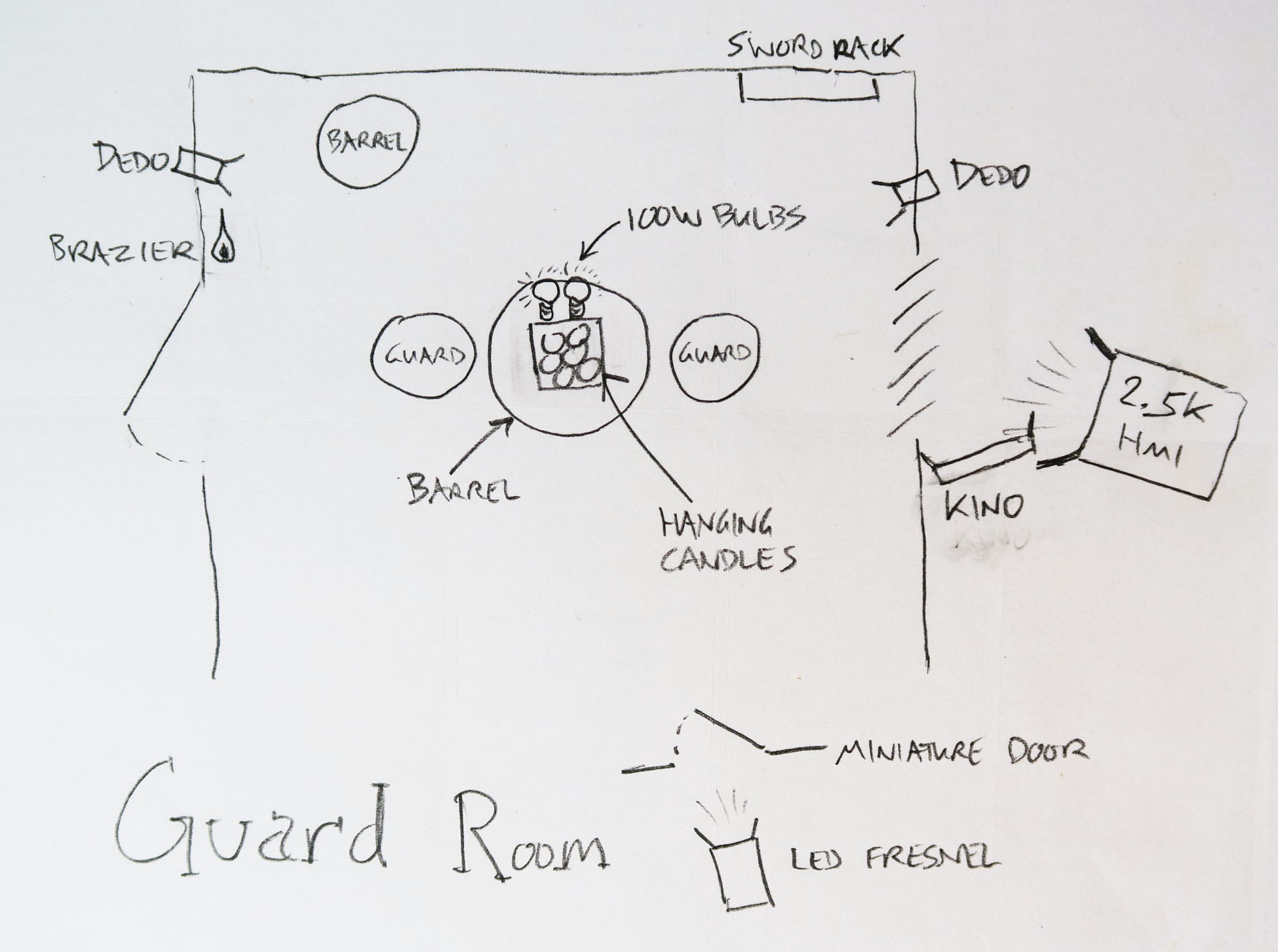
Here are the lighting plans for the guardroom and the cell:
You may also be interested to read the blog I wrote during the shoot about Lighting the Prison Cell, and my post explaining the technique of Cross-backlighting. And here is an unpublished post I wrote during the shoot about the guardroom….
The guard room shoot came at the end of a long and intense week of shooting interiors. By Sunday most of the lead actors had left, we had crested the hill and the end of principal photography was in sight. The atmosphere was even more relaxed and informal than usual, particularly as everyone’s favourite spouter of inappropriate comments, Richard “Squish” Roberts, was playing the lead jailor.
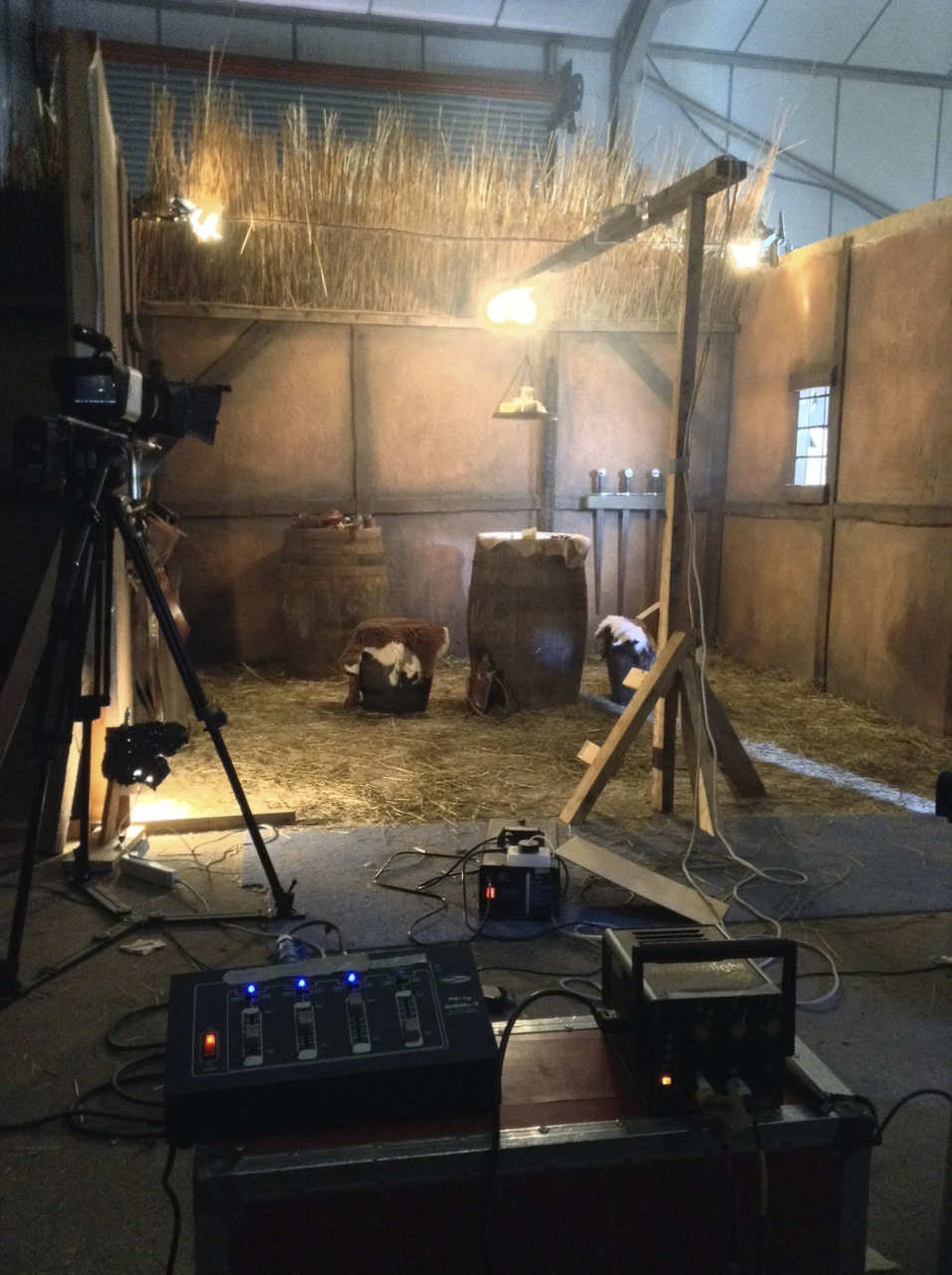
A behind-the-scenes view of the lighting set-up for the window and swords
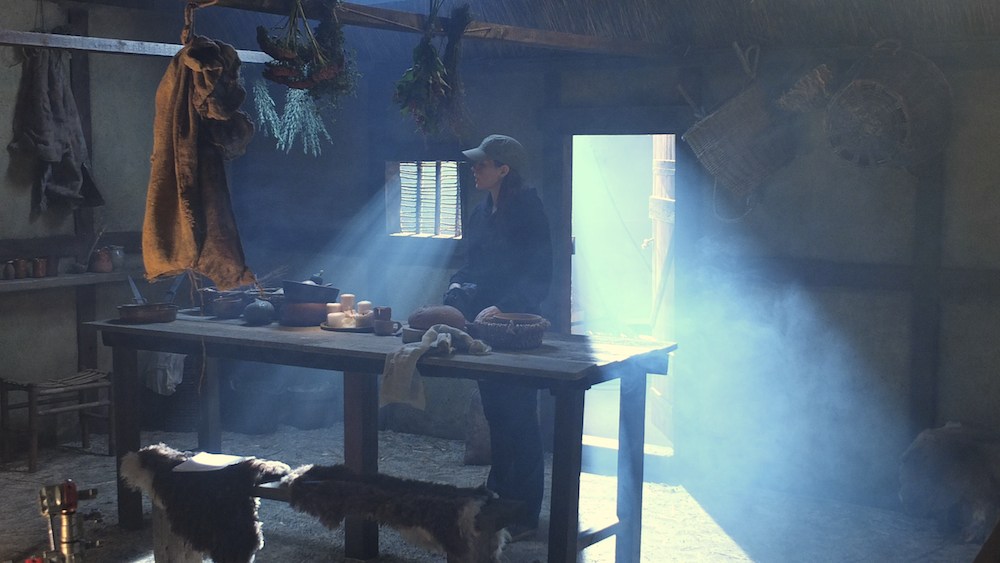
Ren’s bedroom had been repainted and redressed to be the Kah’Nath guard room. This meant a single, small window again, and as usual I couldn’t resist blasting a 2.5K HMI through there for a shaft of hot, smoky sunlight.
The Window Wrap in action on the swords
I wanted to highlight the rack of swords next to the window, which the shaft of light wasn’t catching, so I used a variant on my Window Wrap technique. I put a 2′ 4-bank kinoflo outside the window at such an angle as to light up the swords without blocking any of the HMI light.
I was interested to find that the art team had done something a bit different with the room’s candles, hanging a cluster of them from an overhead beam. I asked for the “table” (actually a barrel) – where the guards would be playing a board game – to be placed directly under that.
The Dedos (left and right of the picture) and 100W globes used to enhance the light from the candles
The candles wouldn’t shed light directly down on the game in the classic single-light-source-coming-straight-down-onto-the-poker-table style, but I felt it would give me an excuse to cross-backlight. I clamped a Dedo to the top of each side of the set, each one spotted on one of the two characters who would face each other across the barrel.
A view of the finished lighting set-up from over the dimmer boards. On the floor to the right can be seen the shaft of light from the LED fresnel coming through the fake door (off right).
These Dedos couldn’t be flickered, being the kind which go into a single control box with only three discreet settings for brightness. So to introduce some dynamics, and soften the light a bit, I clipped a dimmable 100W bulb to either side of the beam from which the candles hung. This would also ensure that Hunter would be lit when he stood next to the barrel.
An additional light source in the set was a small brazier on the wall next to the dungeon door. This seemed bright enough to shed plenty of light by itself, particularly as Squish would be standing right next to it for a large part of the scene.
The final touch for lighting was to re-use the fake door to create the effect of daylight spilling in as characters exited and entered from off camera. This time I placed an LED fresnel behind it.
Check back next Saturday for another instalment of Lensing Ren, and meanwhile watch the next episode of Ren itself from Tuesday at 8pm GMT at rentheseries.com
It’s the mid-point of season one of Ren: The Girl with the Mark and here’s my video breaking down the cinematography of that third episode. Topics covered this week include grip equipment, aspect ratio, smoke and faking candlelight.
Here is the lighting plan for Ren’s bedroom:
There is more on simulating firelight in my First Musketeer blog post Candlelight.
For my thoughts on composing for the cinemascope aspect ratio, take a look at 2.39:1 Composition.
Check back next Saturday for another instalment of Lensing Ren, and meanwhile watch the next episode of Ren itself from Tuesday at 8pm GMT at rentheseries.com
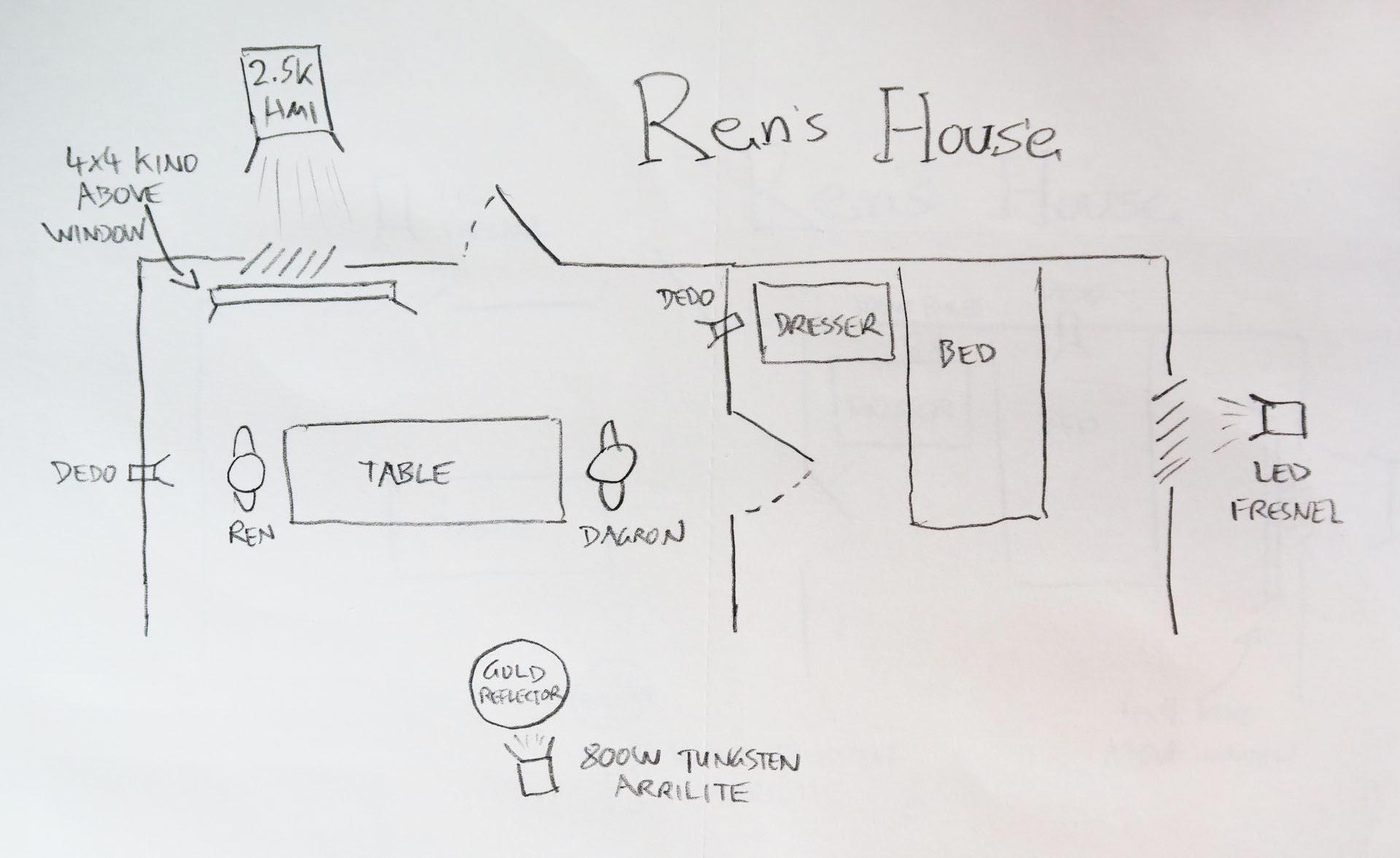
Here’s my video breaking down the cinematography of episode two of Ren: The Girl with the Mark. This week I discuss lighting Ren’s house, tweaking wide-shot lighting for close-ups, and depth of field.
Here is the lighting plan for Ren’s house:
And here is a video blog from the set of Ren’s house:
Check back next Saturday for another instalment of Lensing Ren, and meanwhile watch the next episode of Ren itself from Tuesday at 8pm GMT at rentheseries.com
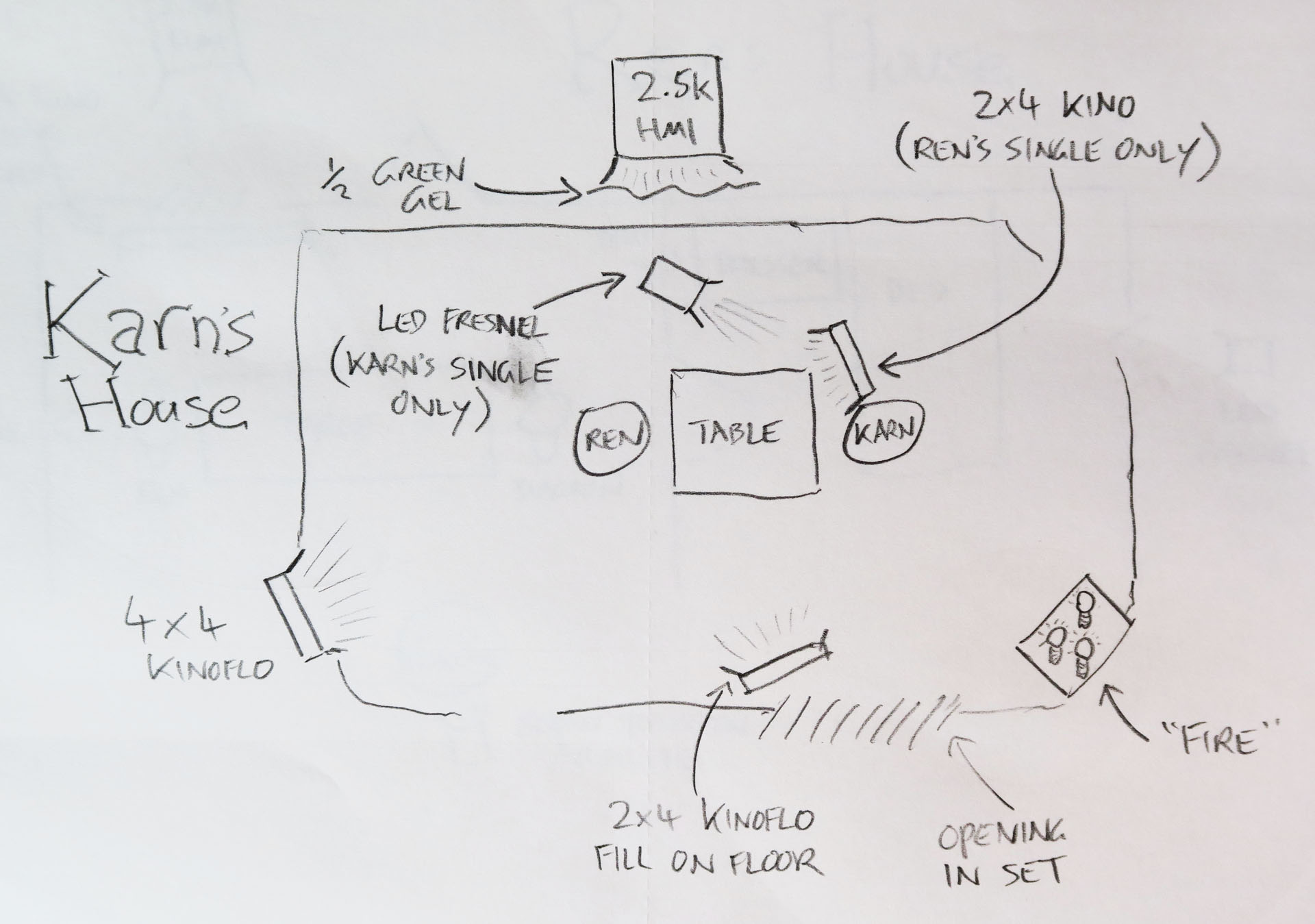
Here is the first in a series of cinematography videos I’m publishing to compliment the five episodes of Ren: The Girl with the Mark as they are released over the coming weeks. These videos will tell you the how, what and why of photographing the show. This week I discuss the camera equipment used, differentiating characters photographically, and lighting Karn’s magical woodland house.
Here is the lighting plan for Karn’s house:
And here is a video blog from the set of Karn’s house:
You may be interested to read my article on Masculine and Feminine Lighting, which gives some more detail on the techniques used to light Ren and Karn in the riverside scene.
Check back next Saturday for another instalment of Lensing Ren, and meanwhile watch the next episode of Ren itself from Tuesday at 8pm GMT at rentheseries.com
Kate demonstrates the action. Photo: Laura Radford
In the autumn of 2014 I served as director of photography on Ren: The Girl with the Mark, an incredibly ambitious short-form fantasy series, and have since been assisting with postproduction in various ways. Now that season one of the show is complete and ready to show to the public at last, I took the opportunity to sit down with director Kate Madison and ask her about some of the unique aspects of the show’s production…
Kate, many people will know you as the director, producer, co-writer, actor and general driving force behind Born of Hope, a Lord of the Rings fan film with over 35 million YouTube views. Did that film’s success open any doors for you, and what was the journey from there that led you to want to make a web series?
Born of Hope potentially opened doors even if they weren’t visible doors, in the sense that although it didn’t result in Hollywood coming calling, it created a a bit of a buzz and it became known in the industry. Myself and Christopher Dane [the lead actor] did start work on a fantasy feature film script called The Last Beacon and spent time trying to pursue that avenue. That then led into another feature film idea, so we were looking down the route of a feature film rather than anything else, and spent what felt like a number of years just not going anywhere.
I started thinking, what can we actually do when we don’t know investors or people with money. We concluded that with the internet – there’s an audience there, our audience is there. The crowdfunding thing which worked for Born of Hope is online, so we need to go back to that.
Many people will ask, “Why fantasy when there are so many cheaper and easier genres?” How do you respond to that?
For me, film and TV is about escapism, so I enjoy action-adventures and comedies and historical stuff – things that are not Eastenders. Fantasy is a huge genre. To me it’s a way to have the freedom to do whatever you want. I can take things I like – historical things, costumes, set design – and the joy of fantasy over period is, you can go, “I’m going to use this Viking purse with this medieval-looking helmet!” I like the freedom of fantasy. You can still have a character-driven, interesting story, set in somewhere fantastical, or even just a forest. There’s no dragons or creatures in Ren – so far – but the options are there, that’s the joy of it.
Having a laugh on set with Nick Cornwall (Dagron). Photo: Laura Radford
There was an enormous amount of goodwill and legions of volunteers who helped with Born of Hope. How important were those people, and finding others like them, when it came to making Ren?
Hugely important! Born of Hope could not have been made without a ton of volunteers, having no budget at all. With Ren, because we were in a similar position – which was a shame really, after all that time we still hadn’t got a big enough budget – we again had to rely on volunteers to make it possible!
There was an incredible sense of community, of shared ownership and very high morale throughout the production of Ren. Was it important to you to foster those things?
It’s incredibly important to keep morale high. I think it’s slightly easier when people are volunteering because they’re there because they want to be there and not just for the pay cheque. I was very keen to let everyone have fun on the project and also to have fun myself, because these projects are incredibly hard. So if the work was all done for the day, OK, I’m allowed to switch off now and grab a Nerf gun! People were staying there [at the studio], so they wanted to have a good time in the evening.
If we work a little later because there’s a break in the middle where we’re having a laugh, that means you can go later because everyone’s chilled rather than slogging away and not feeling like they’re enjoying themselves.
When people are volunteering, it feels like [the project] is everybody’s, and it is. People would come in and help and maybe end up designing a dress. The joy of filmmaking for me is the collaborative nature of it. There’s always someone behind you with an idea. You don’t feel like you’re ever on your own completely. If you’re at a loss, then someone else – whether it’s the DoP or the runner – [can suggest things].
A panoramic view of Ren’s village set. Photo: Michael Hudson
Very few micro-budget productions have their own studio, but Ren took over a disused factory for several months. How did that come about, and what were the benefits of it?
The benefits were through the roof, I’d say! We wonder if the project would have happened without it.
As we were going through budgets and scouting locations, we realised how difficult it was going to be [to shoot on location] – the logistics of making the village look like the village in the script and what if it rained for that week [the location was booked for]? It was just terrifying.
We started to think, is there another option here? It was just luck that Michelle [Golder, co-producer], on a dog walk, got talking to someone who knew someone. He mentioned this place in Caxton which was really big but we wouldn’t be in anyone’s way and we could just take it over. We were going to get a really good deal because it was sitting empty. It was twice as much for six months in Caxton in comparison with six days on location. And we would have the freedom to build whatever we wanted! There was all this interior space we could build in but also have costume rooms and production offices.
I’ve always loved the idea of having a place to work where everyone can come together. It’s fantastic nowadays that you can communicate with people all over the world, but you can’t beat a face-to-face conversation with someone and being able to look at the same picture and point at it and talk about it. It meant we were able to achieve a lot more in scope but also in quality.
Kate contemplates one of the interior sets. Photo: Ashram Maharaj
Perhaps the greatest achievement of the production was creating a medieval village from scratch. Building the set, sourcing enough extras and costuming everybody were three massive challenges. How did you tackle those?
I live in Cloud Cuckoo land sometimes I guess! The set build, I thought, “It’s fine, we can do this, we can build this circular wall essentially with a few alleyways going off it and fill it with some market stalls.” Chris was in charge of building the set, and did an amazing job with a bunch of volunteers that came back over and over again. Although we bought a bunch of materials we made use of an amazing site called Set Exchange which is a sort of Freecycle for sets and we found a bunch of flats on there – that helped a lot.
Populating the village was always going to be challenging. Suzanne [Emerson] who also played the role of Ida got heavily involved in helping to find extras. She’s involved in a lot of the amateur dramatics in Cambridge. It was probably horrible [for Suzanne and Michelle] but an amazing miracle for us that we’d finish shooting one day and go, “You know we’re actually going to shoot that tomorrow and we need some people,” and then the next morning you’d turn up and people would show up to do it. We had varying numbers, but there was never a day when no-one showed up.
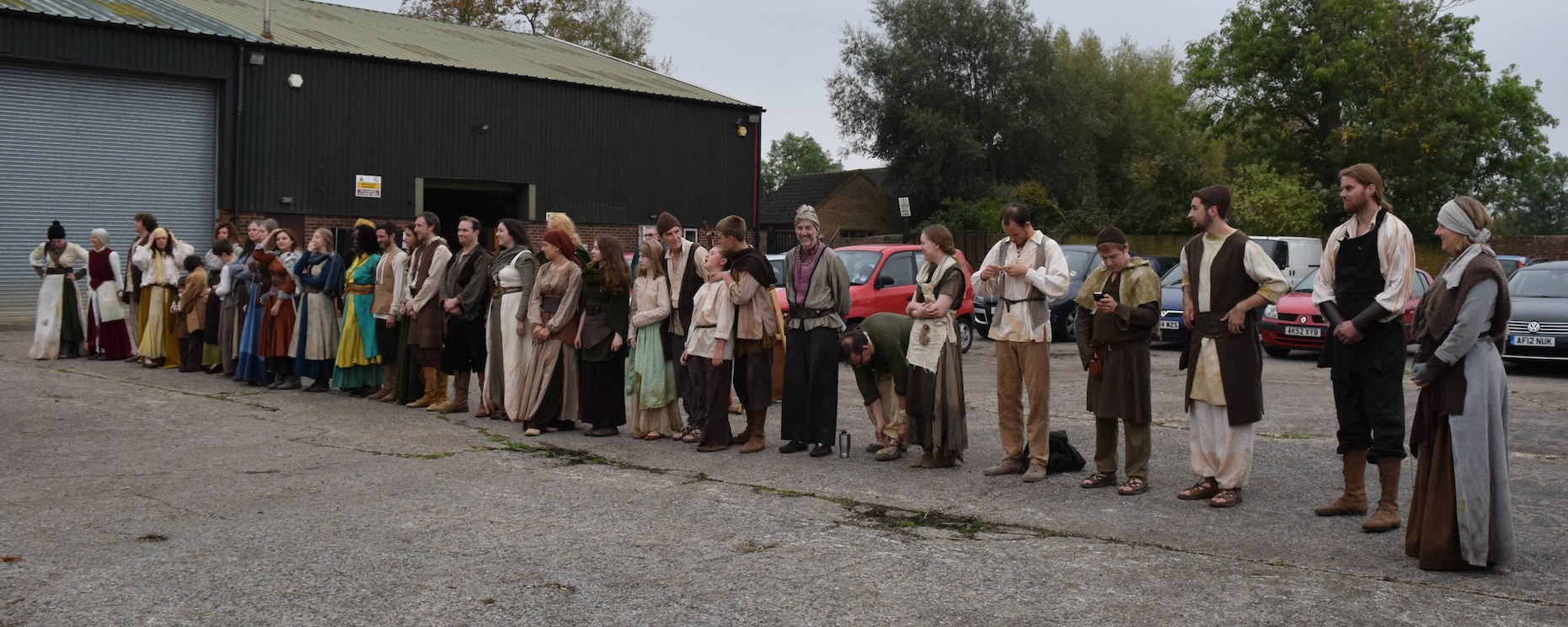
Supporting artists line up for a costume inspection in the car park of the Caxton studio. Photo: Michael Hudson
As for dressing them – we grabbed all of the Born of Hope costumes, Miriam [Spring Davies, costume designer] had a bunch of stock stuff as well. We ended up buying a bunch of things from New Zealand, from a costume house called Shed 11 that did Legend of the Seeker. The Kah’Nath armour came from Norton Armouries; John Peck – who had been involved with Born of Hope supplying stuff for orcs – I called on his good will again.
It was lovely to make the hero costumes from scratch. Miriam and I would go through the costume designs and then we went and looked at material. Chris and I randomly on a holiday to Denmark found some material we really liked for Karn’s tunic. Ren’s dress – I bought that material ages ago and it had been sitting around. Miriam and I took a trip to the re-enactors’ market as well. And we went to Lyon’s Leathers, spent what felt like a whole day wandering his amazing storeroom and picking out stuff for different characters, for Hunter’s waistcoat and Ren’s overdress, and we got the belts made there.
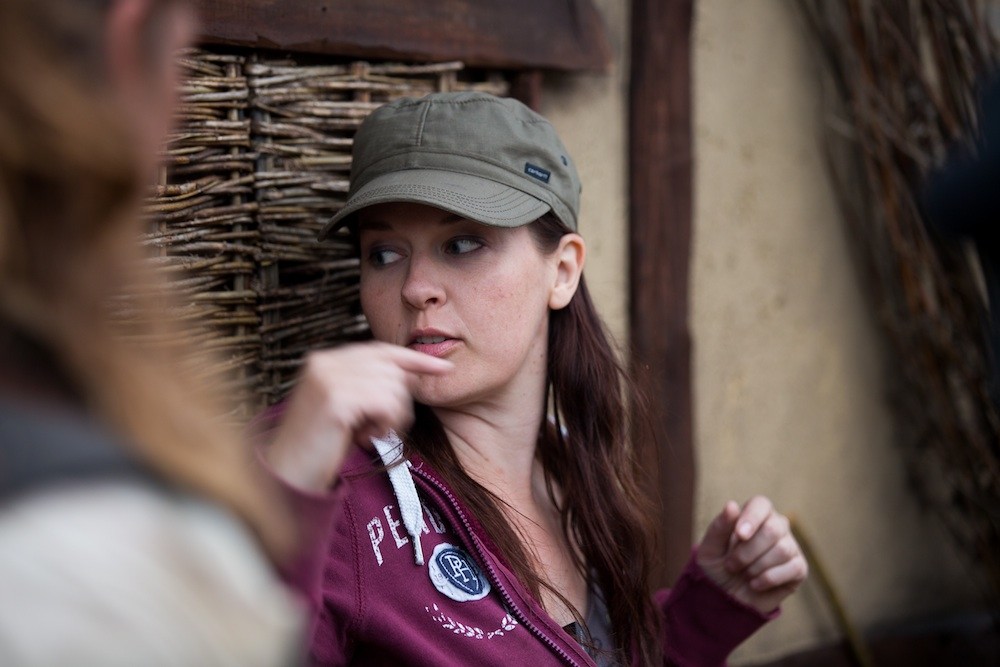
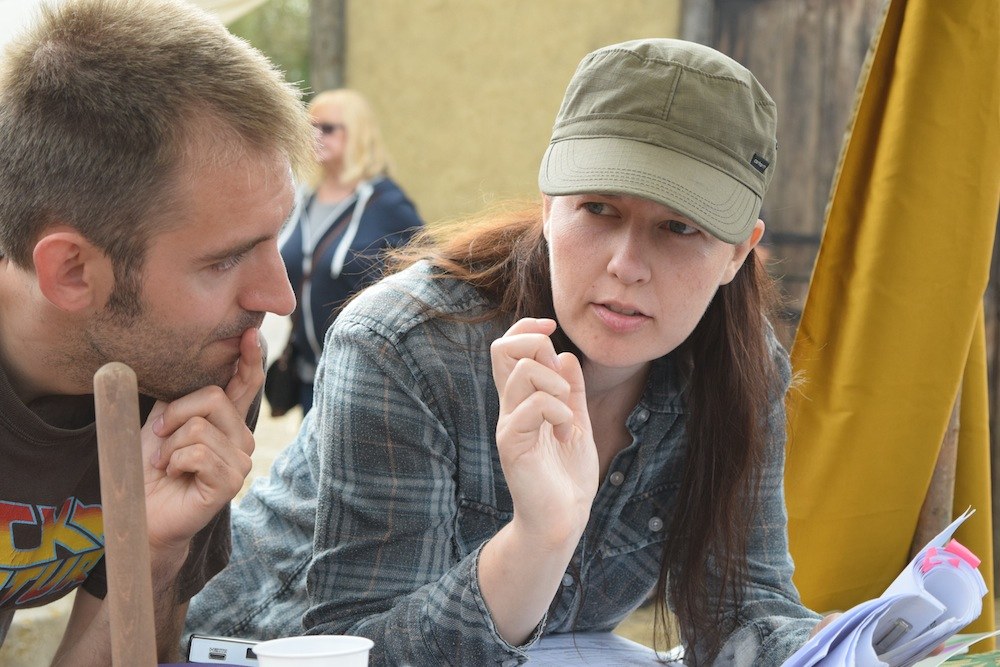
Discussing shots with me on set. Photo: Michael Hudson
I’ve heard you say more than once, “If it’s not right, it’s not worth doing.” How important is quality to you, and how do you balance that with the budgetary and scheduling pressures of such a huge project?
I’m not very good at compromising. If we’re going to spend months and months working on something that none of us are going to be happy with or proud of then it’s a waste of time and we might as well stop now. I think it’s probably that I’d like to be off in New Zealand making Legend of the Seeker, so I treat it as if I’m doing that I suppose, and I try not to let the budget or circumstances stop us from doing that.
I knew that most of the things are achievable. You know, to put together a costume that’s weathered well and looks really interesting is not hard to do, it just takes more time to do than buying it off the shelf and sticking it on, but the quality difference is so extreme. People will be much happier with you in the end if you’ve worked them hard for an amazing outcome than if you’ve worked them hard and it looks rubbish.
Sophie Skelton as the eponymous Ren. Photo: Alex Beckett
Most filmmakers are making stand-alone shorts or features, though the medium of web series is growing. Do you think it’s the way forward? Do you think there can be a sustainable career in it?
Ren is going to be an interesting experiment – can people watch something that, if we stuck [all the 10-minute episodes] together would be a pilot for TV – will they watch that on the web in the same way they would watch a TV thing or will they get bored and go and watch cats?
It is a new field. Although web series have been going on a long time, it’s still growing, there’s no funding in the UK, there’s no obvious way of having revenue from it, because the online platforms like YouTube, the advertising revenue is absolutely minimal as a percentage of views, and there’s only so many t-shirts you can sell. We struggled to raise money for the first season and we only raised enough to barely scrape our way through while putting in our own money.
Unless it does amazingly and maybe garners the interest of a big brand or sponsorship, if we’re having to crowdfund every time and we can’t crowdfund the huge figures that we’d need to make this, then it might not be the way forward for Ren and we might need to figure out a different thing… [unless] we get picked up by a bigger corporation like Amazon or Netflix.
We’ll see how this first season goes. We’d love it to become sustainable and a show that we can keep putting out and people can enjoy, but this is the experiment for that I suppose.
You can watch Ren: The Girl with the Mark for free, Tuesdays at 8pm GMT from March 1st, at rentheseries.com or on the Mythica Entertainment channel on YouTube.
The director of photography is one of the crew members who has the greatest influence over the pace of a shoot. How long you take to light each set-up has a huge impact on how much gets done in a day. So it’s only natural that you are usually consulted on the shooting schedule during preproduction. More often than not, your pleas for more shooting days will be ignored because there simply isn’t the money. Nonetheless, it’s your duty to feedback on the schedule, and if you can be specific about your concerns then you may occasionally succeed in getting tweaks made. And if not, at least you can say, “I told you so.”
Here are some things I’m looking for when I assess a schedule.
Length of shoot. Are there enough days? Is there a second unit to mop up up anything you drop, or do you have to cover everything on every day yourself?
Turnarounds. Is there a full day of daylight exterior immediately after a night shoot, for example?
Night scenes scheduled during daylight hours. Is the AD expecting you to black out windows, or is this a mistake? I hate blacking out windows; it robs the visuals of depth.
Stunts, VFX, make-up gags etc. Has the AD factored in the extra set-up time that comes with these things? Again, if there’s a second unit for this stuff then it may not affect you.
Nightmare shots. Has adequate time been allowed for any special, fancy shots that might take longer than usual to set up?
Location moves. Are there any location moves during the day, even just between rooms in the same house? Has time been allowed for these moves? Has extra time been allowed for the first scene in each location, to allow it to be lit properly? This may be less of an issue if you have a pre-rig crew.
Easing into it. Does the shoot start off a little easier to give the crew time to get into the swing of things?
Movie star shots. Are there any big heroic or romantic moments late in the schedule? Towards the end of the shoot, everyone will be tired, and this will show on the actors’ faces. Try to have key close-ups brought forward in the schedule, or warn the AD that lighting and make-up will take longer than normal.
Seasonal variations. On long shoots, there may be noticeable changes in season (trees in leaf/not in leaf, for examples) during production, and the available hours of daylight may change. Has this been taken into consideration?
Cover sets. Has the AD got contingency plans if the weather is bad?
A good 1st AD should have thought of most if not all of these things, but it never hurts to check them out yourself.
Want to learn more about scheduling? Check out my posts on scheduling my feature film Soul Searcher and my short film Stop/Eject.
My camera and lighting crew for last year’s feature
I’ve been working in the film business for 16 years now, but until very recently I hadn’t really worked on a ‘proper’ production, one that had a budget above five figures. Here are some differences I noticed stepping up from micro-budget to low budget…
Formal crew structure. There is a proper separation between departments, even between camera and lighting (which is quite strange for the DP, in charge of both). Woe betide anyone who moves set dressing without asking the art department, or who plugs something in without checking with the sparks, or who stores equipment in a room without asking locations.
Proper production and locations departments. The feature I worked on last year had two producers, a line producer, a production manager and a production co-ordinator, plus a locations department. I’m used to productions where one person does all those jobs, and often directs as well. Figuring out which person to approach about any given issue was fun! (Creative Skillset’s website is a good place to check if you’re not sure who does what.)
Advance prep. With a large crew, time cannot be wasted waiting for things that could have been pre-rigged. Heads of department are expected to think ahead and splinter their crew if necessary to be ready for things coming later in the day or week. For a DP this most commonly means pre-rigging distro and/or lighting.
Delegation. Aside from operating the camera, I did little hands-on work on the recent feature shoot. Lens changes, grip rigging and lighting set-ups are all handled by other people on the instructions of me, and of the gaffer and the 1st AC. Sometimes this means the DP can go and have a cup of tea, but often it provides important thinking and planning time – an opportunity to reccie the next set and design the lighting, or to review footage in the edit room, or reccie a possible location with other HoDs, or discuss the afternoon’s shots with the director. It’s impossible to do this sort of forward planning if you’re changing your own lenses and setting your own lamps up.
Hard wrap times. On micro-budget shoots the wrap time is a theoretical concept, with no more relevance to reality than an episode of Sponge Bob Square Pants. On a bigger production, you wrap at wrap time, because if you don’t then the gaffer might pull the plug. Occasionally the crew will be asked if they are willing to go over by half an hour, say, in order to complete a scene. But everyone must agree, and that half hour must be deducted from the next day.
Lunch break, not just lunch. In micro-budget land, getting lunch at all is not a given. But when you do get it, you’re often expected to eat as quickly as possible and get straight back to work. On a bigger production you get your hour lunch break come hell or high water. And there’s proper catering. With desserts!
Reliance on the crew. If you’re working with a small camera and mains power, you can stay late with the director and steal a few extra shots, if necessary. But when everything’s run off a generator, which only the gaffer is qualified to operate, and your camera package is almost too heavy to lift onto your own shoulder, and you have no idea how half the bits and bobs connected to it work because your ACs always deal with it, you really can’t do anything on your own.
Permissions and qualifications. For insurance reasons you must have qualified people overseeing the electrics and the rigging. You must also check with the locations department before using any space or equipment or filming in any area that was not discussed and signed off in preproduction.
Paperwork. Most HoDs seem to have some kind of daily paperwork to do on a larger production.The DP happily escapes this (the ACs handle the camera reports), though they do have to complete a risk assessment before shooting commences.
People management. Because of the size of the team under you, people management becomes a major part of an HoD’s job. I’ll go into more detail on this in a future post.
I’m very excited to say that the fantasy action series I DPed in 2014 – and have spent most of my time since then helping with post on! – will premiere free online on March 1st. Here’s the new trailer which I cut for the show…
Our lead actress, Sophie Skelton, set the internet buzzing last week when she was cast as the pivotal Brianna Randall in the Starz series Outlander, ending months of speculation. Meanwhile, other members of the cast have appeared in Doctor Who, Stargate, Jekyll & Hyde and will appear in this year’s season of The Musketeers. And of course the director is the brilliant Kate Madison, whose last film Born of Hope is at 35 million views on YouTube and still clocking.
I’m prouder of Ren than anything else I’ve ever worked on, and I can’t wait for you guys to see the series at last. Check out the official Facebook page, where we’ll be sharing new micro-trailers (which I also edited) and lots of other content throughout February. And when the series is released in March on rentheseries.com, look out for some special blog posts right here on neiloseman.com breaking down the lighting set-ups and the thinking behind them.
Following on from last week’s filmmakers commentary, today I’ve posted the cast commentary for Stop/Eject on YouTube. It features Georgina Sherrington, Oliver Park and Therese Collins all chatting about the film as it unrolls before their eyes. Click the annotations in the video to access a commentary-less version if you haven’t seen Stop/Eject before.
My award-winning short fantasy-drama Stop/Eject is just coming to the end of its festival run, and soon I’ll be publishing a breakdown of that run, how much it cost and how many festivals it got into. But in the meantime, here’s the director and producer’s commentary which Sophie Black and I recorded at the Cannes Film Festival in 2013.
If you haven’t seen the film, you can watch it without commentary below.
Next week I’ll be posting the cast commentary with Georgina Sherrington, Oliver Park and Therese Collins.