Shooting in Rain

Il pleut dans la nuit. Ce n'est pas jolie.
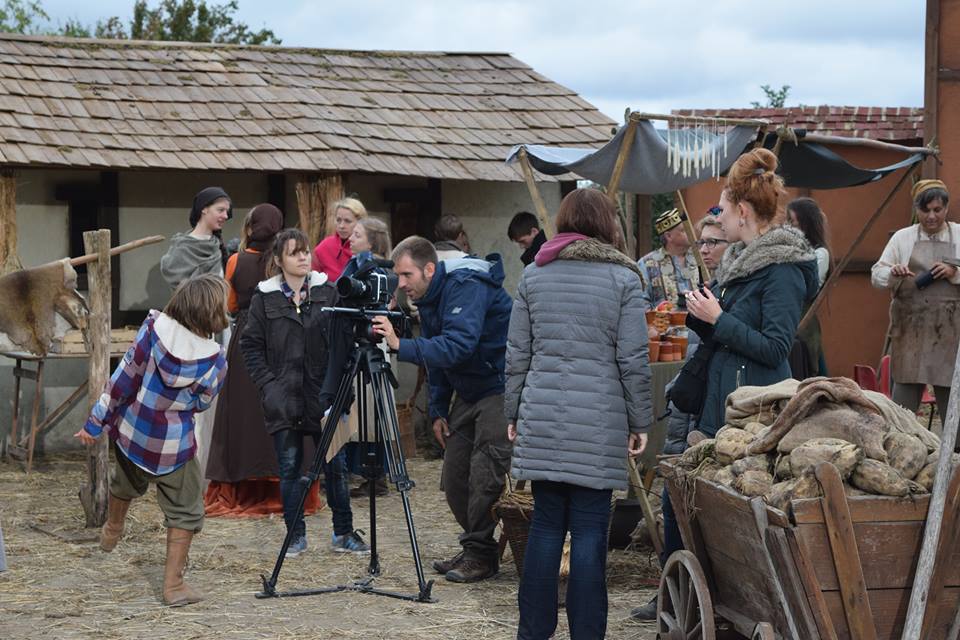
The rain in France falls mostly on the crew of The First Musketeer.

Rain. How we’d love to go inside and have a cup of tea when the old British precipitation interrupts a shoot, but quite often the schedule demands that we carry on regardless. Here are a few tips for filming in the wet stuff.

Cover the Camera

If you don’t have a proper rain cover, a transparent recycling bag with a couple of holes cut in it will usually do the job, but have someone hold an umbrella over the camera at all times as added protection. If you have them, put on a matte box and top flag to keep rain off the lens.

Check the Lens

Condensation may well be an issue. Have an assistant with a ready supply of dry lens tissues (in a ziplock bag), because a cloth will quickly get too damp to be of any use.

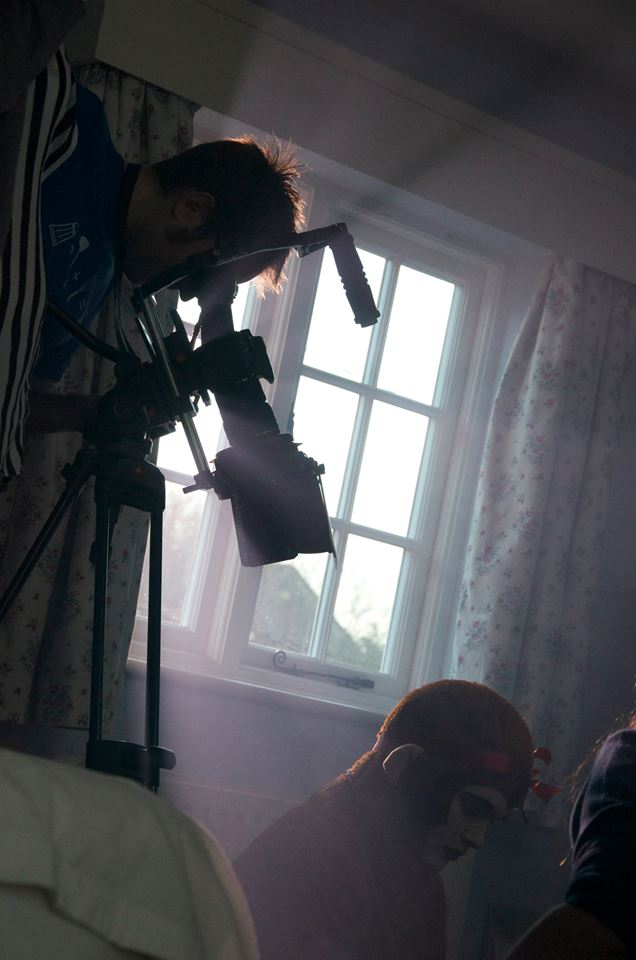
In this photo by Miriam Davies from a location shoot on Ren, you can see a bagged LED panel on the left of frame.

Look After the Lighting

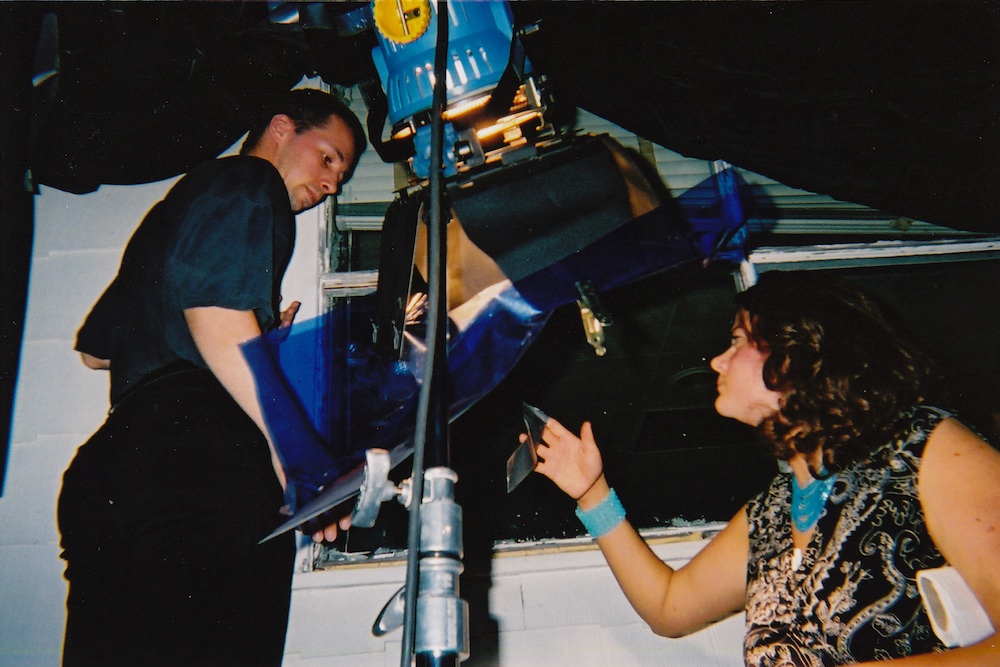
Transparent recycling bags are perfect for covering LED panels, which don’t get hot.

Tungsten lamps get so hot that they burn off any water before it can do any damage, so as long as they’re switched on you don’t need to worry about them getting wet, but you should wrap the switch in a plastic bag.

The same goes for HMIs, though you’ll need to put a bin bag over the ballast. Make sure the bag is loose at the top, so that the heat from the ballast can inflate it and then dissipate through the bag; if you wrap the bag on tightly, the ballast will overheat and cut out.

People can be understandably concerned about mixing water with electricity, but honestly, I’ve run tungsten and HMI lamps in the pouring rain for hours without covering them, and never had any problems. If you’re really worried, clip a sheet of gel over the lamphead to make a little hood.

16A cable
16A cable

Use Outdoor Cabling

Ideally you should use only 16A (and above) cabling with C-form sockets (the round blue ones); these are rainproof. If you have to use domestic 13A extensions, wrap all the connections in plastic bags.

Seeing the Rain

The key to making rain show up on camera is backlight. If you want it to look like a real downpour, get your biggest HMI at the back of shot and blast it towards camera. Or maybe you don’t want to see the rain, maybe it’s bad for continuity, in which case you should avoid backlight at all costs.
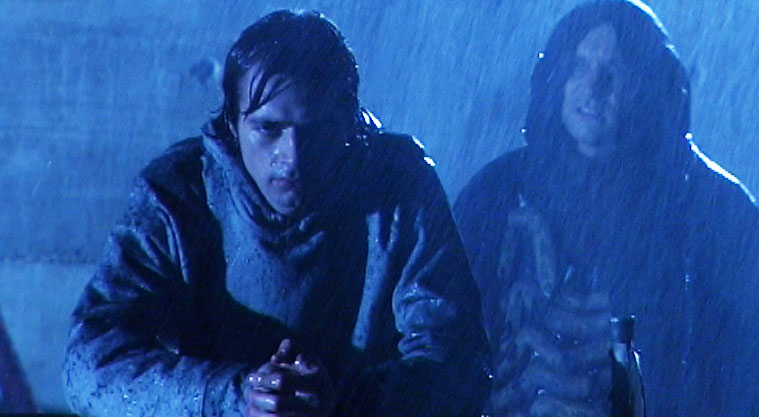
Ye olde person-talking-to-other-person's-back shot in Soul Searcher, obviating the need for a shot-reverse.
The rain in this shot from Soul Searcher is fake, but it’s backlight that makes it show up.

Need rain for your shoot but the sky is cloudless? Read my post on faking precipitation.

Got precipitation of a more wintry nature? Check out my tips for shooting in snow.

I’ll leave you with the latest Ren behind-the-scenes video, which is all about rain and shooting – or not shooting – in it. Subscribe to get the Mythica Entertainment channel to see all the latest Ren videos as they’re released.

Shooting in Rain

Lighting ‘X, Y & Z Rays’ by Revenge of Calculon

Stage-bound music promos can be an interesting challenge for a cinematographer. Often there is no set that has any basis in reality, no windows, no starting point for lighting. This should be very freeing but is actually pretty scary. Where to start?

This is X, Y & Z Rays by Revenge of Calculon, my latest music video for director Tom Walsh of Polymath Pictures

Nick Pylypiuk did an awesome job of building and programming the LED panels, and Amy Nicholson did a great job of dressing the gadgets and cables. How did I go about lighting it?

2 of the 800W tungsten Arrilites hidden behind the big LED panels
2 of the 800W tungsten lamps hidden behind the big LED panels

Well, cinematography isn’t just about mimicking natural light. It’s about depth and contrast, to name just two things. And depth was where I started. If I didn’t want the LEDs to float in a black background, then it was necessary to light the cyclorama to reveal it as a separate layer behind the LED panels. But leaving the cyc dark would give the image more contrast. I wanted to have my cake and eat it. So the lamps I lit the cyc with had to be dimmable so that they could be off at some points during the track and on at others.

I placed 800W tungsten lamps on the floor behind the central and outermost LED panels, uplighting the cyc. Poor Emma, the art assistant and the smallest member of the crew, was assigned to hide behind one of the panels, pulsing the 800s on a dimmer board in time with the music.

Next I needed to light the musicians. We didn’t have access to the studio grid, the LED panels were providing plenty of light from behind, and any light from the front would have polluted the panels, so my only option was to light from the sides. I placed a Dedolite off to each side, gelled with different varieties of blue/green gel to make this layer of the image stand out from the warm, ungelled tungsten of the 800s.

The 4 Dedolites can be seen here, gelled blue-green, blue-green, purple and yellow.

This was all very well, but it left a lot of the art department’s nice foreground dressing in complete darkness. So I set up a second Dedolite on each side, crosslighting the amps and other gubbins. I gelled one of these yellow and the other pinky-purple. Normally I prefer to use a narrower palette of colours, but since the patterns programmed into the LED panels used all the colours of the rainbow, I felt I had license to do the same.

After a couple of run-throughs, I decided on an alternating, pulsing pattern for the four Dedolites at half the speed of the 800s. My initial instinct had been towards something more sophisticated, but there was plenty going on on the LED panels without needing to make the foreground too manic.

Clockwise from top right: a blue-green-gelled LED panel, a tungsten-tubed Kinoflo and a daylight-tubed Kinoflo Divalite amongst the set dressing

Amy was still looking to add to the set dressing, so I suggested putting our battered old Kinoflo into shot for a bit of extra interest. This left only a Kinoflo Divalite and a 1×1′ LED panel in my arsenal. “What the hell,” I thought, and hid them behind a couple of the amps to pick out some more of the set dressing.

Despite all this, I still think the strongest bits of the video are those where all my lights are off, leaving just the patterns on the large LED panels. With a bit of dispersed smoke in the studio, the LEDs give off a lovely glow, and the dynamic wrapping backlight they shed on the performers is really beautiful.

And we quickly found that they looked great out of focus, and went with that for a few set-ups. In fact, much of the single day of shooting was spent experimenting and going with the flow. Tom trusted me to get interesting coverage while he helped operate the LED panels, and I found the electronic music guiding me into Wes Anderson-style camera moves: lateral tracks, and bold, simple pans and tilts.

Find out more about Polymath Pictures at www.polymathematics.co.uk.

Photo by Amy Nicholson


Lighting ‘X, Y & Z Rays’ by Revenge of Calculon

How to Black Out Windows

Blacking out a window
Blacking out a window on Beyond Recognition

Sometimes when shooting indoors, you need to make day look like night. And believe it or not, there’s an art to blacking out windows. Light is like water: it leaks in through the tiniest crack, and you need to appreciate that if you’re going to black out a window successfully. Here are my tips.

  1. Don’t do it. Shoot at night; it’s quicker and easier. It will also look much better because you can light the view outside for added depth in the background of frame.
  2. Ignored rule one? Well, at least do a split shoot so that you only shoot away from the windows during daylight, and shoot towards them after dark. If the windows aren’t actually in frame, your light seal doesn’t need to be 100%.
  3. Ignored rule two as well? Unquestionably the best way to black out a window is to gaffer tape black drapes or bin bags to the outside of the window frame. Don’t try to tape to the surrounding brickwork; it won’t hold. The gaffer tape needs to go in an unbroken line all the way around the edges, or light will leak in through the cracks.
  4. If you have large windows to black out, it may be tempting to rig drapes on stands. OK, fine, but you still need to gaffer tape all the edges. And make sure the stands are well sandbagged in case the wind gets up.
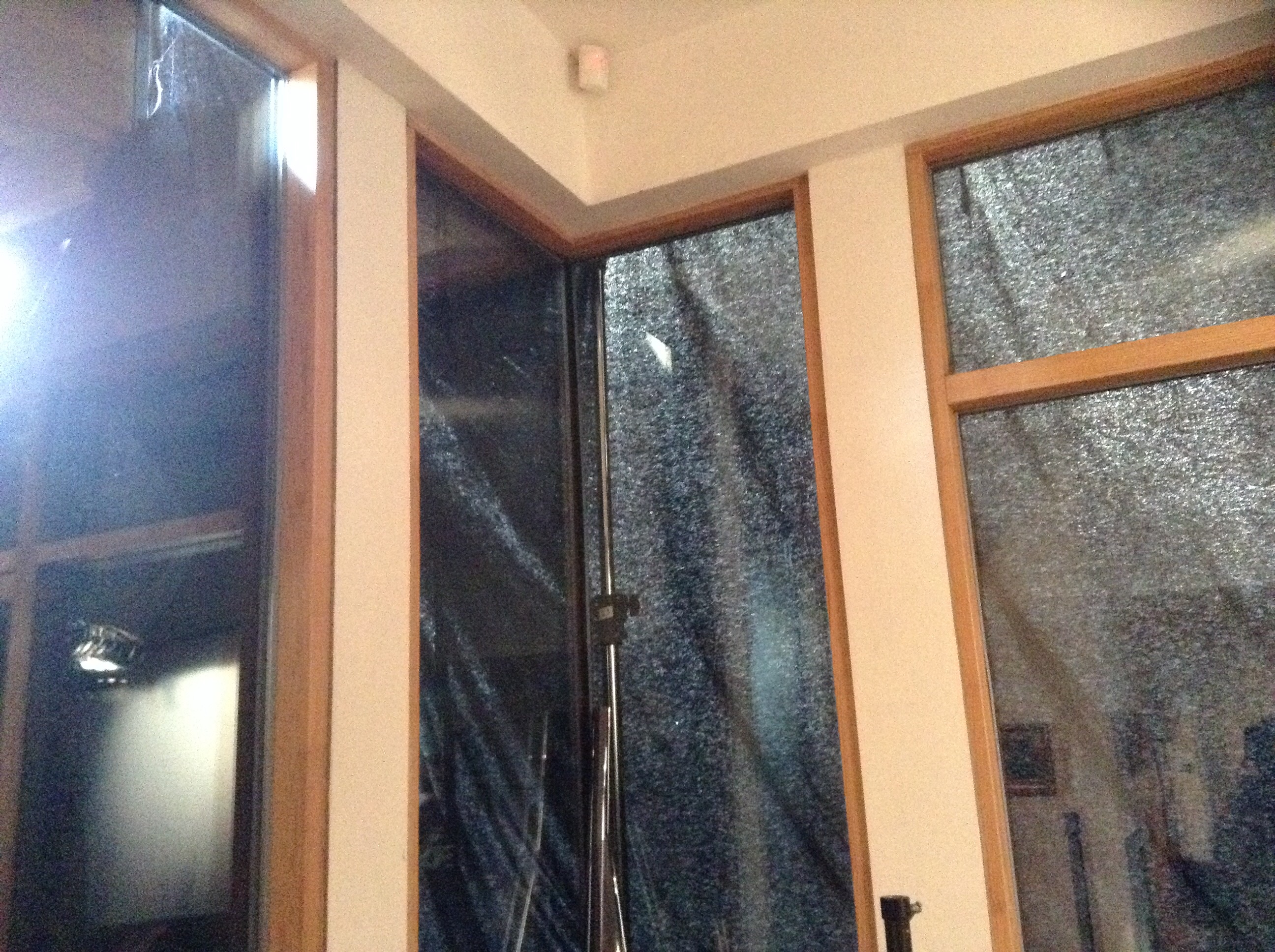
  5. Here’s an example where the lefthand side hasn’t been taped. As you can see, the daylight comes in and nicely cross-lights the drapes, showing up every wrinkle and utterly destroying the illusion of a dark sky. (Fortunately, in this instance the window wasn’t going to be in shot, and the amount of light leaking in wasn’t sufficient to contaminate the DP’s lighting design.)
    image
  6. When you’re outside doing the blacking-out, it is impossible to judge the quality of your work. You need to go inside and see what it looks like. You’ll probably get a nasty shock.
  7. Beware that some things that seem opaque from the outside – bin bags or fabric – actually let light through. Hold them up to the light to check this before you waste time gaffering them up. These drapes looked completely opaque from outside…
    image
  8. Sometimes the DP will want to put a lamp outside to simulate moonlight, and this will need to be tented around. This is extremely difficult and can waste a lot of time. The lamp will spill light onto the drapes, showing them up for what they are. Black wrap the lamphead as much as you can (without covering any vents) and don’t use a tarpaulin as black-out material because it will reflect the light.
  9. Finally, remember to put any stands holding up the drapes BEHIND the drapes, so they’re hidden from camera. (I’ve seen this mistake made, and made it myself, several times – see picture above!

UPDATE: Karl Poyzer has this great tip: “A much easier way to black out windows not in shot or behind a curtain is to spray them with water and roll tin foil over them, stays stuck there indefinitely, blocks out 100% of the light, is cheap and won’t fall down.” Thanks Karl!

How to Black Out Windows

What I Learnt from Ren

This coming week the core team from Ren, the fantasy adventure web series I lensed last autumn, will meet for a de-brief. We’ll discuss the challenges of season one and how we can meet those going forward to season two and beyond. And we’ll probably drink wine.

So I thought now would be a good time to reflect on what I personally learnt from Ren: Season One, and where I’d like to improve for season two.

“People talk about lighting, but the hardest thing to do [for a cinematographer] is to shoot a day exterior over an extended period… especially in England.” – Roger Deakins

The biggest challenge I was plunged straight into was the fact that most of the season was set outdoors on a single day. How could I maintain a consistency of lighting without huge cranes, silks and big HMIs, or without demanding the production grind to a halt whenever the light didn’t match (something the schedule couldn’t accommodate)? Quite simple, I couldn’t. Perhaps if I’d been involved in preproduction, I could have helped shaped the schedule so that certain scenes were only being shot at certain times of day, but given how much the schedule changed during shooting, this probably wouldn’t have helped.

Colin Smith slates a shot of RIchard Zeman as the Kah'nath Commander
Colin Smith slates a shot of Richard Zeman as the Kah’nath Commander

But being forced to leave lighting the set to Mother Nature had its advantages. Whereas indoors, or at night, the cinematographer must light the set and the actors, for daylight exteriors the only thing you have the ability to light is the actors. That really focused my attention on the faces and telling the story through the way light hit them.

I was able to compile a mental dossier of what works well for each actor – and each character. So I knew that Ren (Sophie Skelton) looked best with a soft front- or side-on key, but not three-quarter, that Hunter (Duran Fulton Brown) looked best in toplight, that Karn (Christopher Dane), the Commander (Richard Zeman) and Lyanna (Dita Tantang) all looked great with a hard side key. I knew that Baynon’s (James Malpas) eyes looked extra expressive with a large bounce board under his face, whereas Hunter only needed a little dot of an eyelight. And so on, and so forth. In the future I want to get better and faster at compiling these ‘dossiers’.

Setting an eyelight under the camera
Setting an eyelight under the camera. Photo: Richard Roberts

Despite gathering all this info during the exterior shoots, it was a still a bit of a shock when week six hit and I suddenly had to light these familiar faces entirely artificially. In the past I’ve often seen natural light as more of a hindrance than a help, but working with it for five weeks solid gave me a new respect for it, and I found myself more critical of my own lighting than ever.

The main challenge indoors was achieving the soft, innocent look I’d established for the title character without a skyfull of natural light to bounce around. The kinoflos I used to key Sophie often made her look very shiny, much to the exasperation of make-up artist Becca Youngs, who had to keep slathering more powder on her. (Which is one of many reasons why camera and make-up tests in pre-production would be beneficial for future seasons.)

In fact it wasn’t until the very last day of the shoot when I discovered that the best soft sources were actually hard sources – like 800W tungsten lamps or even the 2.5K HMI – bounced off Celotex (matte silver bounce board). If you read things like American Cinematographer you start to realise that most DPs create soft sources this way, bouncing par or fresnel fixtures off poly, foamcore, Ultrabounce or the like and often pushing it through diffuser of some kind as well. Stephen Murphy and Ed Moore conducted a great test of various bounce and diffusion materials on their blog recently. The problem with this kind of lighting for a low budget DP is that you need to hire larger lamps, because bouncing and diffusing really dilute a lamp’s power. Though in last month’s Cine Summit, DP David Vollrath recommended cheap-to-hire Source 4 Leikos as bounce sources, so that’s worth looking into.

Shooting on my Sigma 50mm f1.4 from under my signature Stealth Cloth, to keep sunlight off the Blackmagic's screen
Shooting on my Sigma 50mm f1.4 from under my signature Stealth Cloth, to keep sunlight off the Blackmagic’s screen

The other thing I’d love to spend money on next time, if at all possible, is a set of cine lenses. Season one was shot with my three Sigma DSLR primes and some legacy Pentax primes belonging to gaffer Richard Roberts. While the Pentax glass looks great, and the Sigma glass is fine at f4 – the stop I shot most of the show at – when it starts to get wide open it goes a bit soft (not that the average viewer would notice). Inevitably some of the night and interior scenes had to be shot wider than f4, and everything shot on the B camera – Richard’s Blackmagic Cinema Camera, with its smaller 16mm sensor – was exposed at f2.8 to match the depth of field. Plus I deliberately used an ultra-shallow depth of field for certain scenes in which Ren is feeling the effects of the spirit within her. So lenses that hold their sharpness better at wide apertures, and which are easier to pull focus on, would be great for season two.

Whatever level of resources we can get for future seasons, I know it will be a fantastic experience and I’ll learn a whole lot more, so bring it on!

Filming Ren's death scene. Just kidding…. or am I? Photo: Michael Hudson
Filming Ren’s death scene. Just kidding…. or am I? Photo: Michael Hudson
What I Learnt from Ren

What Does it Take to be a Cinematographer?

Adrian Biddle
Adrian Biddle

Being a director of photography is not just about having an eye for composition and understanding light. There are many other skills a DP needs. Today I’ll discuss what some of those are, in my opinion, and in the opinions of some top Hollywood DPs.

“Obviously you have to know what you are doing, have an eye for photography, and know about film and composition. But it’s a team effort.” – Adrian Biddle (Aliens, Event Horizon)

Shane Hurlbut (Need for Speed, Terminator: Salvation) says that 33% of a cinematographer’s job is managing their crew. You need to pick great people to work with, nurture them, share your knowledge with them, and trust them to deliver the goods.

Frankie DeMarco (Mad Men, All is Lost) advises trying to think like an editor: what specific shots do you need to tell the story? Editing is one of the areas it’s most useful to have experience of, as a DP. Knowing whether what you’re shooting will cut together is vitally important. I often find myself suggesting to a director that we run a scene from a little earlier, have someone come into shot at the start, or cut it later so they exit shot, knowing how useful that stuff can be in post.

Understanding the jobs of other departments is very useful. The more you know about production design, costume and make-up, the better you can light it. The more you know about acting, the better you can appreciate the impact your decisions – equipment placement, the strictness of adherence to marks you demand, the lenses and angles you select – have on an actor’s work. This doesn’t mean that you have to do all these jobs at some point, but try reading the occasional book or watching the odd YouTube video about the subject, or better still, forge great relationships with other heads of departments and pick their brains.

Douglas Slocombe
Douglas Slocombe

There are of course many rules to cinematography – the line of action, Golden Thirds, lighting the downside – but how many of them do you need to know?

“To any aspiring cinematographer, I’d say learn the rules before you try and bend or break them. You need a foundation on which to build.” – Douglas Slocombe (Indiana Jones trilogy)

You should take every opportunity to learn; read every blog, every book that you can, go to workshops, to masterclasses; watch behind-the-scenes videos. The more knowledge you have to fall back on in a crisis, the better.

“You always try to create a certain style for each film but there are times when you have to make it up as you go along.” – Jan de Bont (Die Hard, Flatliners)

Flexibility is key. You have to do what’s right for the scene, what’s right for the set and the talent, what the director wants, and what works for the schedule. Sometimes this means changing tack at the last minute. You can’t throw a hissy fit and weep for the lighting set-up you’d imagined; you have to get on with it. Corporate videos, in which you often have to sacrifice your photographic ideals for the mundane needs of the client, are great training for this.

You have to be a storyteller; all heads of department have to be. As DP, your tools for telling the story are lights and lenses. You need to absorb the script, appreciate the narrative beats and come up with creative ways to accent those beats using your tools.

Perhaps the most important thing to have is life experience.

“It’s my personal interpretation of a script that allows me to create the visuals. That interpretation is based on my own life experiences, aesthetics, education, and knowledge, all of which help to shape my understanding of a story.” – Janusz Kaminski (Saving Private Ryan, Lincoln)

Thanks to Stephen Murphy and his DOP Documents for the block quotes.

Janusz Kaminski
Janusz Kaminski
What Does it Take to be a Cinematographer?

Top Tips from Day Two of the Big League Cine Summit 2015

blcs-blue-on-whiteLast week I published the best tips I culled from day one of the 2015 Big League Cine Summit. To complete the set, here are the top tips from day two, starting with that legendary teacher of cinematography, Shane Hurlbut, ASC. Since Shane is so good at sharing his knowledge on the Hurlblog, I’ve only listed a few tips from him; I strongly recommend you check out his site for many, many more gems.

Shane Hurlbut – “Delivering Storytelling Impact with Light, Lens and Camera”

  • On the visual grammar of Crazy/Beautiful: controlled camera moves represent Jay’s controlling mother.
  • Shane likes to use the work of stills photographers as inspiration.
  • He added extra 400W sodium vapour fixtures to the existing 100W sodium vapour streetlights for night exteriors in Crazy/Beautiful.
  • He used a “damaged key” in Crazy/Beautiful to represent Kirsten Dunst’s flustered state. It’s messy, doesn’t quite reach both eyes.

David Vollrath – “Motivated Lighting”

  • “I don’t want to light their faces and bodies specifically. I like to light the space.” – Harris Savides
  • Stand where your subject will be to see what reflective objects are affecting your lighting.
  • Tabletops can be great bounce-boards for toplight. Maybe put muslim or paper on the table to enhance it.
  • Look for things to motivate light: windows, practicals, overhead fixtures, sconces, etc.
  • Once you’ve lit the space, it will become clearer how to light the faces.
  • Work with the art department in preproduction to make sure you get the practicals you need.
  • Flag your other sources off your practical so that excess light isn’t falling on them and washing them out.
  • You can use the reflection of a softbox to create a nice shine on a dark surface or even on a face.
  • A roll of duvetyne armed off a C-stand makes a fair stand-in for a 4×4 floppy flag.
  • “Beadboard” is just another name for polyboard. (I genuinely didn’t know that!)
  • Other bounceboards include foamcore and showcard.
  • Use Source 4 Leikos to fire into your bounce, because they’re easily cut and focused. They’re cheap to rent too.
  • It’s easier to rig a bounce card overhead than a softbox or a kinoflo.
  • Plus Green and Minus Green gels – to match or correct fluorescents – are useful in subtle 1/8th flavours.
  • “Lighting is in the gripping.” Taking away light can be more effective than adding it.
  • A “cocktail” is a layering of multiple gels.
  • A simple black card over a shiny piece of furniture can cut bounce and bring back contrast.
  • Hazers add great atmosphere, but they raise the fill level. To see shafts of light, use a dark background.

Caleb Pike – “Everything You Need to Know About Lenses”

  • A good set of primes will last you decades.
  • Lens choice affects: 1. Field of view, 2. Depth of field, 3. Compression (amount of perspective).
  • Use compression to isolate a subject, or to crop out equipment.
  • Use wide lenses to open up a space, exaggerate expressions or get the most out of camera moves.
  • Longer lenses are more flattering for close-ups. Short lenses can distort the face unpleasantly.
  • Don’t always shoot with your aperture wide open. Choose an appropriate depth of field for your story.
  • Generally it’s best to keep your aperture the same throughout a scene.
  • Avoid non-constant aperture zoom lenses for video work.
  • Primes (fixed focal length lenses) are generally faster, cheaper, lighter and sharper than zooms.
  • Cine lenses are heavier than stills lenses, do not breathe (zoom slightly when focusing), and have fixed filter rings.
  • Cine lenses have hard stops on the focus rings, so you can set focus marks on the lens.
  • Cine lenses have longer throws on the focus rings, so that follow focusing can be more precise.
  • Wide cine lenses have less distortion than their stills counterparts.
  • Passive lens adapters are cheap and simple; smart adapters maintain the electronic connection for autofocus etc.
  • Lens boosters can solve cropping problems caused by using a lens with a sensor size it’s not designed for.
  • Throttle adapters are passive adapters with neutral density fader filters built in.
  • Caleb’s budget lens recommendations:
    1. Nikon 35-70mm f3.5 macro
    2. Olympus 50mm zuiko f1.4 and 1.8 versions – sharp, with long focus throw – around $30
    3. Canon 40mm f2.8 pancake prime
    4. Nikon 100mm F2.8 E series – around $99
    5. Canon 28-80mm F2.8-4.0 L series – well built, very sharp – around $500

Matt Workman – “Camera Moves That Matter”

  • A camera “hand off” is a move that starts focused on one thing and then transitions to focus on another.
  • A classic establisher might start on a mysterious insert then pull back – “hand off” – to reveal the scene.
  • Spielberg, Scorsese, Luhrmann, Singer and Bay all use camera hand-offs frequently.
  • Camera moves increase production value and can cover multiple story beats in one shot.
  • Doing the same thing in cuts reduces your audience’s understanding of the scene’s geography.
  • Crane-ups give you a privileged view, a sense of power.
  • Write down the beats of the scene, then storyboard or previz. All departments can benefit from the previz.
  • Beware of boring bits in the middle of camera moves. Is it better to do it in cuts so you can speed it up?
  • Use Autodesk Maya for previz. Build a library of accurate grip equipment models.
  • Check out Matt’s other site which uses previz tools to illustrate other DPs’ set-ups.
Top Tips from Day Two of the Big League Cine Summit 2015

Top Tips from Day One of the Big League Cine Summit 2015

blcs-blue-on-whiteThis week the third annual Big League Cine Summit is taking place: two days of online masterclasses with top commercial, TV and feature film cinematographers. If you missed this educational and inspirational free event, here are the best tips I culled from day one’s sessions:

Frankie DeMarco – “Composition and Camera Operating for the Big Screen”

  • The advantage for a DP of working with a separate camera op is that you have a second opinion.
  • Try to think like an editor. What specific shots do you need to tell the story? Can you do it in a “oner”?
  • Lots of angles/coverage can kill performances and make the audience overly aware of the camera.
  • If you need to shift position for comfort, do it during a part of the take that the editor is unlikely to use.
  • You can sometimes get away with crossing the line if your singles are dirty.
  • Use clean singles to show that characters are not connecting with each other.
  • Single point perspective, a.k.a. formal composition (framing the subject centrally) can be very powerful.
  • Lighting for silhouette can make a simple moment highly evocative.
  • The best composition reflects character relationships, perhaps using layers and depth.
  • Good composition should draw the eye to the right part of the screen and not distract the audience.
  • Good cinematography should tap into the emotion of the scene and the character whose eyes we’re seeing it through.
  • When watching the blocking, think about the emotions. Let the scene tell you how it should be shot.
  • Let the lens talk to you. Try watching the blocking through different lenses and see what feels right.
  • A great static frame that the actor can move around in trumps panning around with the actor.
  • Use a dolly-in for an emotional moment, but a zoom-in to show a character having a thought or idea.
  • Check out Stanley Kubrick and William Friedkin films to see excellent use of zooms.
  • Use a long lens to disconnect your subject from their surroundings.
  • Play the first take safe, and then you can try tagging hand-props or pulling focus to background characters on later takes.
  • “When in doubt, turn it out.” i.e. beware of over-lighting!
  • Don’t be afraid of changing f-stops from angle to angle to maintain a consistent softness of background when your background is different distances away from different subjects.
  • Don’t worry about continuity too much. “The set is made of rubber.”
  • Try unusual compositions. Be willing to fail.

Kevin Shahinian – “Story Telling Techniques: Adding Massive Production Value”

  • In high-end events shooting, try to get the organisers to pick rooms that will work for sun orientation.
  • Use a long lens to create a potentially unsettling sense of voyeurism.
  • To build tension and unsettle the audience, short-side your subject and show lots of empty background.
  • In an over-the-shoulder shot, add power to the foreground character by having them dominate the frame.
  • With non-actors, shoot candid footage; you may capture genuinely great moments. Use action verbs to direct them, rather than talking in terms of emotions.

Rasmus Heise – “Extraordinary Cinematography with Minimal Lighting”

  • Design lighting that works from all directions, to minimise set-up times.
  • Use more than one colour to add depth.
  • Dot practicals around where possible, to give you sources that will work for different angles.
  • Focus on one key light source in a scene. Everything else is just a bonus.
  • Fluorescent tubes and sodium vapour lamps can be great low budget, low wattage solutions.
  • Philips makes fluorescent tubes with high CRI.
  • Wet down your exterior sets to add contrast and nice reflections.
  • Silhouette shots are quick, cheap and look great.

Matthew Santo – “Commercial Lighting: How to Light Fashion vs. Action”

  • Photographing commercials is all about heightened reality, perfect sunsets, perfect skin, etc.
  • It requires a lot of passive lighting: bounce cards, negative fill, contrast control.
  • On beauty and fashion commercials:
    • Your background can set a darker mood even if the talent has to be lit flatly for beauty.
    • Know your talent’s face in advance – e.g. do they have soft or hard features? Deep-set eyes?
    • What side is the talent’s hair parted on? This could affect your decision on which side to key from.
    • Try to make sure the make-up room’s lighting matches the colour of your lighting on set, so the MUA doesn’t get any nasty surprises on set.
    • Use Briese lights for beauty. They have hard- and softlight qualities.
    • Chimeras may be better for talent with less defined features.
    • Reduce skin texture by pushing fill through large frames or bounce, e.g. 12×12 frames.
    • Hard backlight looks great but beware of fly-away hair.
    • Combine hard and soft sources for backlight that has punch but wraps and doesn’t create shadow issues.
    • There’s a range of Cosmetic lighting gels that add a little warmth and diffusion.
    • Use a low overall light level for talent comfort and less squinting!
  • On sport and action commercials:
    • It’s about movement and body definition. Backlight and sidelight are most important.
    • Edgelight defines the talent’s body shape. Toplight adds muscle definition.
    • Lens flares add dynamism but reduce contrast, so light high-key.
    • Use higher light levels for highspeed shooting and to maintain focus as people move.

Stefan V. Borbely – “Deconstructing High End Car Commercials”

  • Rather than lighting the car, light the environment and the car will reflect that environment.
  • For exteriors, wait for dramatic skies because the car will reflect these.
  • Silver cars are the easiest to light.
  • Use long fluorescent tubes or long reflectors to make seamless long highlights on the bodywork.
  • Use Cinema 4D to test your lighting set-ups for reflections.
  • For night exteriors, take stills on the recce and note your exposure settings.
  • Bagolights are great for creating streaks of light on cars.
  • Fisherlights are a good substitute for the sky.
  • If you can’t afford Fisherlights overhead, put lamps on the floor and shoot them up into big polyboards.
  • Schedule your exterior shots for sunrise and sunset, and shoot inside the car in the middle of the day.

There is still time to get free access to the summit at bigleaguecinesummit.com Stay tuned to neiloseman.com for top tips from day two.


Top Tips from Day One of the Big League Cine Summit 2015

Six Cinematic Uses for Fairy Lights

They’re everywhere at this time of year, twinkling away, but I carry a string of fairy lights with me on every shoot, whatever the season, because they can be useful in many ways. Here are a few:

1. Firstly and most obviously, they’re handy set dressing to tell the audience that it’s Christmas. Useful in a montage to help sell a passage of time, like in this shot from Stop/Eject:

StopEject013682

2. Fairy lights produce lovely bokeh in the background of a close-up, as in this scene from the Doctor Who TV Movie. Use a long lens and a wide aperture for the maximum effect.

vlcsnap-2013-02-06-10h48m38s142

3. In fact, you can use fairy lights to create a completely abstract background of out-of-focus lights, maybe as a backdrop for credits, titles or DVD menus.

stock-footage-bokeh-light-out-of-focus-fairy-lights

4. You can tape fairy lights to a polyboard and create a lovely soft light source as Eve Hazelton demonstrates in this video at 4:28.

eyelight

5. Fairy lights against a black background, underexposed, make an instant starfield backdrop as seen in Soul Searcher at 39:21. These were actually some of Hereford’s Christmas lights that the council had put up outside the window of my flat.

starfield

6. Similarly, fairy lights can represent distant city lights, as seen outside in the first shot of this trailer. (It was actually filmed in the daytime with makeshift black tenting around the window and the fairy lights within that.) For another example, check out the model shots of the train in Soul Searcher, above, like the one at 1:22:07. This behind-the-scenes photo of the miniature set shows the string of fairy lights that were used as “streetlights” between the model buildings.

TrainBG

Six Cinematic Uses for Fairy Lights

Review of the Year: 2014

Lining up a shot on the village set for Ren
Lining up a shot on the village set for Ren. Photo: Michael Hudson

Last year’s review saw me uncertain as to where to go next as a director, but chuffed to have DPed some great projects including Girl and a Scar and The First Musketeer. I stated my goals for 2014 as follows:

So in 2014 I hope to work as DP for many more great directors, to complete A Cautionary Tale, to see Stop/Eject get into a significant festival, to enter Virgin Media Shorts again.

Finding a frame with director Sophie Black on Night Owls
Finding a frame with director Sophie Black on Night Owls. Photo: Dimitri Yiallourou

Well, I’ve achieved 50% of those.

Virgin Media Shorts is no more, so that was the end of that goal.

A Cautionary Tale – now re-titled Amelia’s Letter – is nearly finished – finished enough that we entered it into a festival last month. But we still need to tweak the grading, record the music with live players and mix the sound.

Stop/Eject got into the highly significant Raindance Film Festival, and has recently been long-listed for a Bafta. Not too shabby.

Last but the opposite of least, I have indeed worked as DP for many great directors this year. You may have heard me mention a little web series called Ren once or twice, and that I quite enjoyed it. As I write this I’ve just been looking at some of the rushes again and even though I was there for two months shooting it, I’m blown away by the production value which director Kate Madison got on screen. Big things will happen for Ren, I feel sure of it.

Shooting Hellblazer
Shooting Hellblazer. Photo: Amy Nicholson

Shorts I lensed this year included Coffin Grabber (dir. Claire Alberie), The Gong Fu Connection (dir. Ted Duran), Access All Areas (dir. Rick Goldsmith), Night Owls (dir. Sophie Black), and Forever Alone (dir. Jordan Morris), plus the music promo for Hellblazer by Savage Messiah (dir. Tom Walsh).

Perhaps the most important thing to happen in my career this year was my decision to stop doing corporates. This was a massive decision that started with me telling a client of over a decade’s standing that I didn’t want to do their editing any more, and snowballed from there. Little corporate jobs booked way in advance were getting in the way of bigger, last-minute drama shoots. There could only be one winner.

Corporates had been my main source of income for nearly fifteen years, but I’d had enough. I simply couldn’t take the lack of creativity any more.

I was focusing in on what I wanted to do and stripping away what I didn’t. I don’t want to be executing notes from corporate clients. I don’t want to be shooting interviews. I don’t want to be lensing training videos in bland offices with no crew and a client who has no understanding of aesthetics or story. And I don’t want to be stuck in a room with a computer, editing, especially when there are so many people out there who can do that much better than me.

Gaffering on By Any Name
Gaffering on By Any Name. Photo: Sophie Wiggins

I want to be on set, DPing drama. I want to tell stories with lighting and composition until I die. If people want me to direct things occasionally, fine, that’s fun, but cinematography is my passion and my calling.

An interesting sideline that has developed is gaffering, something I’d never done before this year. I’ve worked on two shorts and a feature this year as gaffer for DP Paul Dudbridge, and it’s been great experience to watch another cinematographer at work.

So in 2015 the goal is very simple: keep DPing drama, with a bit of gaffering in the gaps. There is a short film in development for me to direct, and I have a vague ambition to direct some music videos, but those are much less important than continuing to light and shoot drama. If I can earn enough money to buy one of those new-fangled hoverboards that are coming out next year, maybe some self-lacing Nikes and a hover conversion for my old road car, I’ll be happy.

Merry Christmas everyone and remember: life’s too short to not be doing what you love.

Review of the Year: 2014

Cinematography: My Process

Consulting director Sophie Black's storyboards on Night Owls. Photo: Dimitri Yiallourou
Consulting director Sophie Black’s storyboards on Night Owls. Photo: Dimitri Yiallourou

I thought it might be of interest to describe my typical working process as a director of photography on a shooting day. Different directors and ADs will run their sets different ways, so this is a generalisation.

I like to start the day by reading some of Stephen Murphy’s DOP Documents over breakfast. These elegantly-laid-out collections of screen grabs from top cinematographers are fantastic inspiration.

On some productions I’ve had long talks with the director, I’ve seen storyboards or shotlists and I’ve been on the location scouts or walked the sets already. On others I’m a last minute hire and I know nothing beyond what it says in the script. (And this should go without saying, but you need to read the script. Apparently some DPs don’t. WTF?)

Whenever I see the set for the first time, be that in preproduction or on the day, I start to think about light sources. If it’s outdoors, what is the sun orientation? If it’s indoors, where are the windows? If it’s night, what practical sources are there and do I need to add or remove some?

Ideally the next thing that happens is that the actors arrive, still in their street clothes, and the director blocks the scene with them. If I see anything that can be tweaked to orientate the talent better towards the light sources, or to provide more interesting framing, I’ll suggest it.

During the blocking I’ll wander around with Artemis (a virtual director’s viewfinder app on my iPad). If there’s a shotlist or storyboard, I’ll find the angles described and check they work. If not, I’ll find the angles I think will work well. I’ll screen-grab all of these and show them to the director when they’re done blocking. There may then be some give-and-take, perhaps adjusting the actors in situ through the viewfinder, until the director is happy.

Before the actors depart to get into costume and make-up, I’ll have my assistant put down marks for their key positions. Then the cast can leave and I can get down to the business of lighting the scene. Here’s broadly what I’m thinking about, in roughly the order I tend to think about it:

  1. Realistically, where would light be coming from?
  2. How should the scene be lit to create an appropriate mood?
  3. How should the cast be lit to look their best and enhance their characters?
  4. Aesthetically, what lighting will look the most pleasing?
  5. Practically, where can I put lights with the grip equipment I have, without any of it coming into shot?
Lensing Three Blind Mice

Once I’ve taken a few minutes to figure that out, I’ll start issuing instructions to my gaffer. I might walk around planting lamps, or just stands, and let the gaffer finish the job by cabling them, or I may let him set some lamps up while I puzzle over whether I’ll need other lamps elsewhere. Meanwhile the camera is being set up with my chosen lens on, either by an assistant or me, if we’re short on crew. (Most directors leave lens choices to me.)

When most of the lamps are set, I’ll fire everything up and draft in whoever’s around to stand in for the actors so I can see if it’s working as planned. I don’t use a light meter, so everything is judged by eye on the monitor, perhaps with the aid of a histogram. Some tweaking usually ensues.

By this point hopefully the cast are back on set and we can start camera rehearsals. Although these are useful to the cast and director, they’re invaluable for me so that I can practice the camera move and see how the light works on the actual actors and costumes. Usually there’ll be a little more tweaking of lights before we shoot. With any luck this doesn’t hold up the director because they’re busy giving last minute direction to the cast.

After we shoot I’ll tell the director whether the take was any good from a camera and lighting standpoint. I generally don’t request retakes unless I’ve screwed something up pretty badly. Long experience has taught me that the editor will always choose the best take for performance, regardless of any minor camera wobbles or dodgy lighting, so I’m not going to waste time insisting on another take which won’t get used. The important thing is for the director to get the performance they want. Having said that, it’s my job to flag up any cinematography fluffs so that it’s the director’s decision whether to go again or not.

Once the first shot is in the can, lighting for the coverage should be fairly straightforward. I’ll have my assistant change the lens, then I’ll move the camera to the new position myself and see how the existing lighting works. Then I can tweak things accordingly.

And so it goes on until the scene is wrapped.

OK, enough from me for a minute. Want to see a legendary cinematographer’s process as he lights a scene? Check out this unique and fascinating video.

I’ll leave you with the latest Ren production diary, which asks (and fails to answer) the question: “What is a DoP anyway?”

Cinematography: My Process