Update: if you missed the live version you can watch a recording of it by clicking the play button above. I was meant to make a guest appearance in it but they ran out of time.
Back in 2008 I helped out briefly on a feature-length Lord of the Rings fan film called Born of Hope. Directing this epic production, producing it, financing most of it, and even acting in it, was the extremely tenacious Kate Madison. “It’s incredible to see what craftsmanship, sensitivity and attention to detail is being brought to bear on this ambitious project,” said Weta Workshop chief Richard Taylor. Check the film out below – it’s an impressive achievement. And it’s had a staggering 23 million views.
Kate is now embarking on a new project, a fantasy web series called Ren, and to mark the launch of its crowdfunding campaign she’s hosting a special webcast this Saturday night. The evening of entertainment will start at 8pm with a Born of Hope screening with live commentary from cast members. There will also be a live Q&A where they’ll answer your questions about BoH or Ren or whatever you’d like to ask. There will also be fun giveaways, live link-ups, special guests (including Yours Truly), and much more.
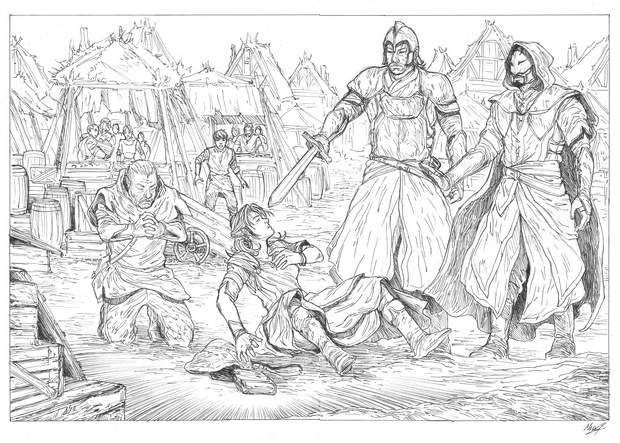
Ren encounters the Masked Man, the leader of the Kah’Nath – Concept art by Max von Vier
“I’ve been keen to get another project on the go and have been contemplating various formats,” Kate says. “Web series have become a popular medium for independent filmmakers and I find that the potential for shaping an ongoing storyline for, and with, the fans is very appealing”.
The series is named after its lead character, who lives a quiet life in a small village until dramatic events, involving an ancient powerful spirit and the ruling warrior order of the Ka’Nath, force Ren to leave her safe existence and find the truth behind the web of lies she’s believed in all her life.
“The inspiration for the show is very much rooted in great fantasy stories like The Lord of the Rings, but epic books and TV series like Game of Thrones and the more lighthearted Legend of the Seeker have also influenced me in the creation of Ren,” says Kate. She adds that one of the most important features of Born of Hope was the fan base that helped finance, design and even act in the film and that she is keen to involve the fans even more in this project. “The series is in the very early stages, with only the first season written, so we will look to the online fan community to influence what happens… and yes, even be in it!”
Whatever position you occupy on a film crew, you are always a storyteller. Everyone is working to build and enhance the narrative and emotional threads which will engage the audience.
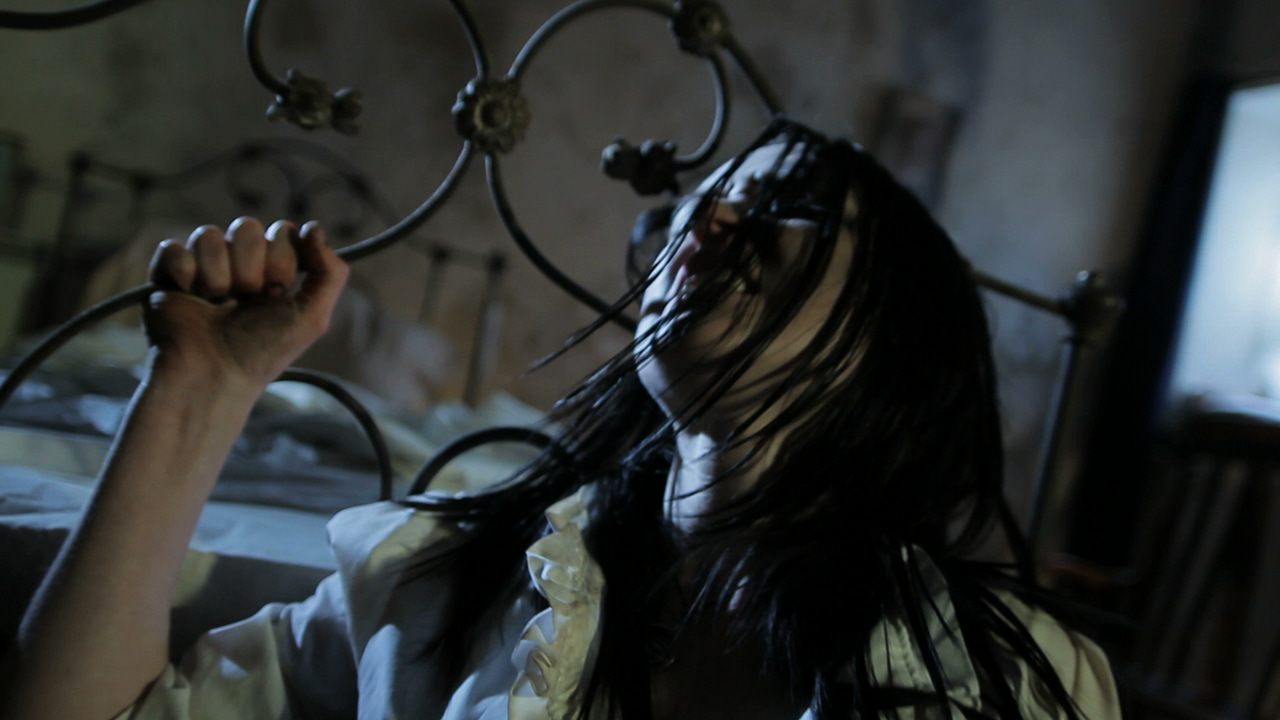
Cinematography is certainly no exception, and on the recent shoot for Dave Cave’s dark fantasy Girl and a Scar, my task was to take the lighting of an interior location on a journey which mirrored that of the titular Girl (Ileana Cardy), starting from a place of heightened realism, building to a crescendo of crazy and then finally returning to normality. It was a great visual script, describing candelight, daylight seeping in through cracks in boarded-up windows, wind and lightning, so there was plenty to get my creative juices flowing.
Copyright 2013 One For All Productions and Yellow Fever Films
Above is the wide shot from the opening scene. I’ve used a classic cool/warm colour contrast between the moonlight and the candlelight. The windows of the house were supposed to be boarded up, so the barn doors of the 650W tungsten fresnel (gelled with full CTB) off camera right are fairly narrow to create the streak of light on the back wall. A second blue-gelled 650W fresnel is behind the frosted door on the left, providing a bit of depth and suggesting another window or hole in the roof.
The candlelight is provided by an orange-gelled 300W fresnel hidden behind the corner of the fireplace to the left of screen. The difficulty with candlelight is always matching the angle the light should be coming from, and in particular hiding the shadow of the candle itself, which in reality would not exist. We solved the problem in this instance by splattering dark wax over the shadow on the top of the cabinet. A dimmer was used to flicker the 300W appropriately.
Copyright 2013 One For All Productions and Yellow Fever Films
Above is the third interior scene, and one of my favourite shots in the film. To kick up the stylisation a notch I’ve used flags to make the streak of light on the back wall a little harder-edged.
This shot is a good example of how effective side lighting can be. There are no light sources on the camera side of the subject at all; it’s all coming on from the side and slightly behind, leaving the camera side of her in darkness. We call this dark side of a subject the “down side”, and it’s always more interesting to have this side be the one facing camera.
Copyright 2013 One For All Productions and Yellow Fever Films
Above is the scene which represents the height of weirdness in the story. There are two things I’ve done to make the lighting more stylised. Firstly I’ve introduced some green light, motivated by an off-screen doorway. This combines with the make-up and a fantastic performance from the actress to enhance the character’s sickness. Secondly I’ve adjusted the blue-gelled 650W fresnel that was behind the frosted door in the first scene. It’s no longer bouncing off the wall in that back room – instead it’s pointed directly at the talent with the door now open. This creates a strong, steely backlight. Combined with a dutched handheld camera, the overall effect is suitably unsettling.
Copyright 2013 One For All Productions and Yellow Fever Films
The scene ends with the curtains of the room’s main window opening to bathe the Girl in light as she comes out of the other side of her dark journey. To enhance the natural light that would come in when the curtains were opened, I bounced a fresnel off the ceiling and ran it through a dimmer board so it could be faded up as the curtains parted. Another 650W was placed outside the window, positioned exactly behind the talent’s head to give her a halo of light and create lens flares when she moved her head to reveal the light. (The lamp itself can’t be made out on camera because it’s so bright.)
So that’s an example of how cinematography can serve narrative and character. How have you used light to tell the story?
Colin Smith lines up the Super-8 camera as director Sophie Black pans the mirror.
After an unseemly delay, here’s the third and final part of my series about lighting Ashes, Sophie Black‘s dark fantasy drama. Read part one here and part two here.
For the fantasy world dubbed “Toybox” by the production team, Sophie wanted a gritty, grainy, comfortable look. She was keen to shoot the scene on Super-8 and wanted to make full use of that high contrast celluloid look with harsh spotlighting, deep shadows and vignetting.
The biggest problem for me was how to get a spotlight effect in a fairly small room with an ordinary daylight fresnel. To get a circle of light small enough to fit entirely within the camera’s frame required the lamp to be much further from the subject than was possible within the space. I suggested shooting at night and putting the light outside the window, but the schedule couldn’t accommodate that.
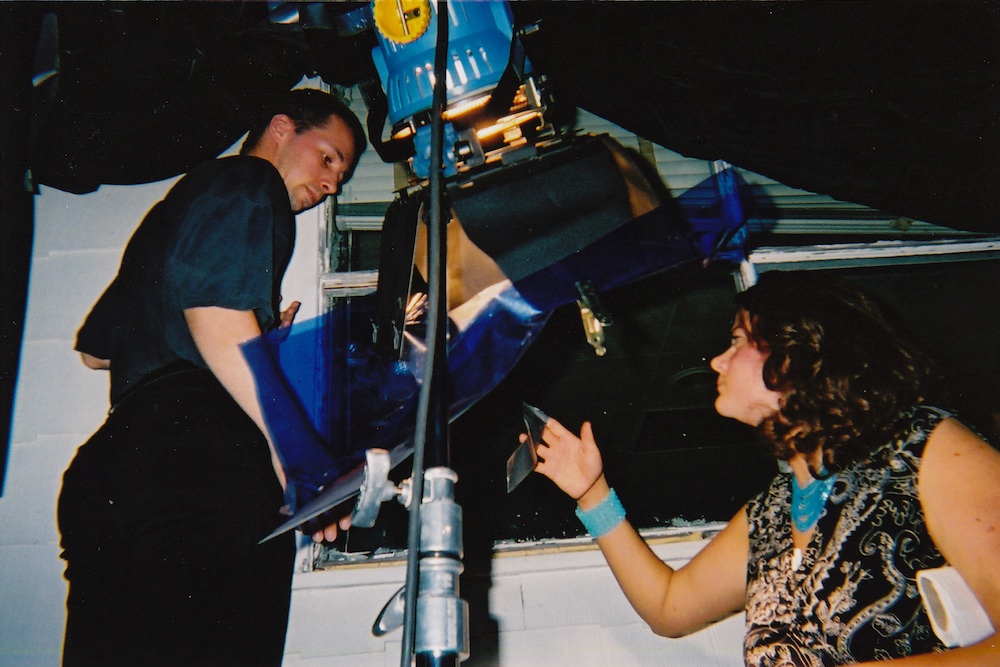
The problem was solved by bouncing the light off a circular mirror. This masked the light into a relatively sharp circle, because the lamp was the entire length of the room away from the mirror. (The closer a mask is placed to a lamp, the fuzzier the edge of the mask will appear when thrown on the subject, so simply cutting a circle out of cardboard and placing it in front of the lamp would have given us a blob of light instead of a defined circle, because there wouldn’t have been enough space to put the cardboard far enough away from the lamp.)
Bouncing a redhead off a circular mirror for the sweeping light effect. Photo: Sophie Black
Not only did the mirror allow us to achieve a key shadow puppet shot which Sophie had conceived, it also enabled us to create a sweeping light effect for other parts of the sequence. Inspired by one of Lana del Rey’s music videos, Sophie wanted the effect of headlights passing by outside a window. We were able to do this simply by panning a redhead across the mirror.
The Toybox scene was shot both on Super-8 (by Col) and on my Canon 600D as a back-up. I set the ISO to 1600 on the DSLR to bake in a grainy look. I won’t do this again, however, because I failed to take into account the effect of the camera’s H.264 compression. The grain looked fine on the viewfinder, but once compressed and recorded there were lots of blocky artifacts. I hoped that the Super-8 film would come out well so this sub-standard digital material wouldn’t have to be used, but alas there were some focus issues and several of the shots were inexplicably missing from the reels when they came back from the lab. Fortunately the day was saved by a talented VFX artist who applied a very convincing Super-8 look to the 600D footage, which hides the compression artifacts.
Ashes is nearly finished now and we’re all very excited to see how it’s turned out. Meanwhile, here’s the trailer:
In September I had the pleasure of working once again with Lara Greenway – star of Soul Searcher, director of Hostile and The Runner, and producer of Hard Boiled Sweets and Danny Dyer vehicle Deviation. This time she was directing a pilot for a comedy web series called How to be Dead, written by Dave Turner. It was released online for Halloween and here it is:
The pub scene is my favourite thing I’ve lit in a long time, so I thought I’d break down what went into it.
The aim was to separate the lead actors from the background as much as possible. This was accomplished through depth of field (shooting at around f2.0), colour contrast (lighting them warmly and the background coolly), backlight and smoke.
Working from the foreground of the shot backwards, we have a crossed pair of Dedos behind camera, each with a half orange gel and each spotted on one of the leads. Hanging from a pair of connected C-stand arms straddling two of the pub’s wooden roof beams is an 800W Arrilite giving the leads a white backlight.
There’s a fireplace off camera to the left (in the master shot). To give the impression of it being lit, I put a reflector in it – gold side facing out – and aimed a 1K Arrilite at this reflector. My trusty gaffer Col wobbles the reflector during takes to create a flickering effect which is visible on some of the closer extras in the left of the frame.
A third Dedo, positioned near the fireplace, is trained on the skeleton hanging in the background.
Outside in the tiny beer garden is a 2.5K HMI that’s blasting through the patio doors. A blue-gelled 1K Arrilite, indoors but in the far background, adds further “moonlight”. Between them these two lamps are illuminating the copious amounts of smoke we pumped in, giving the whole scene a wonderful volume and depth.
Finally, in the far background on the left, there’s a fourth Dedo hidden in the entrance to the ladies’ loo, throwing a little pool of light on a painting on the wall. I also turned on the pub’s existing sconces to create extra contrast.
Last week I looked at some watery lighting created for one of the fantasy scenes in Sophie’s short, Ashes. Today let’s look at another of the film’s fantasy scenes and another element: fire.
Sarah Lamesch and Adam Lannon in the “Hollywood” scene
There are about half a dozen 100W bulbs hidden on the floor behind the bed, and another half dozen on a boom arm out the top of frame, again behind the actors. There are no other light sources but the candles themselves. To give a little bit of movement to the light, my righthand man Col is wobbling a reflector just off camera. More movement would have been nice – some dimmers perhaps, or someone lying behind the bed wiggling the bulbs a bit – but given that it was a closed set I felt it was better to keep things simple.
Col tapes the tights to a filter tray
I was so focused on the lighting of this scene that it was only the day before the shoot that I realised the key to the forties look was going to be diffusion. By this point it was too late to add any Promist filters to our package, so I consulted Shane’s blogs on diffusion for other methods of softening the image. AD Chris was subsequently dispatched to buy some tights.
In an ideal world you get hold of some very fine silk stockings and tape a piece to the back of your lens. We were stuck with bog-standard 15 denier, and the design of the EF-S lens mount makes it impossible to put anything over the rear element, so it had to go on the front. Col stretched the piece of fabric across one of my Pro-aim shoulder rig’s 4×4″ filter trays. Putting the tights on the front rather than the back makes the effect much less subtle, but fortunately Sophie really liked it. You can see it in action on the still above, but I’ll leave you with a side-by-side comparison from a quick test we did on lead actress Sarah Lamesch:
Sarah Lamesch with (right) and without (left) the stocking filter
Earlier this week I DPed Sophie Black’s short film, Ashes. The script contained three fantasy scenes which were really fun to light because they didn’t have to be in any way realistic. All the scenes took place in the same bedroom, so here was a great opportunity to light the same space in three completely different and pretty whacky ways (plus in a more down-to-earth way for the “real world” scenes).
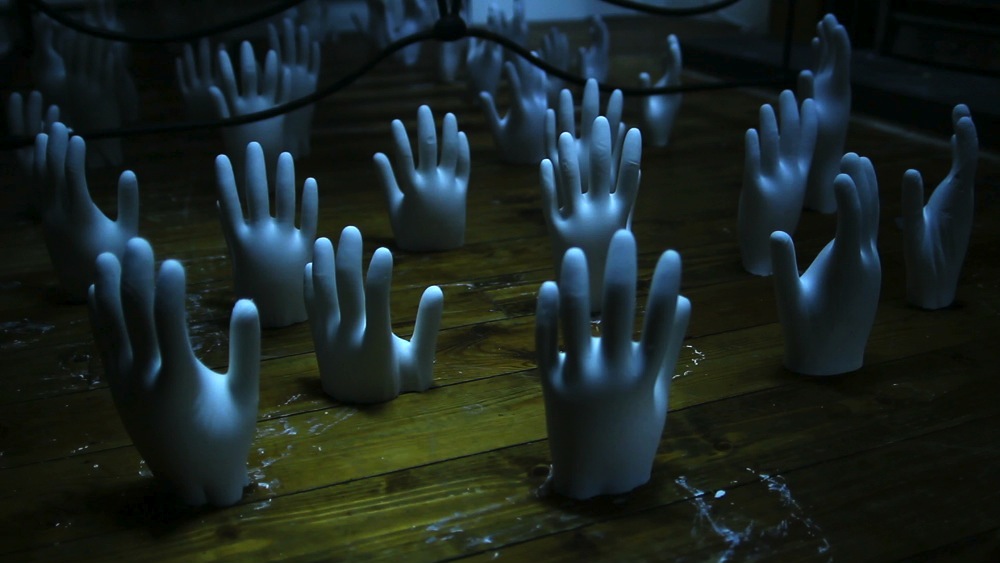
In lighting the fantasy scenes I drew inspiration from techniques covered in some of the blogs I listed in my top five last week. Sophie’s vision for one fantasy scene was of the lead character, played by Sarah Lamesch, on a bed adrift on a sea of hands. The hands were moulded in plaster and spread all over the floor, and it was my job to create the impression of water through lighting. So I turned to The Underwater Realm’s website, recalling a video blog they posted last year when their DP Eve Hazelton began testing lighting techniques for dry-for-wet photography (around six minutes in).
The silver wrapping paper on the ceiling
Big thanks to Realm Pictures for posting this blog. Although Eve ultimately rejected the technique in favour of something more realistic, it was perfect for Ashes. I had Sophie buy several rolls of silver wrapping paper, which we pinned loosely to the ceiling. I placed a 1.2K Arri Daylight Compact on the floor in the corner, pointed up at the paper. As we rolled, Sophie aimed a desk fan at the paper to create rippling, watery reflections.
I knew I wanted to do something special with Sarah’s incredibly striking eyes in this scene, to complement the make-up. I started off by having Colin rig a DIY lamp above her, surrounded by black wrap and card with only a slit of light coming through to highlight her eyes. Unfortunately I discovered that the light from DIY lamps just isn’t focused enough for this kind of effect, so I abandoned it.
Instead I created Sarah’s eye-light using a string of white Christmas lights taped to a piece of black card. This was inspired by Galadriel’s eye-light in The Lord of the Rings – a reference Sophie gave me. As it turns out, I think the starry reflections you see in Sarah’s eyes here are more from the silver paper than the fairy lights.
Sarah Lamesch as Sarah
This scene was also interesting from a grip point of view. We’d borrowed a jib, which we mounted on my dolly so that we could boom up from the hands on the floor, over the footboard and track to Sarah’s face. This was a real team effort. Colin handled the dolly and jib movement, while first assistant director Chris Newman operated the camera to begin with. As soon as the camera had cleared the footboard I jumped up onto the bed and took over from Chris for the rest of the shot.
In my next couple of posts I’ll look at the other fantasy scenes and we’ll see how Shane Hurlbut’s blog and a Lana Del Rey video inspired the cinematography in those.
Some of the crew, plus our makeshift dolly and our transport
Exactly a decade ago today, I flew out to New York to serve as director of photography on Tom Muschamp’s microbudget thriller Beyond Recognition. It’s the story of Geoffrey Mills, the world’s best plastic surgeon, who gets ensnared in dangerous machinations when he refuses the mafia’s request to alter their don’s face.
To this day it remains my favourite of all the shoots I’ve been on. I was 22, I’d made The Beacon (an experience which largely led to me getting the job, I think) but I’d never DPed a feature for another director, and I’d never been to the States before.
Director Tom Muschamp in The Star Building
Tom, a Brit, had met an American producer who offered to source all the locations in upstate New York and host the cast and crew at her mother’s house, which was massive in a way that only American houses can be. There is something quite post-modern about the fact that, although I was there to make a film, I was seeing and experiencing things which had hitherto been confined to films for me, like screen doors, root beer and morbid obesity.
My bed for three weeks
The gaffer, the first assistant director and the runner (Tom’s cousin Ed Reed, who later production-managed Soul Searcher) travelled from the UK with Tom and I, but the cast and the rest of the crew were American. For the most part the atmosphere was fantastic. We were all young and enthusiastic and bonding over the trials of shooting an ambitious script with minimal resources in roasting temperatures – in fact “Hot in Here” by Nelly became the anthem of the shoot. Michelle Branch’s “Everywhere” and Avril Lavigne’s “Complicated” also have strong associations with Beyond Recognition for me, as one or other of those songs seemed to be playing on the radio every time we piled into our hired minibus to go to the next location.
Part of The Star Building becomes a plastic surgeon’s reception
I’d sent a wish-list of lighting equipment to the production team ahead of time, including several large HMIs and a whole bunch of other kit. When I arrived in New York they said, “Er… well, we’ve got the gels you asked for…” A quick trip to Home Depot was called for. I think that was my first experience of lighting with halogen work-lights, otherwise known as DIY lights. Later Tom splashed out on a set of four Arrilites, which he kindly let me keep at the end of production, and most of which I still have and use to this day.
Many scenes were shot in what became known as The Star Building – a small, disused factory in the grounds of the house we were staying in. It was full of junk, which we were constantly shifting around to enable us to film in different corners. The toilets didn’t work properly, and I distinctly remember an incident in which the first AD disappeared for a bowel movement, and shortly afterwards some suspiciously brown water started dripping from the ceiling.
Blacking out a window
There was a lot of night shooting, which was great experience for me and helped me develop the Cameron-esque blue look that would define Soul Searcher. When it came to interiors, my memory is that daytime scenes were typically shot at night and vice versa, though God knows why. We were forever blacking out windows or setting up artificial suns.
The lead actor
One key thing I learnt from Beyond Recognition is the importance of having your cast and crew sign contracts before you start shooting. The lead actor was very unreliable, but made all kinds of demands once the film was in the can and Tom needed his signature on the dotted line. The lead actress was a bit ditzy as I recall, repeatedly plugging in her hair-drier at a hotel location and blowing the fuse every time because of all the lights we were running. And then there was the actor who, when we needed a bug detector as a prop, said “I’ll bring mine,” and was sent to prison a few years later when he was caught defrauding hundreds of thousands of dollars from a hide-out in the basement of the World Trade Centre. And you think I’m kidding.
Crew-wise, we seemed to splinter into two factions towards the end of the three week shoot – those who were happy to do whatever it took to get the movie made, and those who just wanted to moan and slack off (I will never understand why these people sign up to unpaid shoots in the first place). The hours were very long and there wasn’t a single day off in those three weeks, but I’m afraid that’s what micro-budget filmmaking is like. I loved it.
Like many Brits returning from the US (especially New York) for the first time, I was quite depressed afterwards and for a few months could think of little other than wanting to return to New York and how much cooler everything is over there.
But principal photography on Beyond Recognition was not over when the New York stuff wrapped. Part of the film is set in Italy, and Tom had lined up locations in the picturesque Fai della Paganella in the Dolomites. So on September 29th I was back on a plane, this time to Verona. The crew line-up had changed a bit; strangely the members of the second faction mentioned above were not invited back, and a couple more Brits joined us including Simon Ball and Max Van de Banks, both of whom I’d worked with before and who would go on to work on Soul Searcher. Ed Reed, meanwhile, had been promoted to first AD.
The Italian leg of the shoot ran smoother than the US leg, as far as I remember, although we were not popular in the town by the end of the shoot. This was mainly due to the unruly actors, who tended to help themselves to alcohol from the hotel bar (leaving money for it, I should add) and generally act like they owned the place.
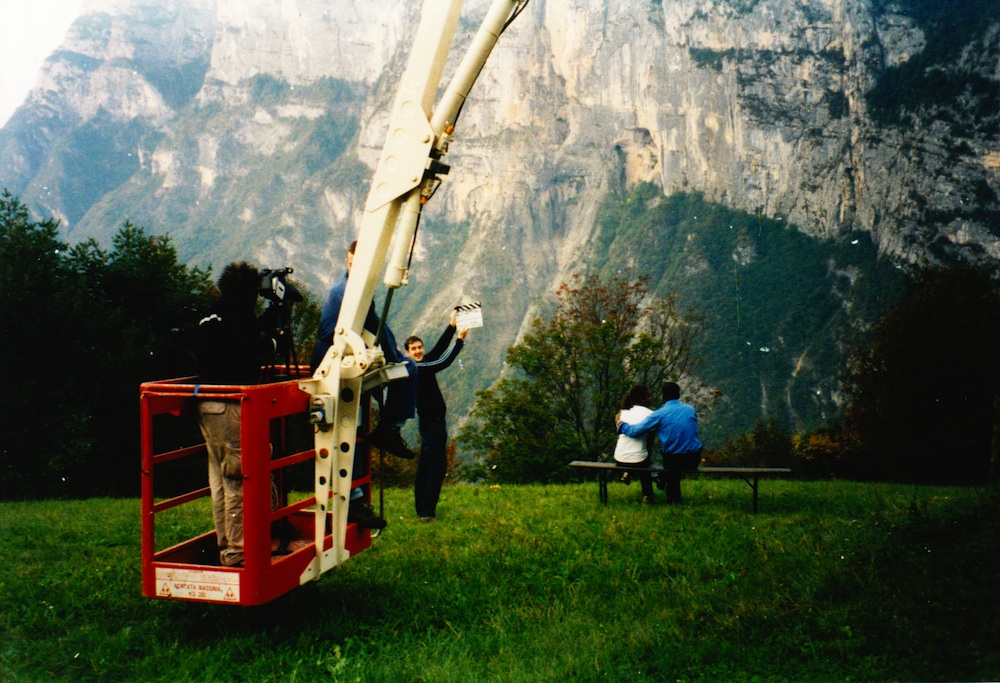
I finally got my HMIs in Fai. Tom hired two 4Ks from Arri in Milan, which I used to light the town square. I also got to film a craning shot up in the mountains from a cherry-picker.
All in all, the project was an amazing experience for me, and left me with a burning desire to work far more regularly as a DP on indie films, an ambition I sadly still haven’t succeeded in. But besides helping shape Soul Searcher, both in terms of its look and Tom’s distribution experiences which I drew on when selling my film, it did lead to other work and in 2007 to my DPing Tom’s second feature, See Saw, on which I met my wife Katie.
Beyond Recognition was released on DVD in the US and other territories, but is only available in the UK as an import. I’ll leave you with the trailer.
P.S. You can read my original blog entries from the 2002 Beyond Recognition shoot here, here, here and here.
A few posts back I wrote about See Saw, the thriller directed by Tom Muschamp which I DPed in the summer of 2007. Today I’m going to share some of the tribulations experienced in the making of this sequence:
The sequence was filmed in the Hamptons, a popular holiday destination at the east end of Long Island, near New York City. The boat was filmed in a harbour, with the camera and an HMI lamp on the dock. I wish we could have put either the camera or the HMI in another boat, because it’s never a good idea to have your camera and your only light source close together; you end up with flat lighting that looks like flash from a stills camera. Unfortunately we didn’t have much choice. Putting the HMI on a boat was too dangerous, and putting the camera on a boat would have rendered the footage too shaky for successful compositing with the other element of the sequence: Katherine.
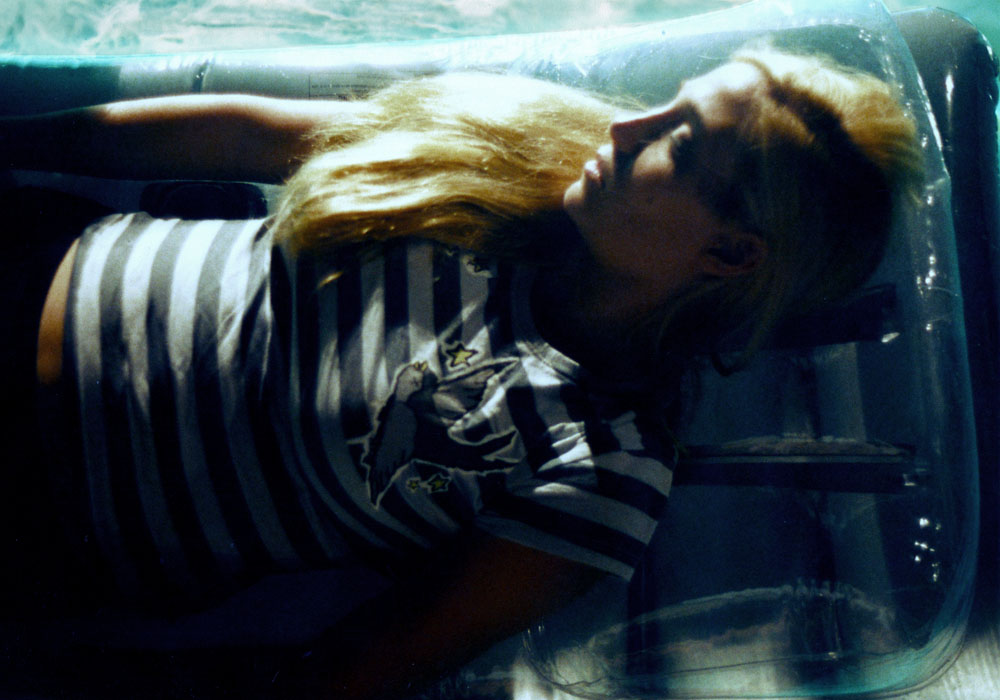
Aimee Denaro as Katherine
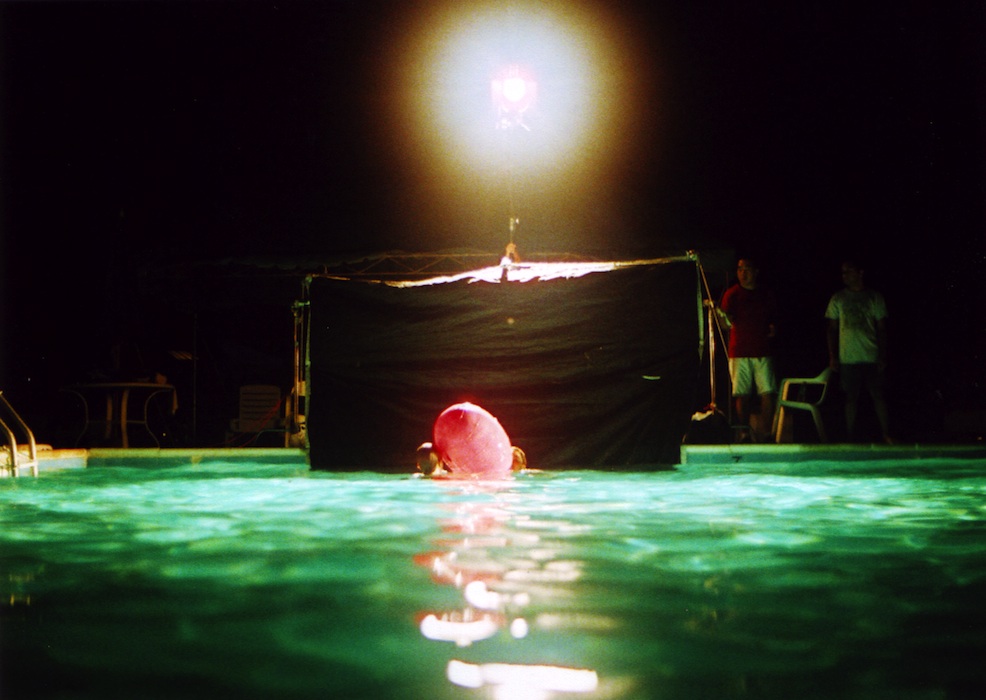
Katherine, played by producer Aimee Denaro, was filmed in an outdoor swimming pool – again, of course, at night. We had been able to get hold of a single black drape, which we rigged half in and half out of the water, to hide the stand for the backlight and to cover the blue-painted pool interior. We originally planned to frame all our shots tightly enough that this drape would fill the entire background, but we ended up shooting off it quite a lot. Fortunately the surroundings were dark enough that we got away with it.
Aside from the backlight there was one other lamp – a key light coming in from the side. Both were 800W tungsten pars if memory serves. As I often do on night sequences, I white-balanced on a red-gelled lamp, fooling the camera into turning everything blue for that classic James Cameron/Michael Mann look.
Director Tom Muschamp
After shooting all the set-ups from the poolside, it was time to dive in – quite literally – and shoot the underwater material. That’s when the fun began.
We had spent the last couple of weeks trying to find an underwater housing we could hire, but nowhere had one that would fit our camera (a JVC GY-HD110). In the end we had to settle for a splash bag designed for ENG (i.e. proper broadcast) cameras. A splash bag is simply a rubber bag with a waterproof zip and a porthole of optical glass at one end. They’re not designed to be used at any depth, but will keep the water out down to a metre or two. So far, so good – this restriction fitted in with Tom’s shot requirements just fine.
But because our camera was too small, we could not screw the filter thread into the porthole inside the bag. This meant there was no way of keeping the camera in a fixed position within the bag. This was, not to beat about the bush, annoying. Oh, and did I mention that the battery adapter on the camera had a loose connection which caused the camera to shut itself off sometimes?
The black drape and backlight set-up
Anyone who knows me knows that I am very quiet. I doubt most of the cast and crew were accustomed to hearing me say much of anything. They were certainly all pretty shocked when, within a few minutes of starting to work with the splash bag, I was cursing and swearing like a trooper. The difficulties of trying to swim, keep the bag underwater (it had plenty of empty space in it so it wanted to float), keep the camera lens lined up with the porthole, prevent the focus ring from rubbing against the inside of the bag and throwing the image out of focus, all at the same time, almost drove me insane. Add to that the battery coming loose from time to time and you can see how I might have been a tad frustrated.
But after a while I learnt to contort my body and the bag into a stable configuration and we got some great shots. By the time we wrapped, thanks to the pool’s automatic overnight chlorination system, we all had red, stinging eyes and Aimee’s top had been completely bleached.
The next time I shot underwater – which I may blog about in the future – rather than trying to hire a housing to fit our camera, we hired a housing that came with its own camera. In hindsight I wish we’d done this on See Saw. If you’re going to try it yourself, I’d recommend getting hold of some diving weights because you’re always fighting the natural buoyancy of the housing. Remember that tiled walls and painted lane divisions are dead giveaways that you shot in a swimming pool; don’t rely on the distorting effect of water to hide these – it doesn’t work that way. Bring drapes or tarpaulins to fill your background.
Okay, that’s all for now folks, but if you enjoy reading this blog then please consider contributing a little cash towards my new short film Stop/Eject.
Katherine clings onto the "boowee" as our American friends like to say
Aimee Denaro in the stairwell of The Supreme Court of New York
Today I saw “See Saw” again. This is the feature-length thriller I DPed in Manhattan back in 2007, where I met my wife Katie. Amazingly the film is still in post-production after more than four years – enough time for Katie and I to get married and for director Tom Muschamp and producer/actress Aimee Denaro to sadly get divorced. We saw a rough cut a couple of years ago and recently Tom sent me a newer version with some significant changes.
One of my favourite things about the filmmaking process is the power you can wield over the narrative in post-production. Think outside the box a little, perhaps add a little ADR, and you can completely repurpose a scene or change the entire meaning of a film. The changes to See Saw haven’t been quite that extreme, but Tom has still taken the pretty major step of cutting the entire first act. Carl was forever telling me trim down the first act of The Dark Side of the Earth‘s script, and I’m sure it’s a battle many writers and filmmakers face: to set up the world and the characters with the utmost economy in order to get to that end-of-act-one plot point as fast as possible. So why not cut the first act all together?
See Saw actually seemed to get away with it for the most part. The lead character has amnesia, so the lack of set-up enables the viewer to share in her disorientation. There are one or two little bits of plot that probably do need to be re-inserted in order to give the climax its fullest impact, but overall I think this brave decision has worked for this particular film.
Watching it again brought back lots of memories of the shoot, a crazy three weeks in the punishing heat of a Manhattan August, with only two days off. Tom and Aimee secured some amazing locations, including a boat circling Liberty Island, Tavern on the Green (the exclusive restaurant used in the Ghostbusters scene where the terror dog finally catches up with Louis), Central Park and The Supreme Court of New York. I still can’t believe how lax security was at the latter. Seeing the crew approaching with large cases and assorted metal poles and stands, the security guard simply moved aside a barrier and directed us around the metal detector. The actors even managed to smuggle in their prop guns with great ease.
But my main reaction on seeing See Saw again is to cringe at my lighting. Back then I was all about hard-lighting everything with clearly-defined and very black shadows. While this looks great in the nighttime scenes, nowadays I would be much more subtle in the daylight scenes, using kinos and hard sources bounced off reflectors to give a more naturalistic look. This is the problem with feature films, no matter in what position you work on them: they take so long to make that by the time they’re finished they no longer represent your best work.
Well, that’s enough disjointed rambling for now. I’ll be sure to let you know when See Saw’s finally released.