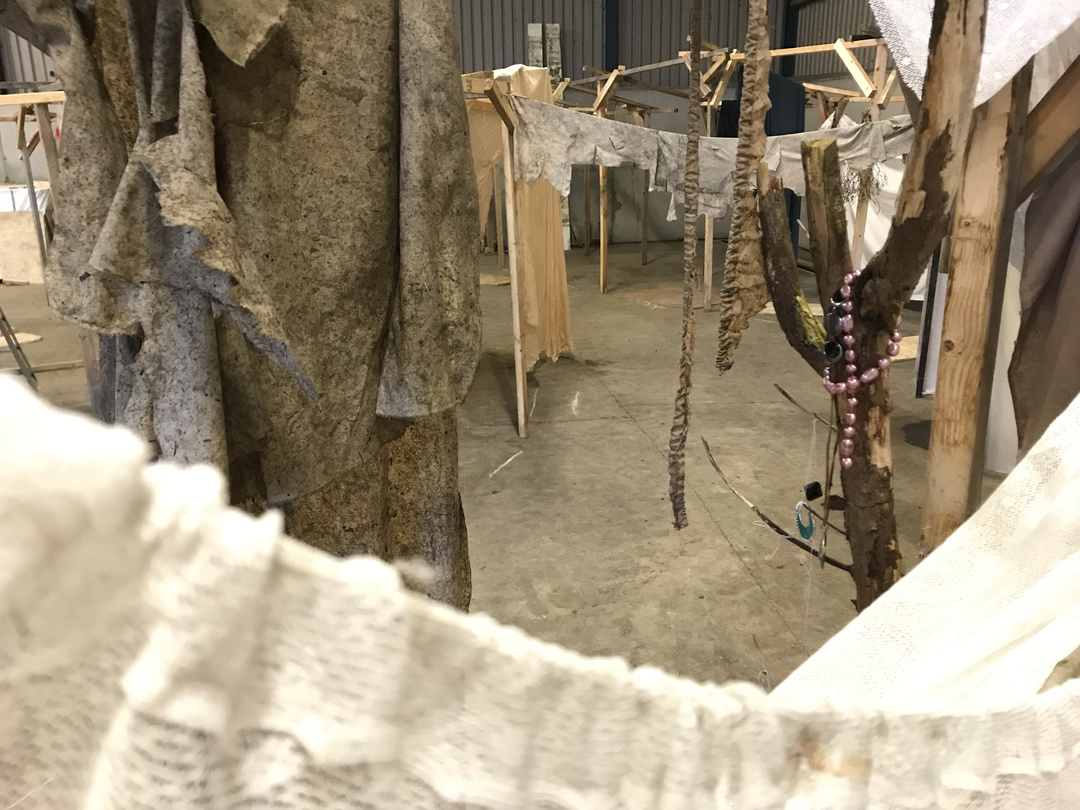
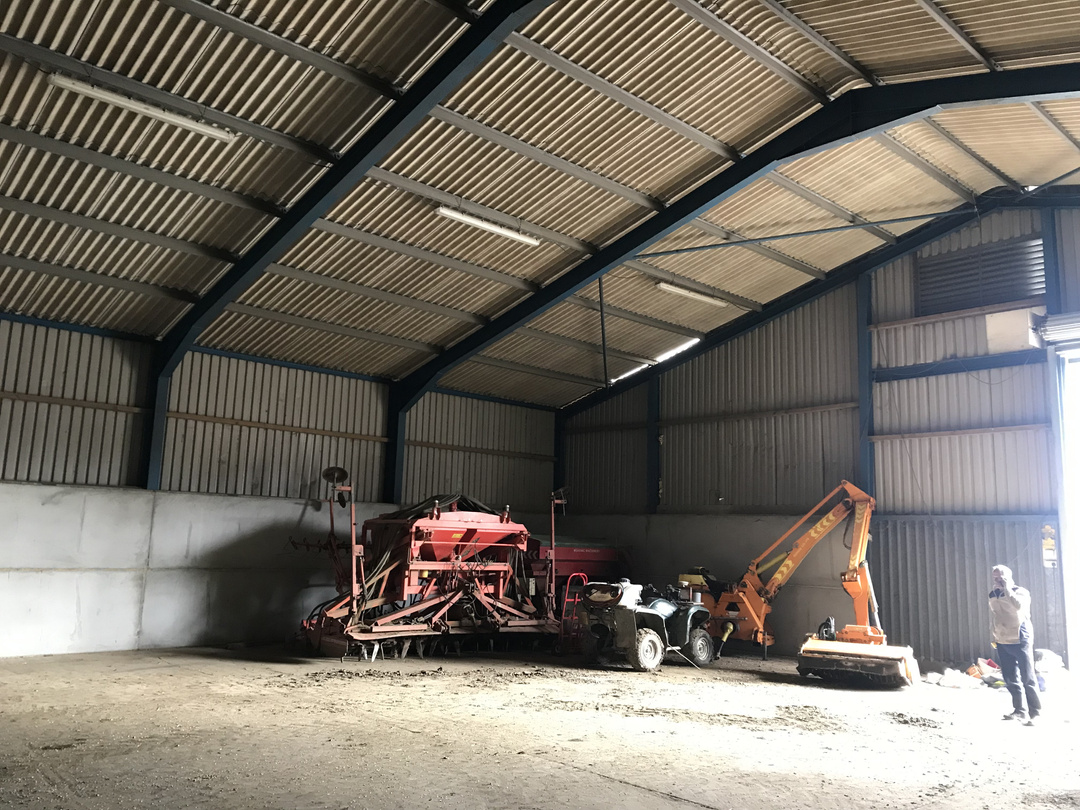
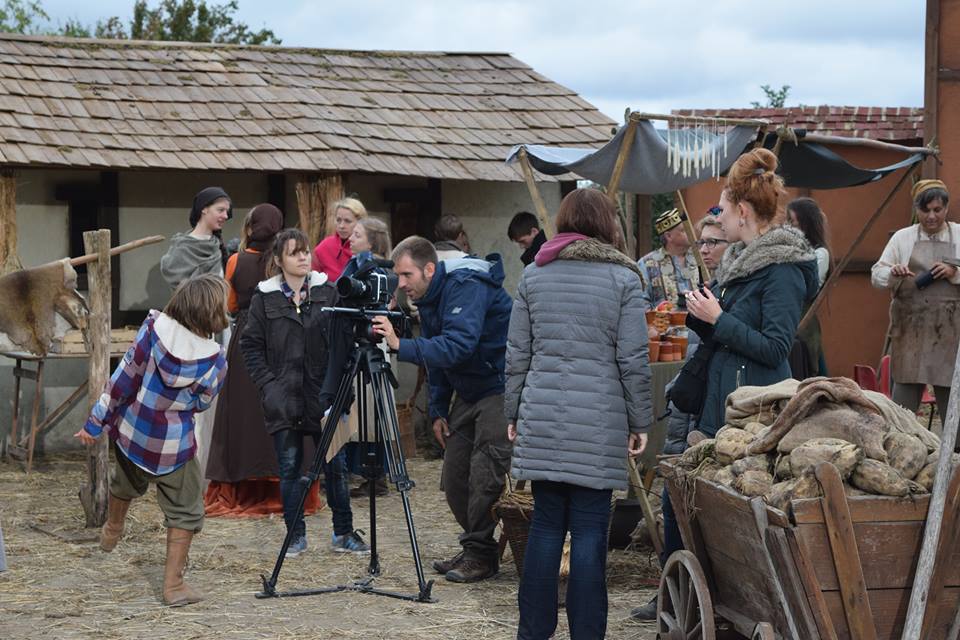
A couple of weeks ago there was nothing in Ren Studio 2.0 but a few piles of a scrap wood and a couple of tables. Now there’s a market!
A few of the stalwarts like Rose, Ross and Michael had done days here and there getting things started in the second half of March. The farmer who owns the studio space very kindly gave us a lot of unwanted wood that he had around the yard, including some skate ramps which we disassembled and Ross used to make all the framework of the market stalls. Michael focused on building the bar for the tavern, which is finished now apart from the top surface.
Several volunteers came along to our first Making Weekend on April 1st and 2nd, and they quickly got stuck in making props and other set-pieces. Dale and Sanjay smashed out a set of ‘stone’ steps and tavern window shutters. The beginnings of a carriage have popped up on one side of the studio thanks to Sean, while a variety of fake foods, melted candles and other mysterious items have started to populate the other side thanks to Ash, Sarah, Kim, Carole, Gary, Rebecca and Jack.
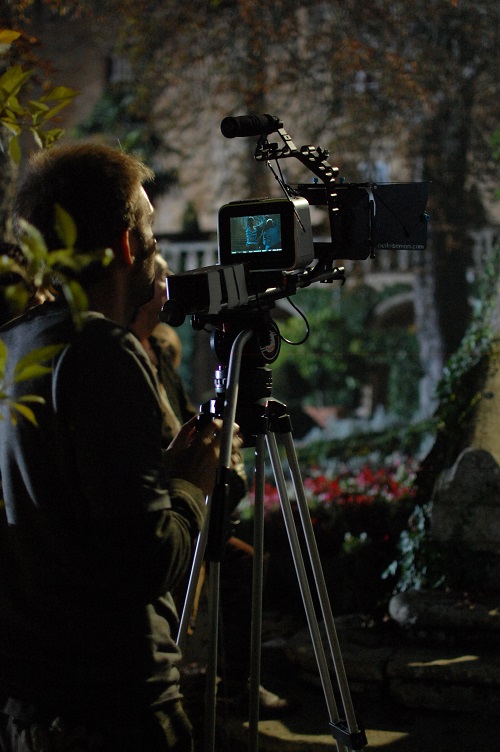
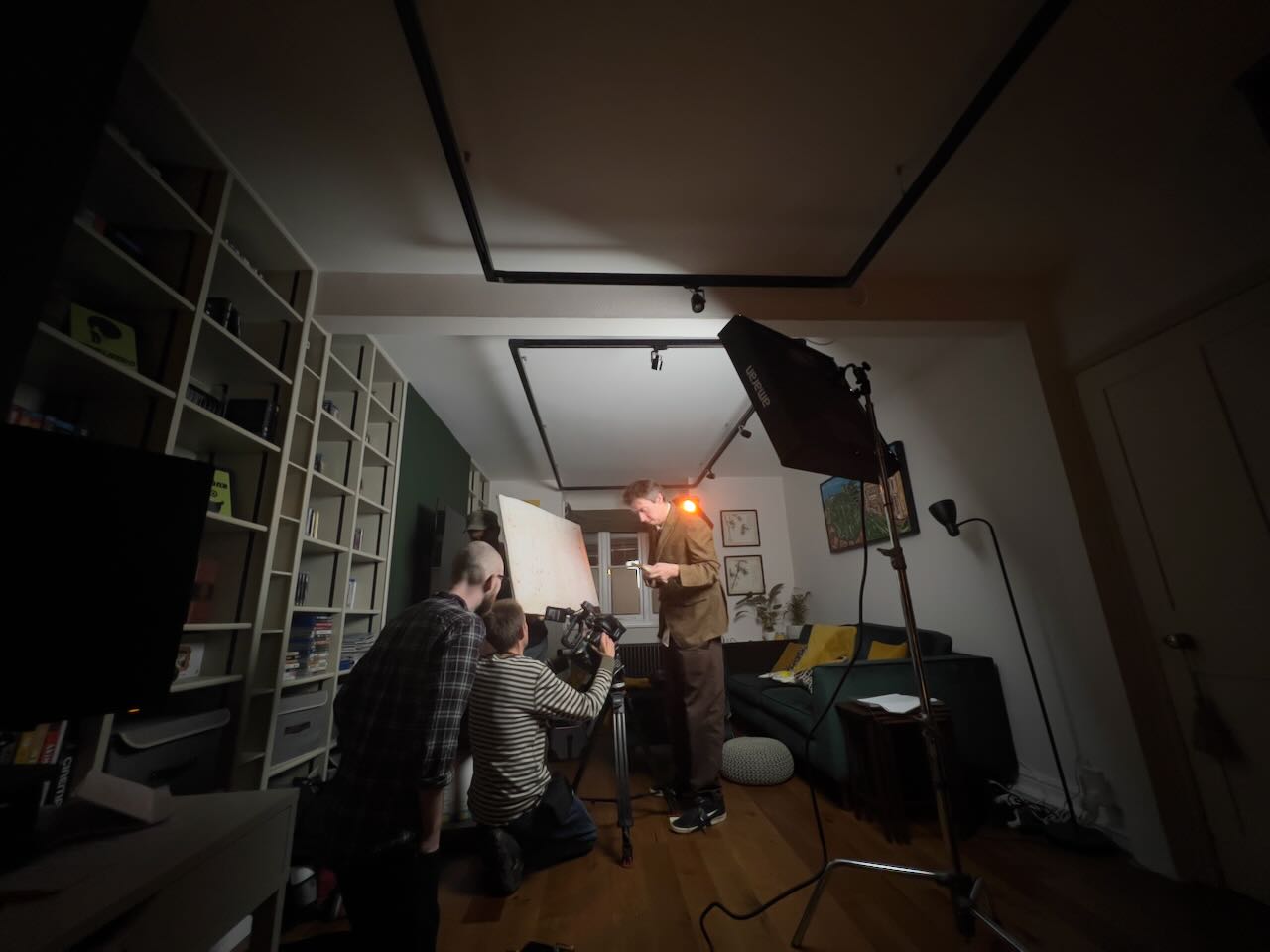
Jonnie Howard, who you may have seen on social media was recently announced as the director of episode 203, paid his first visit to the studio. We discussed the tavern set as well as picking outdoor spots for his exterior scenes and even testing a drone shot with the help of our BTS filmmaker Christopher Buckenham. Gaffer Jeremy Dawson dropped in too, to start making a plan with me for lighting the emerging sets.
Meanwhile Suzanne and her team have been busy in London making toiles – ‘draft’ costumes using cheap fabric – and fitting them to some of our new characters. Our new Ren and Hunter have had their first fittings too, and Hunter has taken part in a fight choreography session of episode 204 with Sophie Black. And I’ve been holding lots of Zoom interviews with potential crew, as well as sorting out mundane but important things like insurance.
Today marks five weeks until we start shooting Ren Season Two!
The big news is that, after four or five days of auditioning in London, plus several Zoom sessions, we have cast many of our supporting characters – and most importantly our new Ren! We’ve yet to decide when and how to announce this, so you’ll have to wait a little while to find out who is the new Girl with the Mark.
Gradually we’ve been moving all the props Kate acquired during Born of Hope and Ren Season One to the studio, as well as gathering the wood needed to make the sets. At the start of April we plan to hold our first Making Weekend – details soon! – and begin construction in earnest.
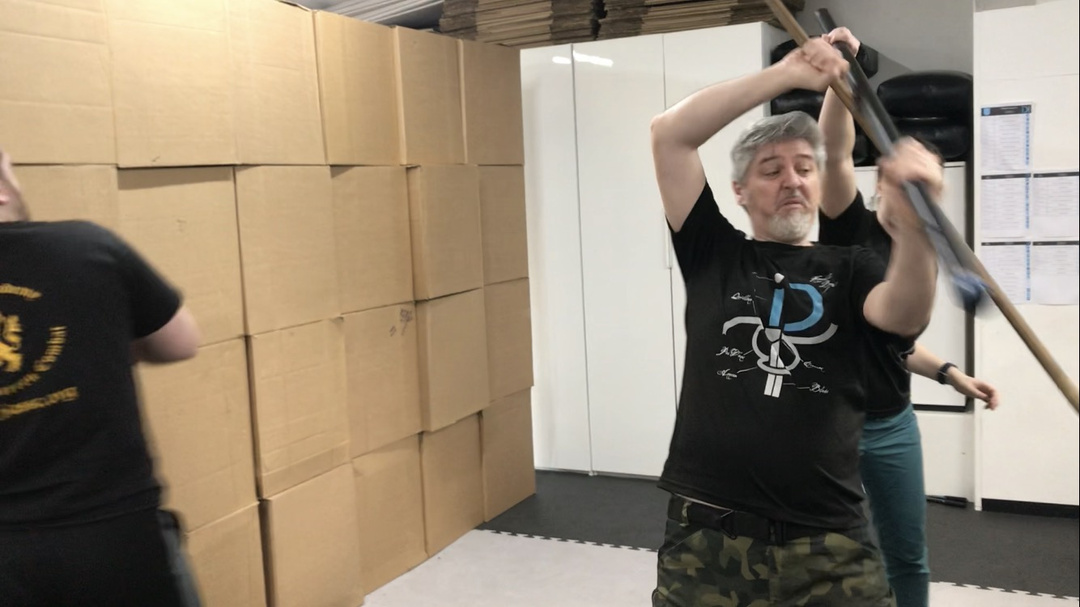
Yesterday we had the first fight choreography session for the season, planning the start of the big ambush scene in episode 203. Ronin Traynor of IDFight gathered a team of fight performers who kindly gave their afternoon to help us visualise the fight in a set made of cardboard boxes (pictured above). We even managed to squeeze in a couple of extra auditions while we were there.
Producing a series like this involves quite a range of tasks. Just to give you an example of what I’ve been up to this morning:
– Connecting actors with our fight choreographer, Ronin Traynor, to arrange training sessions
– Confirming the use of Norton Armoury’s pieces again for the Kah’Nath soldier costumes
– Discussing who is going to make soft foam versions of that armour
– Arranging a van to transport props to our distant locations
– Advertising for crew
– Speaking to a potential editor for the series
– Checking the shooting schedule with some of the cast
– Compiling notes from the directors to send to our make-up artist, Becca Youngs
And this afternoon Kate and I are going to start storyboarding the horse chase using action figures!
Those of you who followed or were actually involved in the making of Season One will remember Ren Studio, the factory in Caxton, Cambridgeshire which we took over for five months. It was our set, prop and costume workshop, our production offices, and ultimately where we filmed most of that first season. It also became like a giant student house as a lot of us lived there for several weeks!
Season Two is a slightly different beast because there’s much more location filming, but we still need a warehouse space to build two of our keys sets in. I have been searching for somewhere since late November, and this week I finally found it: a grain store on a farm near St. Ives, Cambridgeshire. Like the Caxton studio was at first, it’s not much to look at now, but over the next couple of months it will gradually fill with props, costumes and sets, and more importantly all the amazing people who will give their time, elbow grease and love to will Ren: The Girl with the Mark back into existence. And you could be one of those people! You’ll be the first to know when we open up the studio to everyone to come along and volunteer.
Plenty of other things are happening as well. The main one is casting. We’ve already held one round of auditions for our new Ren, and other roles will follow shortly. Huge thanks to everyone who has applied, produced a self-tape or come along to a physical audition. Sadly we can’t cast everyone, but we massively appreciate the time and effort you put in.
The other week we moved all the costumes from Season One and Kate’s earlier production Born of Hope to a double garage where designer Suzanne Emerson is sorting through them and coming up with looks for the new characters. We are so lucky to have this amazing stock as the basis for the new season, along with the new costumes that Suzanne and her team will create.
Meetings and conversations in recent days have covered such diverse topics as how to deaden the reverb in the studio for good sound, how many walls a tavern needs to have, and how do you make a dead deer (apart from the obvious way)?
We’re also still hunting for some of our locations, and we’re pleased to have found a lovely old stone bridge in South Wales that will be a huge part of Episode 203, as well as some very cool hilltop ruins not far away from it.
Currently we are on course to start shooting in late April. Stay tuned to follow our progress!
There’s so much going on at the moment, I hardly know where to start!
We now have a production designer – Rose Collis – and a costume designer -Suzanne Emerson – who actually played Ida in Season One, the woman who won’t buy Ren’s mushrooms! They have both been busy absorbing the huge amount of information on lore and backstory and connecting with the four directors as well as the people who have already started making bits and pieces. Some fantastic ideas have already come out of this process which I can’t wait for you to see.
Last week Chris Dane and I travelled down to Gosport, near Portsmouth, to reccie Little Woodham, a 17th century village and living history museum. This will be representing the Illin Crossroads, a place where Ren and Hunter stop off on their journey. Last season Chris had to build the village himself, so I think he was probably relieved to have one already made this time! The committee members who showed us around were very helpful and friendly, and we look forward to returning there to film in due course. Look out for a video about that trip in the near future.
Chris has also been busy creating a map of Alathia, which will be unveiled here on Patreon soon. Meanwhile I’ve been on some more reccies to look at a couple of local farming and transport museums to see if they have any indoor or outdoor spaces that might work for the scenes in the season.
Mike Rudin has been drying, repairing and reinforcing the Born of Hope cart ready for its new life as the Kah’Nath prisoner wagon. We convened the team to have a look at it so far and discuss how the prisoners will be chained and how they will get in and out.
Hans Goosen is developing a unique system of census records for Ren’s world, using beads and knotted strings since writing is banned. He explained it to me and Rose yesterday and we both boggled at how much effort he has put in to make sure that it would actually function and store the required information! It’s an amazing bit of world building.
Ash Finn is working on a variety of props including some recreations of documents from Karn’s house – oh, a tiny spoiler there perhaps!
At the weekend Becca Youngs, head makeup artist from Season One, and her friend Michelle popped over to Cambridge to experiment with stencils which will allow Ren’s mark to be applied much faster and more consistently than last time. They eventually decided on a sponge application and an acetate stencil, but not before punching some holes in one of my old silicone rubber baking sheets to see if that worked any better!
The team will continue to expand as we begin casting – there’s still time to apply at https://tinyurl.com/rencast if you think you could be the next Ren or Hunter! – and crewing too.
The reason it’s been so quiet on the blog here is that I’ve insanely taken on producing a no-budget fantasy-adventure web series, Ren: The Girl with the Mark. Readers with long memories may recall I was the DP on the first season way back in 2014, and got involved with post throughout 2015 and into 2016 when it was released. Well, now I’m the showrunner!
I’ve launched a Patreon page to fund the series as an ongoing concern, and you’ll need to subscribe to read it regularly, but here are the first two entries to whet your appetite. Please consider joining our Patreon community to get exclusive behind-the-scenes access, fiction from the world of Ren and much more.
The STory So Far
Let me start by bringing you up to date with where we are now.
Season One of Ren: The Girl with the Mark was released in March 2016, created and written by Kate Madison and Christopher Dane, and directed by Kate. (I joined as the director of photography and ended up as part of the core team who shepherded the show through post-production.) The series went on to win 14 international awards from over 40 nominations, and today has about 14 million aggregate episode views on YouTube – an amazing response!
For one reason and another it wasn’t until 2019 that we started gearing up for Season Two. Kate and I wrote the scripts with Ash Finn and Ashram Maharaj, and in early 2020 we ran a Kickstarter to finance new episodes on a bigger scale than the first season. Sadly that Kickstarter campaign was unsuccessful, and just a few weeks later the Covid-19 pandemic reached the UK, which seemed to draw a permanent line under the project.
Cut to: six months later. It’s the second lockdown and, like a lot of people, I’m super bored. To kill some time I thought it would be fun to write a new draft of Ren Season Two. My goal was to address some problems that had been flagged up with the 2019 draft while keeping as much of the good material as possible. Pretty soon I realised that I needed to know what would happen in Season Three in order to give Season Two the right ending, so I wrote that too.
“Well, that was fun,” I thought when I had finished, and forced myself to put it away and focus on other things.
Almost two years passed. The pandemic receded. And I had an itch. A voice in the back of my head saying, “What if…?”
Finally, around September 2022, I asked Kate and Chris if they would consider letting me take the show on. I had given it some serious thought. After the 2020 Kickstarter didn’t succeed I knew that the new season would have to be made on the same small scale as the first one, with an entirely unpaid cast and crew. I also knew that no big streamer or Hollywood studio was going to come along and wave a magic wand to transform it into a big-budget production, because if that was going to happen it would have happened back in 2016. But Kate and Chris had achieved amazing things on their tiny Season One budget, thanks in no small part to a dedicated amy of volunteers, and I believed I could do the same.
Kate and Chris read my version of the script, they felt it was in keeping with the world they had created, and they trusted me to produce something that would be faithful to the legacy of Season One. Even better, they agreed to each direct an episode!
Kicking OFf 2023
Thanks to everyone who’s joined this community so far! We haven’t even launched it on social media yet – that’s coming later this month – so it’s great to have so many of you eager to be involved.
Things have really started to kick off on Ren Season Two in the last few weeks.
Some of you will remember Born of Hope, Kate Madison’s phenomenally successful Lord of the Rings fan film from 2009. For that film a wooden hand-cart was constructed by Mike Rudin. It then appeared a couple of times in Season One of Ren, and has been living in her front garden ever since. Over Christmas Mike picked it up and took it to his garage workshop where he’ll be refurbishing it and turning it into a Kah’Nath prison cart that features in 202 (Season Two, Episode Two) and 203 (Season Two, Episode Three)… and again in Season Three… but let’s not get ahead of ourselves!
Meanwhile Hans Goosen, who helped make the reather for Season One as well as various other props, and appeared as both a villager and a Kah’Nath soldier, is making some of the new coins in the Alathian currency. I say “new” – they were all designed for Season One by James Ewing and Christopher Dane but only the boars and kings were actually made. Hans is now completing the set with horses, stags, eagles and wolves. First though he had to work out what each one is worth to create a realistic currency system – more on that in a future lore post!
Ronin Traynor, who returns as stunt co-ordinator for Season Two, has already planned and videoed the choreography for part of the knife fight in 204.
Locations have been the biggest area of our focus, however. Whereas Season One was mostly set in Lyngarth, Ren’s village, Season Two is all about Ren and Hunter’s journey to find the Archivist. Just yesterday Ash Finn went up to the Peak District to look at a potential location for Tarik’s Mill, a place mentioned in Season One but not yet seen. We are also considering locations in South Wales and near Portsmouth as well as in Cambridgeshire, so we’re going to be racking up the miles!
We’re also looking for a studio space to base ourselves in. If anyone knows of a barn or warehouse type of building in Cambridgeshire that might be available at an affordable rate, please let me know!
Thanks to everyone who’s joined this community so far! We haven’t even launched it on social media yet – that’s coming later this month – so it’s great to have so many of you eager to be involved.
Things have really started to kick off on Ren Season Two in the last few weeks.
Some of you will remember Born of Hope, Kate Madison’s phenomenally successful Lord of the Rings fan film from 2009. For that film a wooden hand-cart was constructed by Mike Rudin. It then appeared a couple of times in Season One of Ren, and has been living in her front garden ever since. Over Christmas Mike picked it up and took it to his garage workshop where he’ll be refurbishing it and turning it into a Kah’Nath prison cart that features in 202 (Season Two, Episode Two) and 203 (Season Two, Episode Three)… and again in Season Three… but let’s not get ahead of ourselves!
Meanwhile Hans Goosen, who helped make the reather for Season One as well as various other props, and appeared as both a villager and a Kah’Nath soldier, is making some of the new coins in the Alathian currency. I say “new” – they were all designed for Season One by James Ewing and Christopher Dane but only the boars and kings were actually made. Hans is now completing the set with horses, stags, eagles and wolves. First though he had to work out what each one is worth to create a realistic currency system – more on that in a future lore post!
Ronin Traynor, who returns as stunt co-ordinator for Season Two, has already planned and videoed the choreography for part of the knife fight in 204.
Locations have been the biggest area of our focus, however. Whereas Season One was mostly set in Lyngarth, Ren’s village, Season Two is all about Ren and Hunter’s journey to find the Archivist. Just yesterday Ash Finn went up to the Peak District to look at a potential location for Tarik’s Mill, a place mentioned in Season One but not yet seen. We are also considering locations in South Wales and near Portsmouth as well as in Cambridgeshire, so we’re going to be racking up the miles!
We’re also looking for a studio space to base ourselves in. If anyone knows of a barn or warehouse type of building in Cambridgeshire that might be available at an affordable rate, please let me know!
Let me start by bringing you up to date with where we are now.
Season One of Ren: The Girl with the Mark was released in March 2016, created and written by Kate Madison and Christopher Dane, and directed by Kate. (I joined as the director of photography and ended up as part of the core team who shepherded the show through post-production.) The series went on to win 14 international awards from over 40 nominations, and today has about 14 million aggregate episode views on YouTube – an amazing response!
For one reason and another it wasn’t until 2019 that we started gearing up for Season Two. Kate and I wrote the scripts with Ash Finn and Ashram Maharaj, and in early 2020 we ran a Kickstarter to finance new episodes on a bigger scale than the first season. Sadly that Kickstarter campaign was unsuccessful, and just a few weeks later the Covid-19 pandemic reached the UK, which seemed to draw a permanent line under the project.
Cut to: six months later. It’s the second lockdown and, like a lot of people, I’m super bored. To kill some time I thought it would be fun to write a new draft of Ren Season Two. My goal was to address some problems that had been flagged up with the 2019 draft while keeping as much of the good material as possible. Pretty soon I realised that I needed to know what would happen in Season Three in order to give Season Two the right ending, so I wrote that too.
“Well, that was fun,” I thought when I had finished, and forced myself to put it away and focus on other things.
Almost two years passed. The pandemic receded. And I had an itch. A voice in the back of my head saying, “What if…?”
Finally, around September 2022, I asked Kate and Chris if they would consider letting me take the show on. I had given it some serious thought. After the 2020 Kickstarter didn’t succeed I knew that the new season would have to be made on the same small scale as the first one, with an entirely unpaid cast and crew. I also knew that no big streamer or Hollywood studio was going to come along and wave a magic wand to transform it into a big-budget production, because if that was going to happen it would have happened back in 2016. But Kate and Chris had achieved amazing things on their tiny Season One budget, thanks in no small part to a dedicated amy of volunteers, and I believed I could do the same.
Kate and Chris read my version of the script, they felt it was in keeping with the world they had created, and they trusted me to produce something that would be faithful to the legacy of Season One. Even better, they agreed to each direct an episode!
To hear all the latest developments on the show as they happen, be sure to join our Patreon community because future blog posts will be exclusively for members.
I have just embarked on producing an independent film project, something I haven’t done since Stop/Eject in 2012.
I have just been looking through some of the many blog posts I wrote evaluating different aspects of making Stop/Eject, and it’s interesting to note some of the advice I left to my future self, like this from “T Minus 2 Days” (April 2012):
In all seriousness, I don’t think I’ll ever make another film… unless there’s money to pay everyone. It just isn’t worth the stress and hassle caused by having to re-cast and re-crew when people pull out.
My new project will definitely break at least two of the lessons I claimed to have learnt when looking back on Stop/Eject in “Back to the Future” (April 2013):
Pay people.
Don’t do multiple jobs, even if you have the necessary skills.
Get the script right before you shoot.
Directors shouldn’t edit their own films.
Don’t shoot without a 1st AD, or at least a script supervisor.
… making unpaid short films will always be a messy, unpleasant business and if you’re at all rational you’d do well to avoid such shoots like the plague.
But where’s the fun in that?
I have been contemplating doing this new project for two years, so I’ve had plenty of time to weigh the pros and cons.
On the con side it will be extremely stressful and I will make no money from it.
On the pro side, as a younger man I might have claimed that it would help my career and perhaps even bring Hollywood a-knocking. Now in my early 40s with over 20 years in the business I know perfectly well that the odds of that happening are – to all intents and purposes – zero.
So why do it? The simplest answer is: for the love of it.
When I stopped writing, directing and producing in 2013 I believed that focusing on a cinematography career would make me most happy. I certainly love cinematography, and I have been lucky enough to do some amazing things over the last few years, like going to the States for 11 weeks to shoot The Little Mermaid, and working with Sir Ian McKellen on a feature adaptation of Hamlet.
But in the gaps when I’m not working, I get the itch to create something myself.
You may have noticed that I’ve missed a couple of weeks of posting on this blog, and indeed after this entry I plan to pause it altogether. However, information about my adventures will certainly be available in due course, and I’ll let you know where to look for that when the time comes.
Thanks for reading, and the best of luck following your own cinematic dreams.
I first drafted this article in 2016. For reasons that may become apparent in the coming weeks I thought it was finally time to dust it off, polish it up, and put it out there. The question is: is it right to ask people to work for free?
Before I offer my opinions, here’s why I have the right to do so. Over 22 years as a freelancer I’ve been on both ends of the deal. When I was a self-producing director I was responsible for several productions where no-one was paid, but I’ve also worked for free on many other people’s productions. This peaked in 2013 when I did over 50 unpaid days as a DP, and would happily have done more if they’d been offered to me. (Some of the fun productions I did that year included the period/action web series The First Musketeer, puppet-based music video Droplets and never-completed comedy feature The Deaths of John Smith.)
Shooting “The First Musketeer” in 2013. Photo: Jessica Ozlo
The last unpaid project I shot was Ren: The Girl with the Mark in autumn 2014. The production values of that show were so high that, once I had it on my showreel, I didn’t need to take unpaid work any more. I was getting enough paid drama work to scrape by on. I’ve written before about how giving up shooting corporate videos was another important factor in being able to transition away from unpaid work, but that’s not the focus of this post. The question is: should anyone do unpaid work in the first place?
Well, I used to do unpaid work because I enjoyed it. It allowed me to exercise a degree of creativity I usually did not get from the corporate work that typically used to pay the bills. The material I got for my showreel was also useful.
But is it enough to say, “If a person is willing to do unpaid work, then there is no harm done”? Surely no-one is forced to do unpaid work? We only do it because we’re getting something out of it, be it an IMDb credit, showreel material, or simply enjoyment.
If you banned unpaid work you would shut down a vast number of productions. The general public wouldn’t care because they’d be productions that don’t generally reach much of an audience, but you’d be denying a huge number of people the chance to be on a set.
On set for “Ren: The Girl with the Mark” in 2014
The problem is, there are far, far more people wanting to work in the industry than there are paid jobs for them to take. Geoff Boyle, NSC, FBKS said in a Cooke Optics interview that the number of people graduating from film and TV courses every year is about equal to the number of people already employed by the industry. So unless no one wants to have a career longer than a year, there are always going to be a lot of people who can’t get paid work.
So doing unpaid work can help you get the experience and contacts you need to fight your way to the paid jobs. But if my career is anything to go by, you have to do a hell of a lot of the unpaid stuff. For many people, no matter how much unpaid work they do, it will never lead to enough paid work to live on.
So perhaps all the unpaid work has become a sort of commiseration prize. You couldn’t get into the over-subscribed paid industry, but you can still work on films so long as you’ve got some other way of paying the bills. There’s the rub though: not everyone can pay the bills and still have enough free time to do an unpaid shoot. There is an argument that by making a shoot unpaid you’re discriminating against people from certain backgrounds who are less likely to have the requisite financial freedom.
Nonetheless, it is probably better that these unpaid shoots happen than not at all. The skills, confidence, creative outlet and friendships that come out of them are worthwhile. It would be lovely to wave a magic wand and make them all suddenly paid, but that isn’t going to happen. So I think unpaid shoots are justified on the basis that they allow some people at least the “commiseration prize”.
If you’re weighing up whether you should take an unpaid job or not, hopefully I’ve helped you to decide. It may help you get to the paid work, but that’s far from guaranteed. Don’t see unpaid work as something you simply have to suffer through to “pay your dues”. Only do it if you’re enjoying it.
And if you’re weighing up whether to produce a project where people will have to be unpaid, be realistic about what you’re offering them. Feed them well, make sure they have a good time, and don’t promise them things you can’t give them. I have more tips on looking after your cast and crew here.
14 months ago production began on the comedy feature Harvey Greenfield is Running Late. Most of the editing is done, and yesterday a reduced crew assembled to shoot one final scene and few odd shots to plug holes.
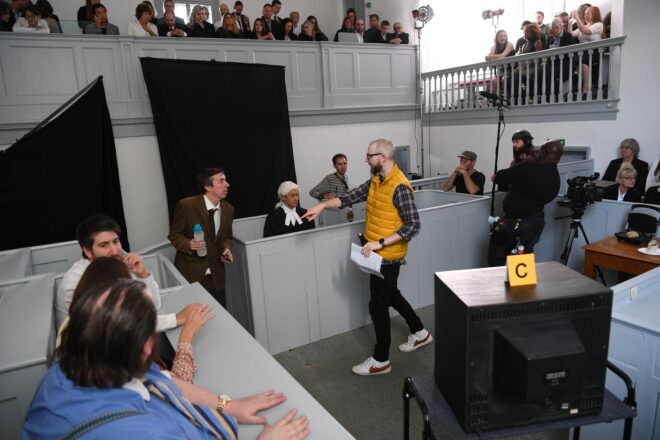
The crew may have been reduced, but the cast was bigger than it’s ever been. Jonnie and the team managed to pack out Sessions House, a historic courthouse in Ely, with about 60 extras to watch Harvey (Paul Richards) present a case against Choice. Also not reduced was the shot list, an ambitious 21 set-ups to be accomplished in just a few hours. I’m not sure how many we got in the end, but we covered everything so we must have got close.
Since the budget was a dim and distant memory, I shot on Jonnie’s own Canon C200 and lenses. An important part of Harvey‘s visual grammar is the use of wide lenses for stressy scenes, with a 14mm having been the apotheosis throughout production. For this reason, but also for speed, we shot almost everything in the courthouse on Jonnie’s Samyang 14mm, swinging to an L-series 24-70mm zoom right at the end. We couldn’t get hold of a Soft/FX filter to perfectly match with principal photography, but we were able to borrow a 1/8th Black Pro Mist to provide a little diffusion at least.
For lighting, Jeremy set up his Aputure 300D and 600D in an upper gallery at the side of the courtroom, firing into the wall to provide a soft side-light throughout the room. We’d hoped not to have to tweak it much from shot to shot, but it did prove necessary, not least because we needed to look up to that gallery in a couple of set-ups. I wanted to use a lot of negative fill to bring down the ambient bounce off the walls, which had evidently been repainted at some point in the recent past by someone with an Ideal Home subscription. But the 14mm doesn’t leave much room to hide things, so there was a limit to the contrast we could introduce. Adjusting the blinds over the main windows – whenever they were out of frame – became one of our major methods of controlling the light.
Once Harvey had rested his case we moved out into the carpark to get Bryan’s “manic wides”. These grotesque caricatures of the supporting characters, imagined by Harvey at the climax of the film, required each actor, in this case Alan, to deliver key lines from their earlier scenes while I shoved the 14mm lens in their face and dutch-tilted like crazy. We recreated the day-for-night shot grabbed with the limo back on Day 13, covering the car in black drapes and firing the 300D with Urban Sodium gel through a side window – orange being another symbol of stress in the movie.
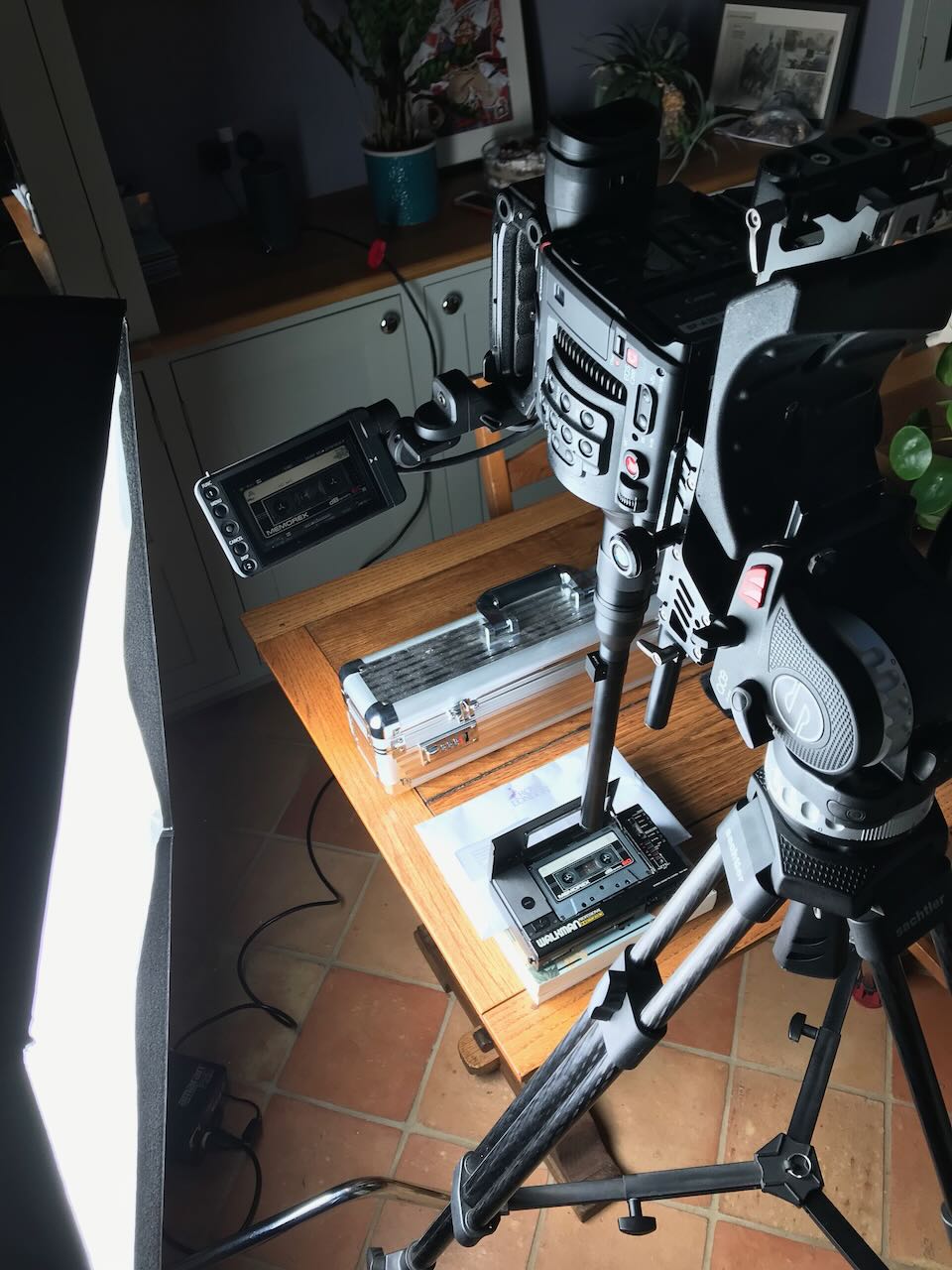
The few of us that were left then regrouped at Jonnie’s house for some ADR and a handful of inserts. The probe lens got another airing to capture a macro shot of a tape recorder, and I got to double as Harvey’s hands flicking through a book. In Paul’s very last shot he was out of focus, due to a lack of continuity-matching make-up, with the book sharp in the foreground.
The final shot of all was Cat, the editor, dropping some Post-its into frame and Jonnie, clad in Harvey’s jacket, picking them up. Not a grand shot to go out on, but one that nicely sums up the collaborative, all-hands-on-deck nature of no-budget filmmaking. It’s been a fun ride.
Read all my Harvey Greenfield is Running Late posts: