“Harvey Greenfield is Running Late”: Week 2-and-a-Bit

Day 11

In a conference room at a business centre in north Cambridge we set up for a scene in which the titular Harvey arrives titularly late for a big meeting at work. Here we were joined by my good friend Alan Hay, who voiced all the pre-recorded male characters in the stage play, and now portrays Harvey’s overbearing boss Bryan on screen.

A TV monitor in the background of Bryan’s shot, displaying relevant graphics, gave us some trouble. Neither the 50Hz or 60Hz “flicker free” modes in the monitor’s menu lived up to their names. The best – though not perfect – results were achieved by setting the camera’s shutter to 144°, which works out as 60Hz at our frame rate of 24fps. (Next week’s post will be dedicated to the maths behind this. I bet you can’t wait.)

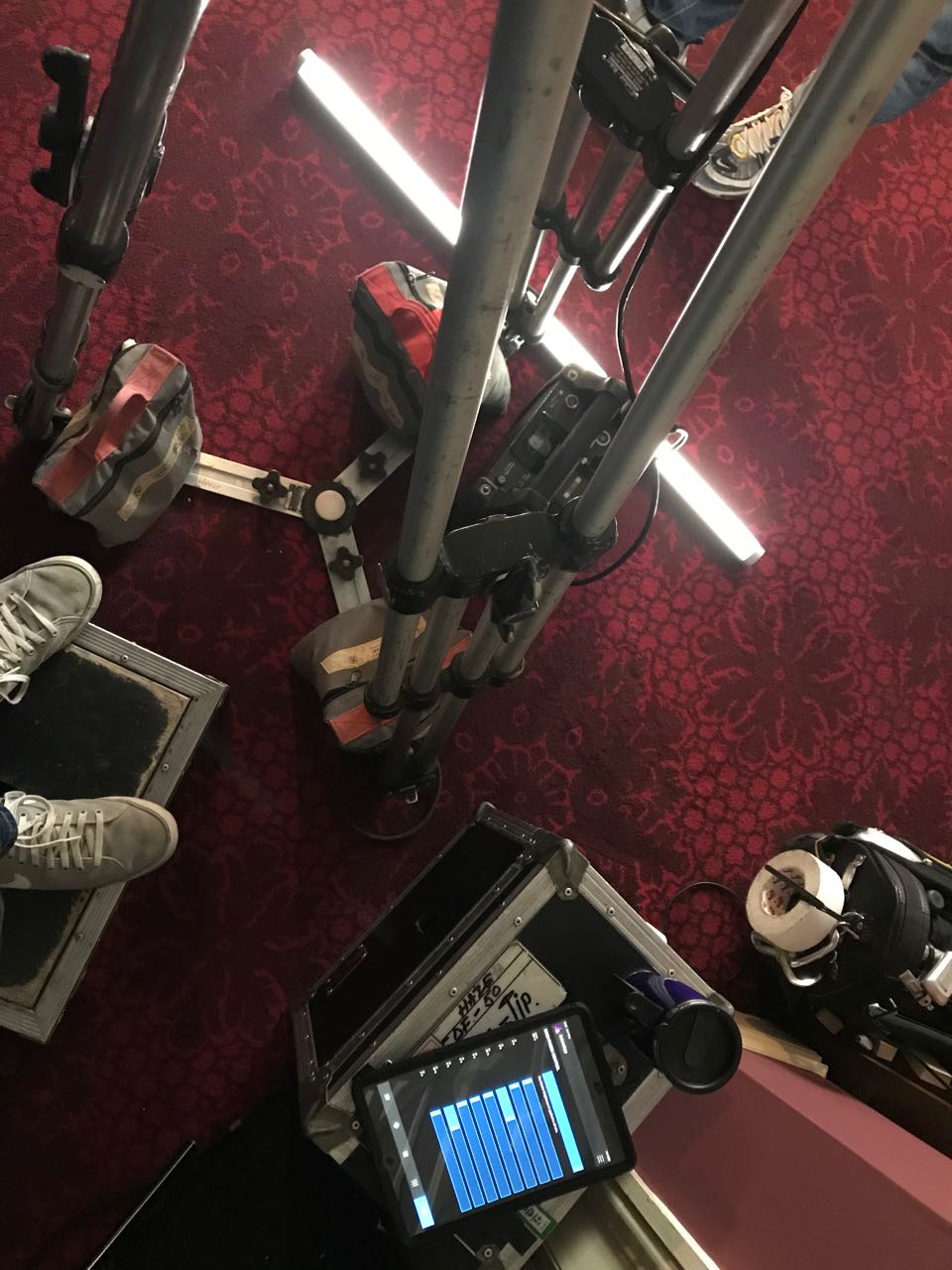
Stephen and James rigged several Astera tubes to the ceiling, which we mostly used to give everyone a tungsten-coloured backlight whichever direction we shot in (Harvey’s stress colour again). The key light was motivated from the window, which we weren’t able to light from outside of, but we generally used the Litemat 2S to punch up or wrap the natural light from that direction. We used floppy flags on the opposite side of the room to stop too much ambience from the atrium spilling in.

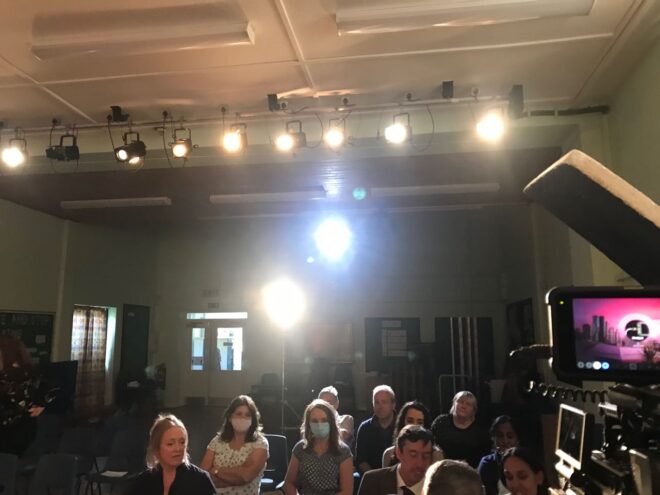
Unfortunately by the time we wrapped the meeting scene we were left with a difficult choice: to rush a long and funny scene in Bryan’s office, or to postpone it for some future pick-up shoot when we could do it justice. Jonnie wisely chose the latter, allowing us to decamp to a private home in Arbury and get ahead with the scenes set in Harvey’s house.

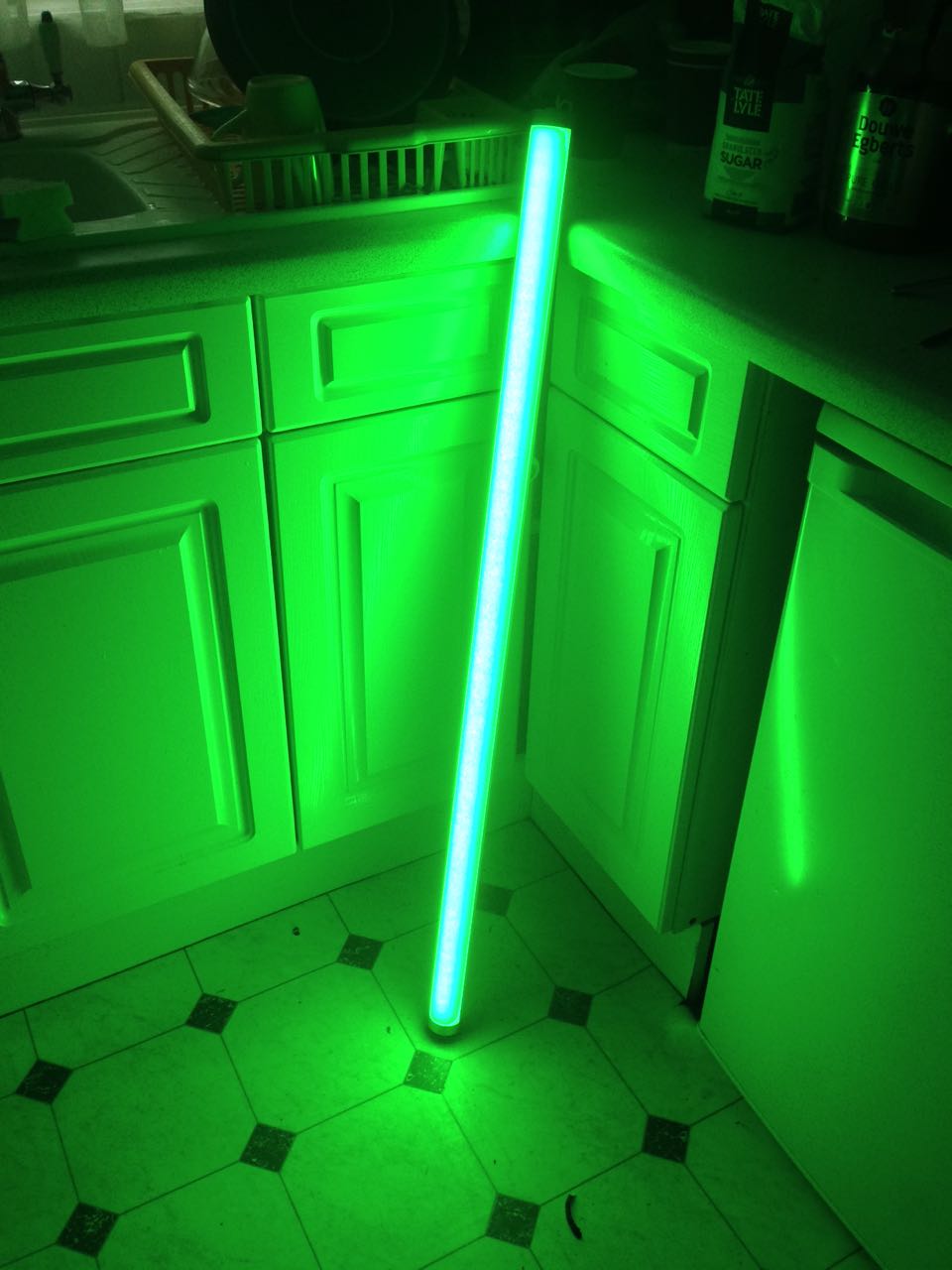
First up at the house was a happy flashback of Harvey and Alice dancing in the bedroom, which Amanda had dressed in calming shades of green. We shot towards the window at 48fps and supplemented the natural light with a single Astera tube in a corner.
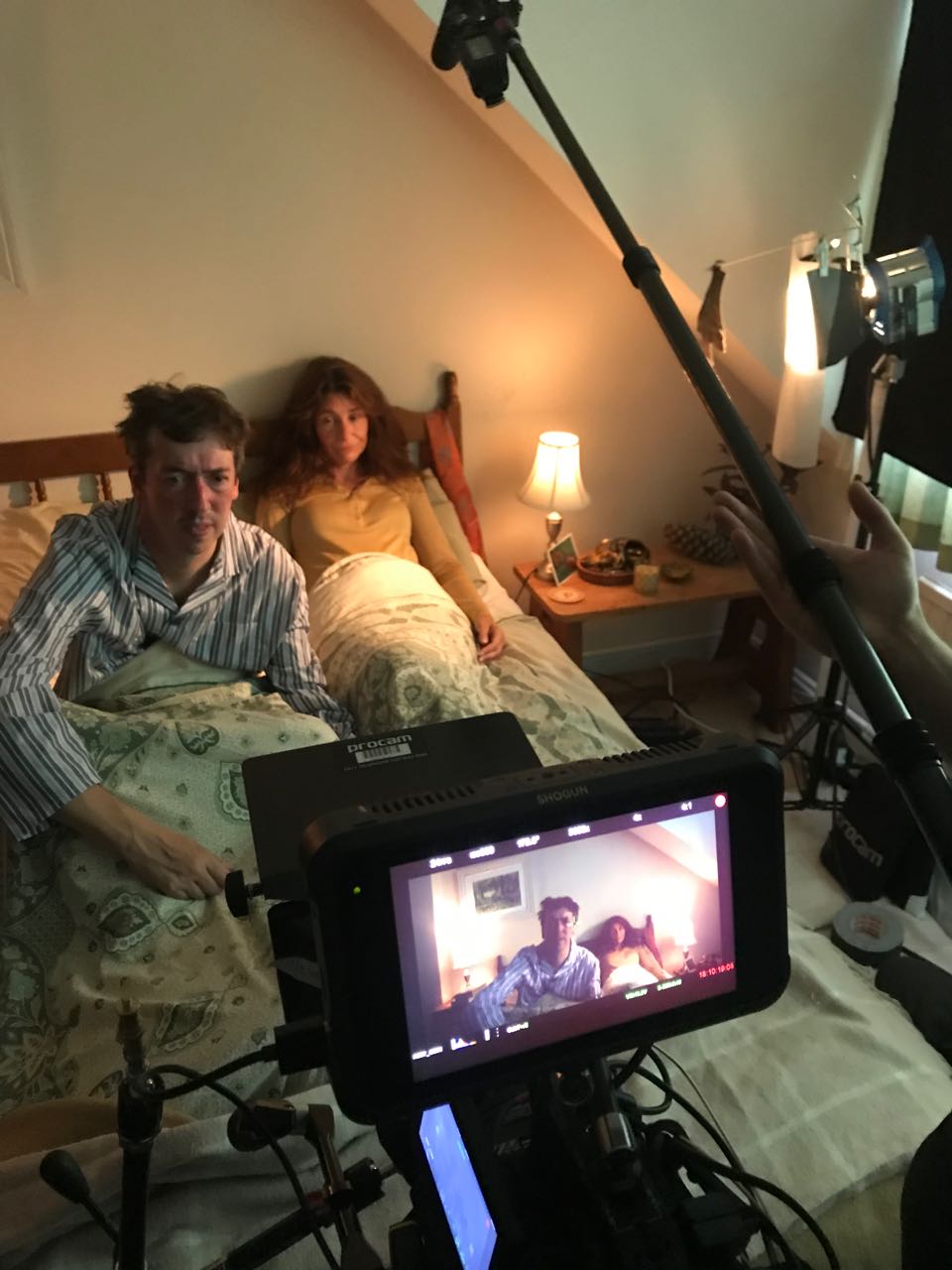
Next was a less positive flashback set at night. As it was still broad daylight I closed the curtains, framed out the window and set the white balance to 3600K to turn the remaining light seeping through the curtains into a dim nighttime ambience. I had asked Amanda to provide matching practicals on the bedside cabinets, which we now turned on and dimmed to get a nice warm orange glow. This looked great but left the actors’ faces very under-exposed, so we added a 300W tungsten fresnel motivated by one of the tablelamps. (The thing you see hanging in front of it in the above photo is a makeshift flag to stop the other tablelamp from casting an unrealistic shadow.)

Then it was back to daylight – again natural light supplemented by an Astera – and the camera had to stay locked off so that Jonnie could jump-cut to this shot from the same angle at night. Stephen and James set up the lighting while the daylight faded. The main element that I wanted was a streak of sodium streetlight through a gap in the curtains, again part of the stress colour theme, which was achieved with the Aputure 300D gelled appropriately. We wanted to give the impression that this was bouncing off the wall and edge-lighting Harvey in his second position, but in reality we used the tungsten 300W fresnel – now hidden on top of the wardrobe – to get this effect. We bounced two Astera tubes, set very blue with a bit of green mixed in, off a wall to provide ambience.

Overall the frame was still pretty dark, so I decided to do something I’ve seen advised for night scenes before but never actually done: I reduced the ISO by one stop and opened the iris to compensate. Read my article about ISO if you want to understand all the ins and outs, but essentially doing this allowed one more stop of light to reach the sensor – that’s more information to grade with – without increasing the apparent brightness of the image.


Day 12

Back in the house, this time downstairs in the kitchen. We had three daylight scenes to shoot here, and the lighting approach was to push in soft light through the windows using the Litemat or an Aladdin, with some harder streaks where appropriate from the Aputure. Hiding another Aladdin on top of a cabinet and firing it into a corner of the ceiling was a good move by Stephen to raise the ambience in the room while still keeping some directionality.


Day 13

Our first task today was to return to the cemetery and pick up a dropped shot from day 8. Then it was another Steadicam/rickshaw scene on an Ely street where rain, traffic and a recalcitrant beer can combined to make things quite tricky.

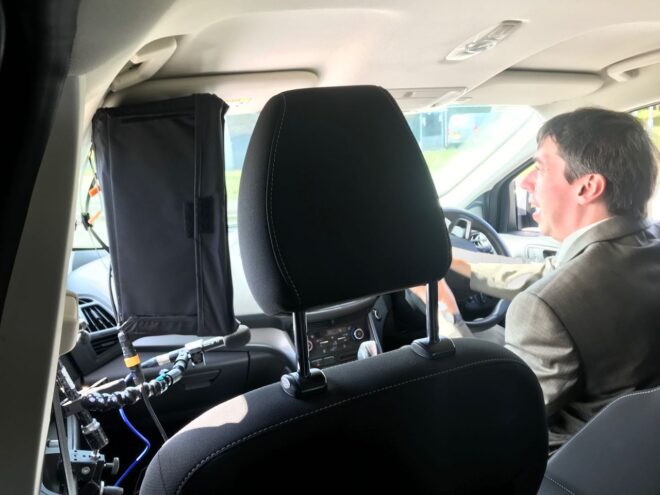
After lunch we had a strict two-hour window in which to shoot three scenes with a hired limousine. The first required it to be driving around, so Filipe (sound mixer), Olga (focus puller) and I squeezed into the front of the main cabin, shooting down the length of the vehicle on the 14mm to where Paul and Alan’s characters were sitting at the back. Jonnie rode in the front passenger seat and watched the monitor over my shoulder. Next to him was an Aladdin which I could use for fill when necessary, but mostly I relied on the dynamic natural light. The heavily tinted windows were a big help, allowing me to retain most of the detail in the sky outside without under-exposing the talent.

When we returned to base, Stephen had all the flags, bolton and lights ready to move into position around the limo for the night scene. His custom-built LED was gelled with Urban Sodium again to key Alan, and an Astera tube inside the limo provided the impression of a passing ambulance.

Then we were left with less than 25 minutes to capture a daytime dialogue scene around the limo. Jonnie had storyboarded it as three set-ups but there was only time for one. Rupert came to the rescue, quickly balancing his Steadicam as Jonnie devised a camera move that would hit all the needed beats.

After a couple more Steadicam shots we moved on to a scene in a hospital car park, a rare moment of calm for the beleagured Harvey. We shot this mostly on the slider, capturing the dialogue in another single developing shot that taxed poor Filipe again but set exactly the right mood for the story. The natural light was very shapeless, so Stephen set up some floppies on one side and bounce on the other.

The day brought principal photography to an end for Stephen and for leading man Paul Richards, both of whom have done stellar work despite the long hours and high energy levels required.

Just after I wrote this Jonnie sent me a rough edit of the limo/hospital sequence and it has turned out very nicely indeed.


Day 14
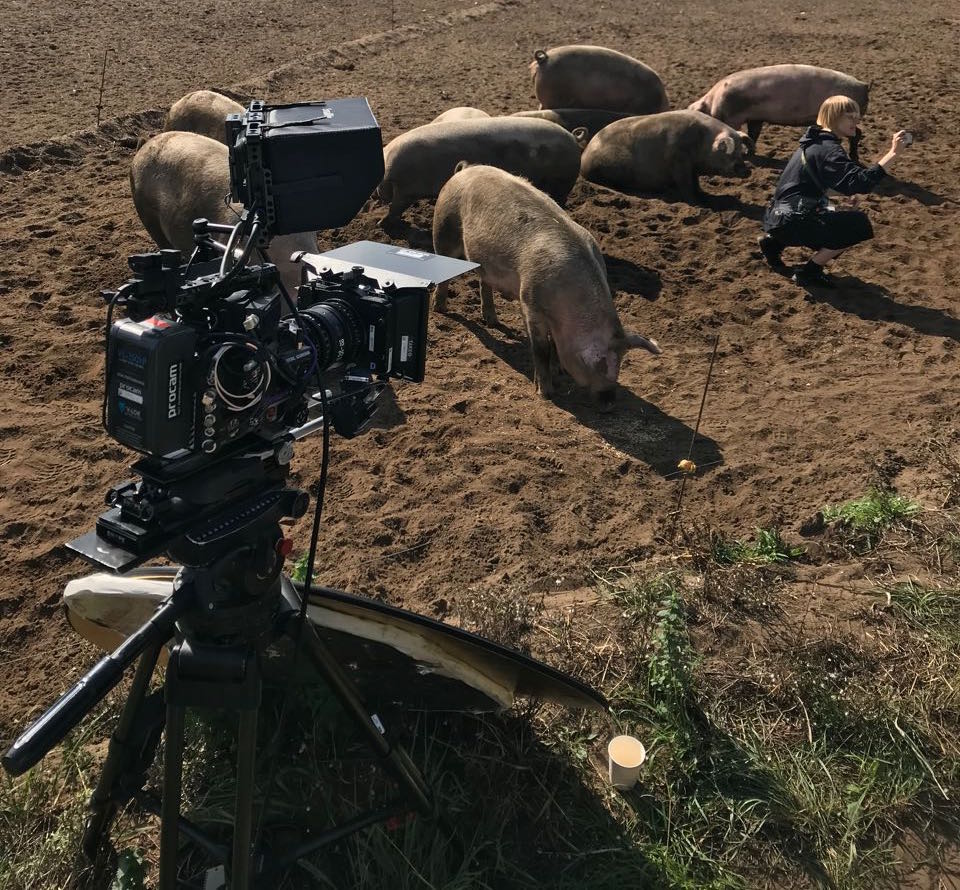
We convened at a farm near Mildenhall to film Billy the pig farmer, one of the many people who hassles Harvey by phone during the story. In a last-minute casting coup Billy was portrayed by 1st AD Rob Oliver with the unscripted addition of his mother Shirley. A comedy duo to be reckoned with. Between takes we scattered food around to entice the porcine supporting artists into the right positions.

After completing this sequence we all took it in turns to hold a piglet. I’m not sure why.

The final scene of principal photography was a spoof charity appeal for “No More Racism UK”. We shot this down at Ely riverside again, where a crowd steadily gathered to watch us film an old white lady throwing bread at a black couple. We captured the whole thing on the slider with the 50-100mm zoom at 48fps and with the Soft FX 1 for extra cheesiness. To get the depth of field as shallow as possible with our limited ND filters I went down to ISO 250, the downside being a reduction in highlight detail which threatened to blow out the feathers of a white swan in shot. I’m sure that’s symbolic somehow.

We wrapped at the astonishingly reasonable time of 3pm and reconvened in the evening for a pizza-fuelled celebration at Othersyde. The shoot was great fun, the whole team has worked really hard, and I look forward to seeing everyone again for the pick-ups.

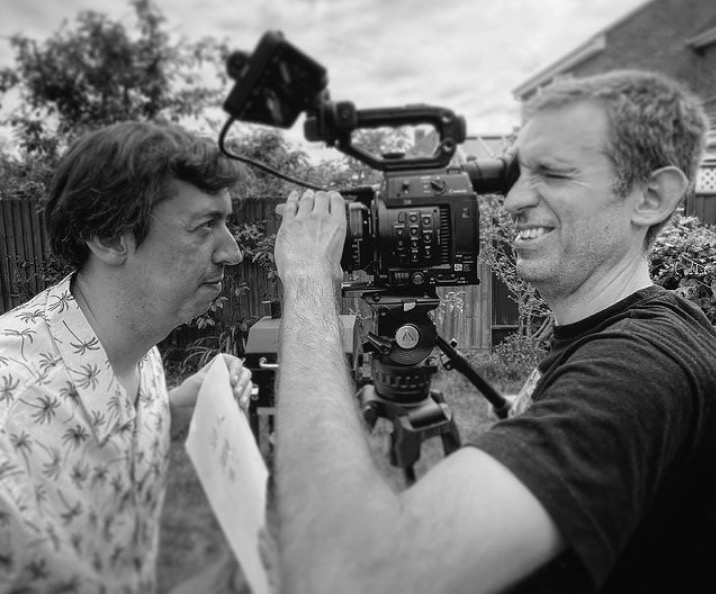
The “Harvey Greenfield” camera department: 1st AC Olga Lagun, 2nd AC Fiyin Oladimeji and me
“Harvey Greenfield is Running Late”: Week 2-and-a-Bit

“Harvey Greenfield is Running Late”: Week 2

Day 6

I think the director is turning into Harvey Greenfield. This morning Jonnie burst unexpectedly out of a hedge apologising for being slightly late.

Our first location was a surprisingly busy park in the village of Exning. We shot under the trees lining the edge of the park, keeping the camera on the same side of the eye-line as this handy arboreal negative fill, allowing the open sky of the park proper to light the actors’ off-camera sides. It’s great when blocking works out in your favour like this.

Then we moved around the corner to Wests Garage. First up here was a 24mm tableau shot to establish Barry the mechanic when he first calls Harvey, just as we have done to introduce the other supporting characters. We placed Barry in an office with a window behind him showing the workshop. Stephen arranged our four Astera tubes (in tungsten mode) around the workshop as practical work-lights, clamping some to pillars and placing others on the floor; wherever possible we are adding orange splashes of light (Harvey’s stress colour) into the background of these tableaux.

Next we shot outside around a car (a Rover I think – they all look the same to me), getting a nice slider shot parallel to the vehicle. Shades of Wes Anderson again. The trouble with all these straight-on shots of windows and shiny cars is hiding all the reflections. Stephen had to build a wall of floppy flags to disguise the slider.

By the time we wrapped the heat was getting to us all, and there was nothing for it but to try out the local pub.

But that was closed for a private party so we went to the other local pub instead.


Day 7

Jonnie was wearing Harvey’s jacket. Definitely turning into him.

We were at Othersyde, part of the Cambridge Museum of Technology, for the biggest day of the shoot: 12 scenes and nine pages of script to cover.

We began in a tent – Amanda had kindly found an orange one at my request – which we flagged on one side, adding the Aputure 300D to the other side to bring some shape to the lighting.

Then we moved into one of the venue’s toilet cubicles, where we simply added a skirt of black wrap to the existing overhead light fitting to reduce the light on the walls and add contrast. (Stephen and spark daily James also had to build a black-out tent around the door so that it could be open for the camera to see in without admitting daylight.)

Then we jumped into the bar of the Engineer’s House to grab a one-shot flashback scene. We lit through two windows (the Aputure and the Litemat 2S, I think) and added fill (a CTB-gelled 2K bounced off poly) and a couple of other sources inside (an Aladdin into a dark corner; a tungsten lamp shining down some background stairs). The shot required some well-timed whip-pans – always good for comedy. These require great skill as a camera operator when executed on sticks, but fortunately for me this one was handheld which makes the muscle-memory involved much easier.

Next we were in another toilet cubicle. Again we skirted the ceiling light and tented around the door, but this time another character had to come in. Here we used an LED fixture which Stephen built himself, gelling it with Urban Sodium as this shot is part of a sequence that has a stressy, streetlamp look to it.

By this time it was getting towards evening and we set up for a slider shot at the front of the site, overlooking the River Cam and shooting towards the low sun. Thanks to Helios Pro – a sun tracking app – we managed to time this just right. A 4×4 poly bounce either side of camera was all that was needed to supplement the beautiful natural light.

Sounds like all that would be enough for one day, doesn’t it? But oh no, the big scene was still to come. With 20 or 30 extras we staged a wedding reception under Othersyde’s marquee. Stephen keyed the wedding party at the head table with the Aputure bounced off poly (both rigged to the marquee’s ceiling) and we backlit them with a tungsten 1K firing out of an upper window of the Engineer’s House. A character off to one side was lit with an Aladdin rigged to the roof of the bar. The aim was to keep the lighting fairly warm overall, but to make those warm foreground colours pop we added blue-gelled 300W fresnels uplighting the Engineer’s House and a 1K in the deep background, gelled with Steel Blue, for a hint of moonlight. All of this was supplemented by the venue’s existing string lights, bar lights, LED uplighters in the flower beds and candles which Amanda placed on the tables.

Although we didn’t quite make the call sheet, we only dropped one brief scene – a pretty amazing result and one for the whole team to be proud of. Our welcome reward was a selection of Othersyde’s finest pizzas.


Day 8

The morning was spent with a beautiful horse-drawn hearse (featuring more fun reflective surfaces!) while the afternoon took place around an off-camera grave in Ely Cemetery. Some brief scenes with the child actors, faking a corner of the cemetery as a park, completed a damp but straightforward day for cinematography.


Day 9

About a third of Harvey Greenfield is Running Late takes its title very literally, seeing Paul Richards’ character hurrying to his next appointments as he makes phone calls and talks to camera. Today was the first day dedicated to capturing these scenes.

The first few scenes were shot as Annie Hall-esque wides in the streets and parkland around of Ely. (Much as Hot Fuzz filmed in Wells but painted out the cathedral, we framed out Ely Cathedral to avoid it becoming an identifiable landmark.)

To get a shot of Harvey looking down at a piece of litter, we put the empty beer can on top of two peli cases. Using the lovely wide 14mm lens we were then able to shoot up past it to Harvey and even rack focus to the can. I never usually hire anything wider than an 18mm but I have certainly learnt to appreciate what a 14mm can do on this shoot, even if it does make lighting and boom-operating more challenging.

Our Steadicam operator Rupert joined us again for the rest of the day, bringing along a rickshaw to enable him to track Harvey more smoothly. This drew plenty of attention from the general public, particularly when we moved down to Ely’s picturesque riverside. Most people were very friendly and kindly stayed out of frame if asked to, but a couple of self-styled pirates seemed determined to get an unscripted cameo. Nevertheless we managed to pull off a long and complicated shot which begins with Harvey approaching camera down a tree-lined car park and then tracks him in profile as he pelts along the riverbank.


Day 10

The morning was spent filming outside a house in Romsey – a short walk from home for me – which was standing in for Harvey’s. There was yet more fun with reflections when we had to shoot Harvey’s neighbour looking out of his window. No matter how tight the budget is, I will never ever take a polarising filter off my kit hire list again.

In the afternoon we captured more Steadicam running scenes around Romsey Park, before moving onto the nearby streets when it got dark. Here the Gemini’s low light mode saw use again, allowing us to rely mostly on the existing streetlamps (not pretty, but it works for the story). Stephen rigged an Aladdin to the rickshaw so that Harvey would have a little fill light moving with him.

Finally we moved back into the park, where Stephen had cross-lit the kids’ playground with tungsten sources. This formed the background of the scene, with the action taking place under a streetlamp in front of the play area. As the streetlamp was naturally very toppy, we fired in a Litemat (gelled with Urban Sodium) from above the camera to make sure that we would see Paul’s face for this critical performance scene.

There will be more on Harvey Greenfield‘s second week in my next post. In the meantime you can follow the film’s official Instagram account or Facebook page.

“Harvey Greenfield is Running Late”: Week 2

“Harvey Greenfield is Running Late”: Week 1

Day 1

The weather was dry and overcast, shedding a pleasantly soft light on the proceedings as the crew of Harvey Greenfield is Running Late set up for our first scene, in front of a small primary school in rural Cambridgeshire.

Then we started shooting and the weather went bananas.

One moment we had bright sunshine, the next we had heavy rain bordering on hail… sometimes in the same take. We had lots of fun and games dodging the showers, maneouvering a 12×12′ silk to soften the sun, keeping reflections and shadows out of shot, waiting for noisy trains to pass, and trying to get through takes without the light changing. But we got there in the end.

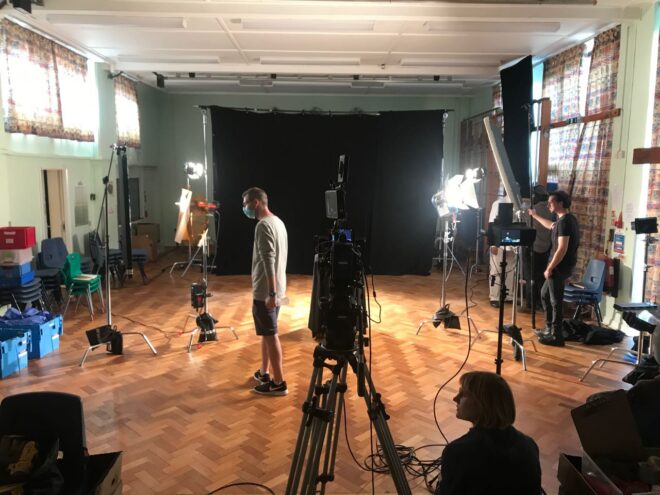
In the afternoon we moved into the school hall, which we were using as a makeshift studio. As well as numerous flashbacks, the film includes several imaginary sequences, including a spoof advert. This we shot against a black backdrop using dual backlights, one on either side, to highlight the talent. I totally stole this look from the Men in Black poster.

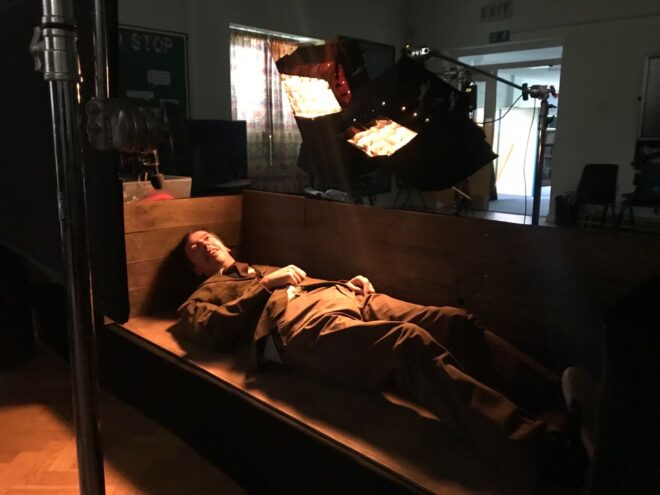
Our last shot of the day was Harvey’s first, and another imaginary scene, this time set in a coffin. To give the appearance of it being underground, the coffin (with no lid and one side missing) was placed on rostra with a black drape hanging below it. To create darkness above it, we simply set a flag in front of camera. Harvey (Paul Richards) lights a match to illuminate himself, which gaffer Stephen Allwright supplemented with two 1×1′ Aladdin Bi-flexes set to tungsten and gelled even more orange.


Day 2

One of the few occasions in my life when I’ve been able to walk to set from home: we started at the University Arms Hotel overlooking Parker’s Piece, one of Cambridge’s many green spaces (and, fact fans, the place where the rules of Association Football were first established).

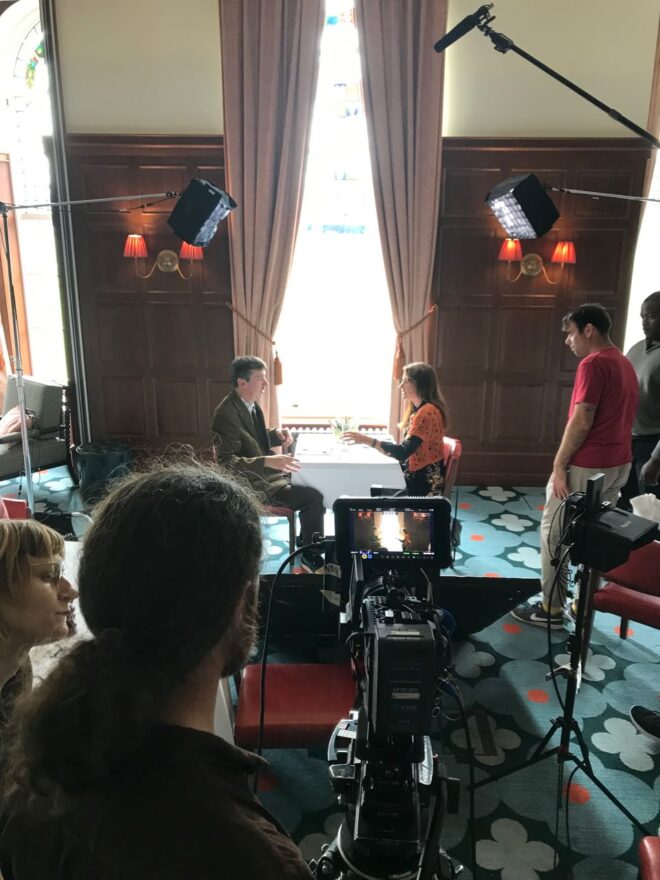
The hotel’s function room was dressed as an upmarket restaurant, where we captured Harvey’s first date with his girlfriend Alice (Liz Todd). We shot towards a window; putting your main light source in the background is always a good move, and it gave us the perfect excuse to do soft cross-backlight on the two characters. The room’s wood panelling and sconces looked great on camera too.

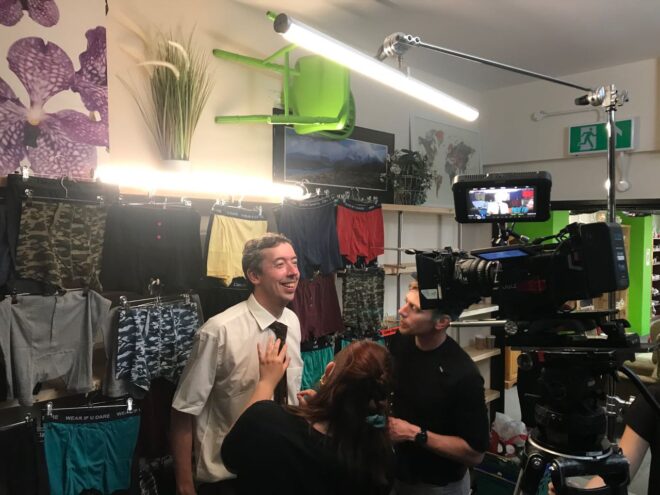
The unit then moved to Emmaus, a large charity shop north of the city, where we filmed a Wall of Pants and some tightly choreographed Sandwich Action. Here we broke out the Astera tubes for the fist time, using them as a toppy, fluorescent-style key-light and backlight.

By now we were getting into the visual rhythm of the film, embracing wide angles (our 18-35mm zoom gets heavy use), central framing (or sometimes short-siding), Wes Anderson-type pans/tilts, and a 14mm lens and/or handheld moves for crazier moments.


Day 3

We were based at Paul’s house for day 3, beginning in the street outside for a brief scene in his car. Shooting from the back, we mounted an Aladdin in the passenger seat to key Paul, and blacked out some of the rear windows to create negative fill, much like I did for the driving scenes in Above the Clouds.

The rest of the day was spent in and around Paul’s shed. Or, to be more specific, the middle one of his three sheds. This is Harvey’s “Happy Place” so I stepped up from the Soft FX 0.5 filter I’d been shooting with so far to the Soft FX 1, to diffuse the image a little more. We also used haze for the only time on the film.

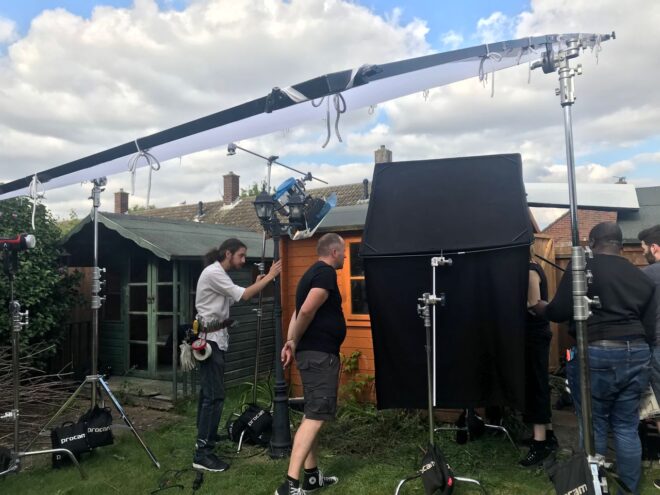
Some shots through the shed window gave us the usual reflection challenges. Stephen rigged a 12×12 black solid to help with this, and we draped some bolton over the camera. Inside the shed we used an Aladdin to bring up the level, and once we stopped shooting through the window we fired a tungsten 2K in through there instead. This was gelled with just half CTB so that it would still be warm compared with the daylight, and Stephen swapped the solid for a silk to keep the natural light consistent and eliminate the real direct sun.

I made my first use of the Red Gemini’s low light mode today, switching to ISO 3200 to maintain the depth of field when filming in slow motion. (I have been shooting at T4-5.6 because a sharper, busier background feels more stressful for Harvey.)


Day 4

Back to the primary school. We spent the morning outside shooting flashbacks with some talented child actors from the Pauline Quirke Academy. We got some nice slider shots and comedy pans while dealing with the ever-changing cloud cover.

Inside in the afternoon we picked up a dropped scene from day 1, then moved on to one of the film’s biggest challenges: a six-minute dialogue scene travelling through a corridor and around a classroom, to be filmed in a single continuous Steadicam shot. This could easily have been a nightmare, but a number of factors worked in our favour. Firstly, we had rehearsed the scene on location with actors and a phone camera during pre-production. Secondly, we had the brilliant Rupert Peddle operating the Steadicam. Thirdly, it would have been so difficult to keep a boom and its shadows out of shot that mixer Filipe Pinheiro and his team didn’t even try, instead relying on lavaliers and a mic mounted on the camera.

For similar reasons, we didn’t do much lighting either; there were almost no areas of the rooms and their ceilings that didn’t come into shot at some point. In two places Stephen rigged blackout for negative fill. I then chose which of the existing ceiling lights to turn off and which to keep on, to get as much shape into the image as possible. We tried to rig a grid onto one of the ceiling lights to take it off a wall that was getting too hot, but after one take we realised that this was in frame, so instead we stuck a square of ND gel to it. We also rigged two Astera tubes in the corridor, but discovered that one of those came into frame too, so in the end a single Astera tube was the only additive lighting. The existing ceiling lights worked particularly well for a slow push-in to Alice near the end of the shot, providing her with both key and backlight from perfect angles.


Day 5

Today we shot a big scene based around a school play. Production designer Amanda Stekly had created a suitably cheesy, sparkly backdrop, and more PQA students dressed up in weird and wonderful costumes to enact snatches of a very random production called Spamlet (making it the second time this year I’ve shot “to be or not to be”, though this time was… er… a little different).

The school had a basic lighting rig already. We refocused and re-gelled some of the lights, keeping it very simple and frontal. Behind the set I put one of my old 800W Arri Lites as a backlight for the kids on stage. To one side, where Alice was standing, we used two Astera tubes, one to key her and one to backlight her. These were both set to a cool, slightly minty colour. My idea of using green for calming characters and moments hasn’t come to fruition quite as I’d planned, because it hasn’t fitted the locations and other design elements, but there’s a little hint of it here.

For the audience, Stephen rigged an Aputure 300D to the ceiling as a backlight, then we bounced the stage lighting back onto them using a silver board. We also used the school’s follow spot, which gave us some nice flares for the stressful moments later in the scene. It was daytime both in reality and in the story, but we closed the (thin) curtains and reduced the ambience outside with floppy flags so that the artificial lighting would have more effect.

We had to move at breakneck speed in the afternoon to get everything in the can before wrap time, but we managed it, finishing our first week on schedule. No mean feat.

“Harvey Greenfield is Running Late”: Week 1

Pre-production for “Harvey Greenfield is Running Late”

Next week filming commences for Harvey Greenfield is Running Late, a comedy feature based on the critically acclaimed one-man play by Paul Richards. Paul reprises the title role in the film, directed by Jonnie Howard, who I previously worked with on A Cliché for the End of the World and The Knowledge.

The production is based locally to me in Cambridgeshire, and over the last couple of months I’ve attended recces, rehearsals and meetings. I’ve tried to approach it the same way I did Hamlet, reading each draft of the script carefully and creating a spreadsheet breakdown. Scene by scene, the breakdown lists my ideas for camerawork and lighting.

Harvey is a stressed and neurotic character who can’t say no to anything. The film takes place over a single day of his life when he finds himself having to attend a wedding, a funeral, a big meeting at his office, a school play and an appointment at a garage. Numerous scenes see him jogging from commitment to commitment (always running late in more ways than one) while taking phone calls that only add to the pressure. In the finest tradition of Alfie, Ferris Bueller and Fleabag, he also talks to camera.

Talking of finest traditions, the budget is very low but ambitions are high! With 100 script pages and 14 days the shoot will be more of a sprint than a marathon.

The UK film and TV industry is busier at present than I’ve ever known it, making up for lost time last year, so sourcing crew and kit has certainly been challenging. But thanks to generous sponsorship by Global Distribution and Sigma we will be shooting on a Red Ranger Gemini – which regular readers may recall I almost selected for Hamlet – with Sigma Cine primes and zooms. I will be working with a completely new camera team and gaffer.

One of the first things Jonnie told me was that he wanted to use a lot of wide lenses. This makes a lot of sense for the story. Wide lenses fill the background with more clutter, making the frame busier and more stressful for Harvey. They also put us into Harvey’s headspace by forcing the camera physically close to get a tighter shot. We shot some tests early on with Paul, primarily on the Sigma Cine 14mm, to start getting a feel for that look.

Influences include Woody Allen, the Coen brothers, Wes Anderson, Terry Gilliam and Napoleon Dynamite, and as usual, watching reference films has formed an important part of prep for me.

Based on the colour palette Nicole Stone has put together for her costumes, I’ve decided to use orange as Harvey’s stress colour and green when he’s calmer. For most of the film this will just be a case of framing in orange or green elements when appropriate, or putting a splash of the relevant colour in the background. For key scenes later in the story we may go so far as to bathe Harvey in the colour.

Right, I’d better get back to trying to sort out the lighting kit hire, which is still up in the air. Possibly this post should have been called Pre-production for “Harvey Greenfield” is running late.

Pre-production for “Harvey Greenfield is Running Late”

5 Ways to Use Astera Tubes

Astera Titan Tubes seem to be everywhere at the moment, every gaffer and DP’s favourite tool. Resembling fluorescent tubes, Asteras are wireless, flicker-free LED batons comprised of 16 pixels which can be individually coloured, flashed and programmed from an app to produce a range of effects.

Here are five ways in which I used Titan Tubes on my most recent feature, Hamlet. I’m not being sponsored by Astera to write this. I just know that loads of people out there are using them and I thought it would be interesting to share my own experiences.


1. Substitute fluorescents

We had a lot of scenes with pre-existing practical fluorescents in them. Sometimes we gelled these with ND or a colour to get the look we wanted, but other times it was easier to remove the fluorescent tube and cable-tie an Astera into the housing. As long as the camera didn’t get too close you were never going to see the ties, and the light could now be altered with the tap of an app.

On other occasions, when we moved in for close-ups, the real fluorescents weren’t in an ideal position, so we would supplement or replace them with an Astera on a stand and match the colour.


2. Hidden behind corners

Orientated vertically, Asteras are easy to hide behind pillars and doorways. One of the rooms we shot in had quite a dark doorway into a narrow corridor. There was just enough space to put in a vertical pole-cat with a tube on it which would light up characters standing in the doorway without it being seen by the camera.


3. Eye light

Ben Millar, Hamlet‘s gaffer, frequently lay an Astera on the floor to simulate a bit of floor bounce and put a sparkle in the talent’s eye. On other occasions when our key light was coming in at a very sidey angle, we would put an Astera in a more frontal position, to ping the eyes again and to wrap the side light very slightly.


4. rigged to the ceiling

We had a scene in a bathroom that was all white tiles. It looked very flat with the extant overhead light on. Our solution was to put up a couple of pole-cats, at the tops of the two walls that the camera would be facing most, and hang Asteras horizontally from them. Being tubes they have a low profile so it wasn’t hard to keep them out of the top of frame. We put honeycombs on them and the result was that we always had soft, wrappy backlight with minimal illumination of the bright white tiles.


5. Special effects

One of the most powerful things about Titan Tubes is that you can programme them with your own special effects. When we needed a Northern Lights effect, best boy Connor Adams researched the phenomenon and programmed a pattern of shifting greens into two tubes rigged above the set.

On War of the Worlds in 2019 we used the Asteras’ emergency lights preset to pick up some close-ups which were meant to have a police car just out of shot.

There are all kinds of other effects you could use the tubes for. There is a good example by DP Rowan Biddiscombe in this article I wrote for British Cinematographer.

5 Ways to Use Astera Tubes

The Cinematography of “Alder”

Back in February 2019 I spent a long day in Black Park, a forest behind Pinewood Studio, shooting a short film called Alder for director Vanda Ladeira. A little late perhaps, but here are my reflections on the cinematography and general experience of making this experimental fairytale.

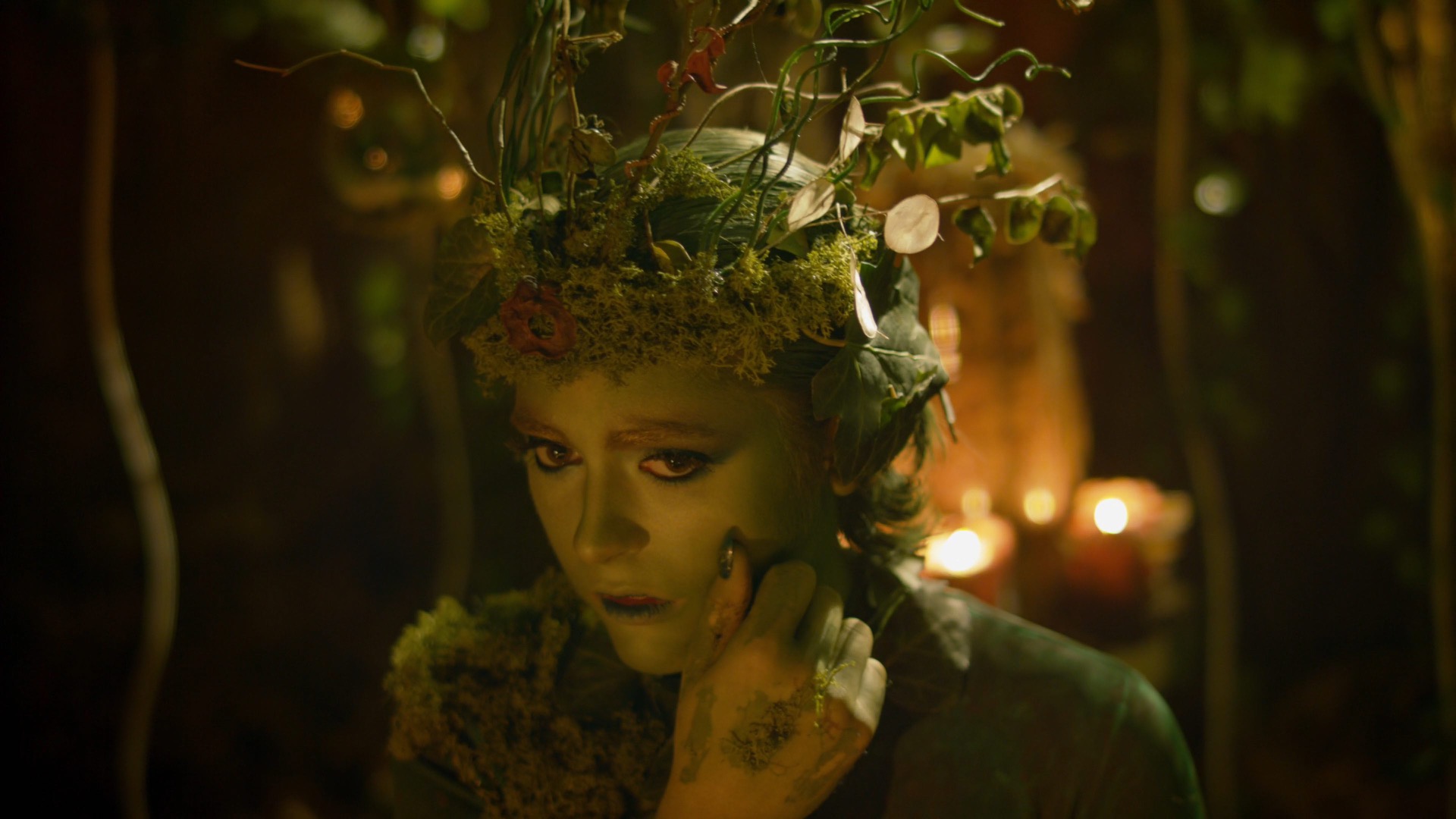
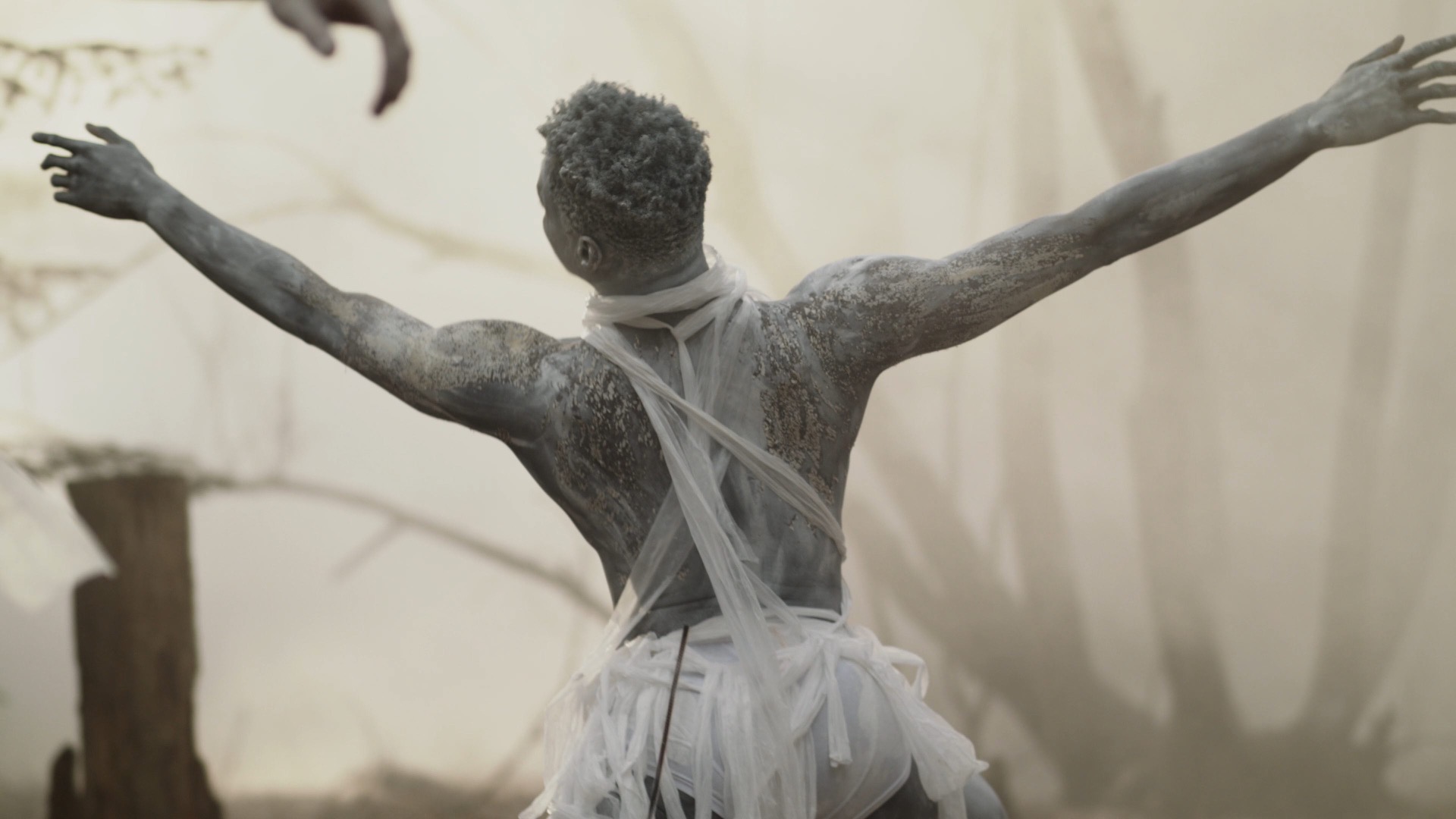
The film is about a forager (Odne Stenseth) who does not realise he is being watched by the very spirit of the forest, the titular Alder (Libby Welsh). As he cuts a sprig of holly, or steps on a mushroom, he is unknowingly causing her pain. Meanwhile a group of ghosts – Alder’s former victims? – cavort in the woodland, and strips of film made with ground-up human bone reach out from the trees to ensnare the forager.

Vanda contacted me after seeing my work on Ren: The Girl with the Mark. She was keen for Alder’s lair to have the same feel as Karn’s house in that series. We had a number of meetings to discuss the tone, visuals and the logistics of the shoot, which initially was going to take place over two days but was eventually compressed to one.

In October 2018 we conducted a recce in a forest that we ultimately weren’t able to use. I remember at the time that I was considering shooting the project on celluloid, tying in with the plot point about Alder making film from her victims’ bones. I dropped the idea after taking light readings on that recce – when it was very overcast – and realising just how dark it could be under the tree canopy.

We ultimately shot on a Blackmagic Ursa Mini and Xeen primes, provided along with the lighting kit by gaffer Jeremy Dawson. The Blackmagic sensors seem to do very well with earthy tones, as I noticed on the village set of Ren, and the Ursa rendered the browns of the bracken, the soil and the forager’s costume nicely. Jeremy also provided us with a jib which enabled us to underscore the forager’s action with some definite moves: an introductory crane down; a dramatic pull up as he drives his knife into a tree; and a frantic boom down with him as he searches for his lost compass. In Alder’s lair we kept the camera drifting from side to side or up and down to bring energy to her more static scenes.

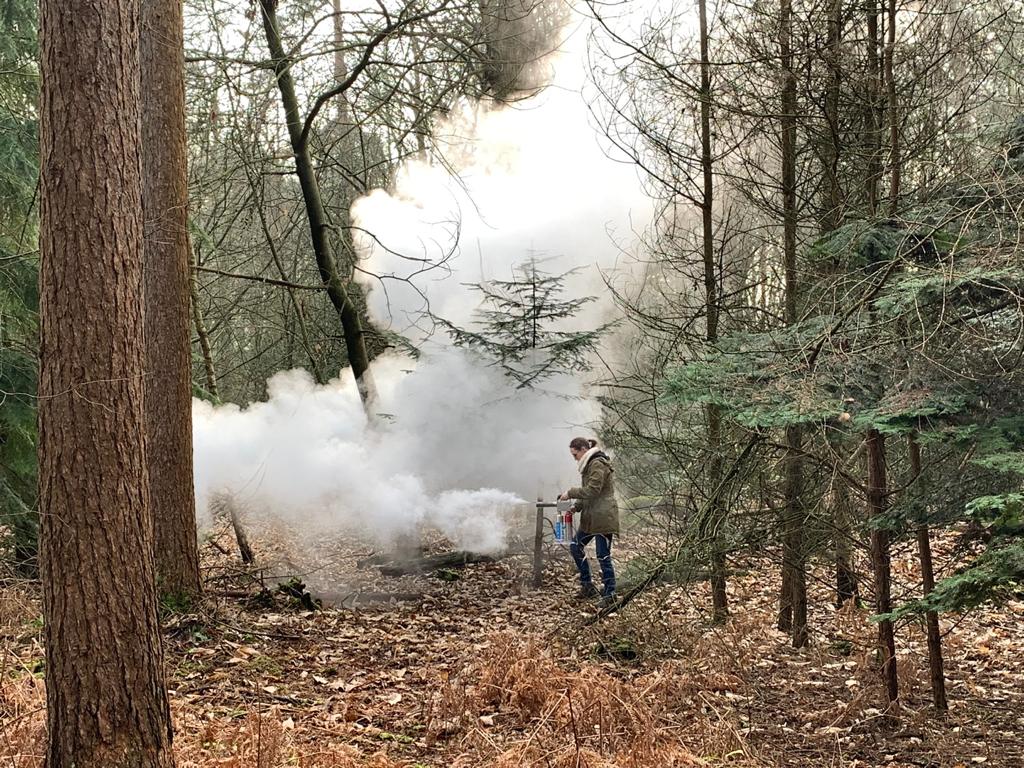
Lighting for the forager’s scenes was all natural, with just a little bounce or negative fill from time to time to keep some shape to the image. An Artem smoke gun, operated by Claire Finn, was used on almost every shot to give the forest some life and mystery, and also to keep the backgrounds from getting too busy; the grey wall of smoke serves to fade the background slightly, keeping the eye focused on the foreground action.

As there was no dialogue, I was free to change the frame rate expressively. Examples include: over-cranking close-ups of the forager’s feet and hands in contact with nature, emphasing the sensuality of his unwitting connection to Alder; over-cranking the dance of the ghosts to make their movements even more beautiful and supernatural; and under-cranking the forager slightly to enhance his panic when he finds himself lost and surrounded.

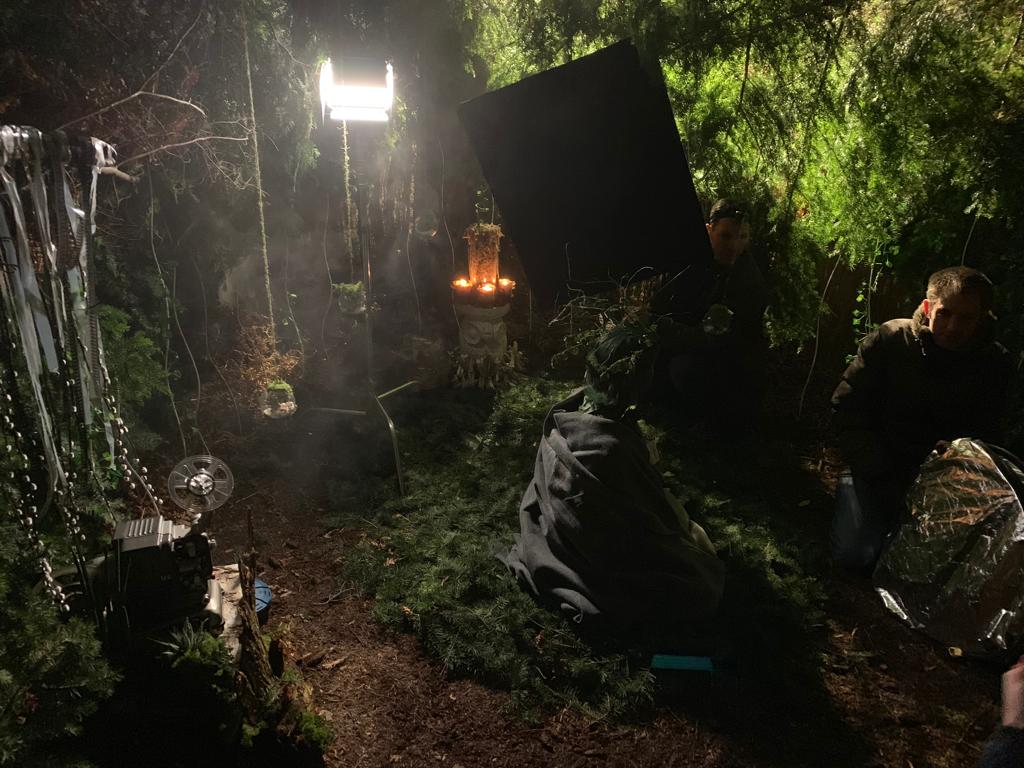
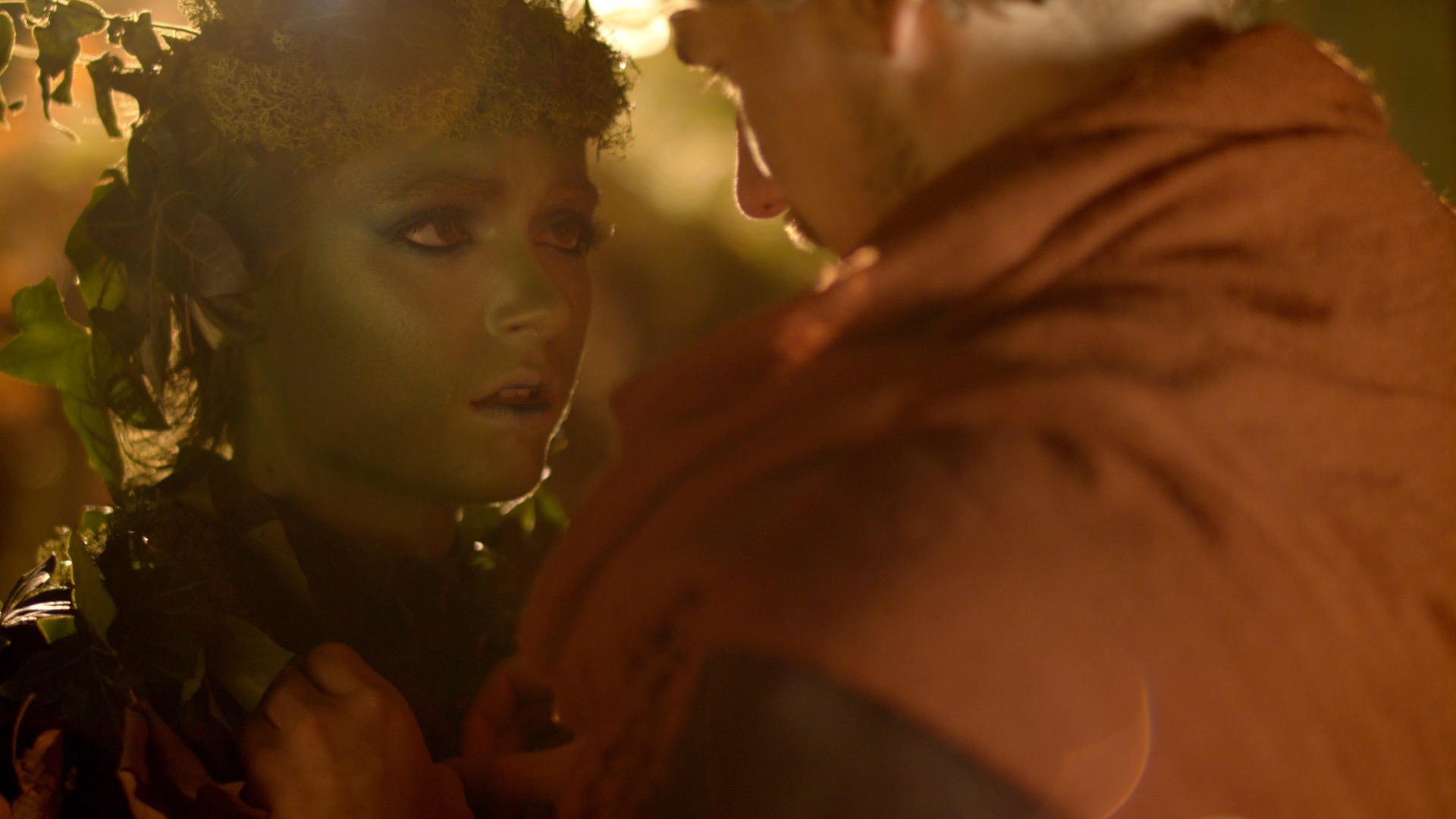
Alder’s lair was a set built by Denisa Dumitrescu in the forest. I took broadly the same approach to lighting it as I had for the reference scene from Ren, making some holes in the branch-covered roof and shining a blinder (a bank of four LED spotlights) through it to produce dappled shafts of sunlight. On the floor around Alder were a number of candles; we beefed up the light from these by skipping an 800W tungsten lamp off a bounce board on the floor.

The biggest challenge was the meeting between the two main characters, a scene scripted for daylight which we were forced to shoot after dark due to running behind schedule. It was the longest and most important scene in the film and suddenly the cinematography had to be completely improvised. We did not have anywhere near the lighting package that a woodland night exterior normally calls for – just 800W tungsten lamps, a few LED fixtures, and a generator only powerful enough to run one of each.

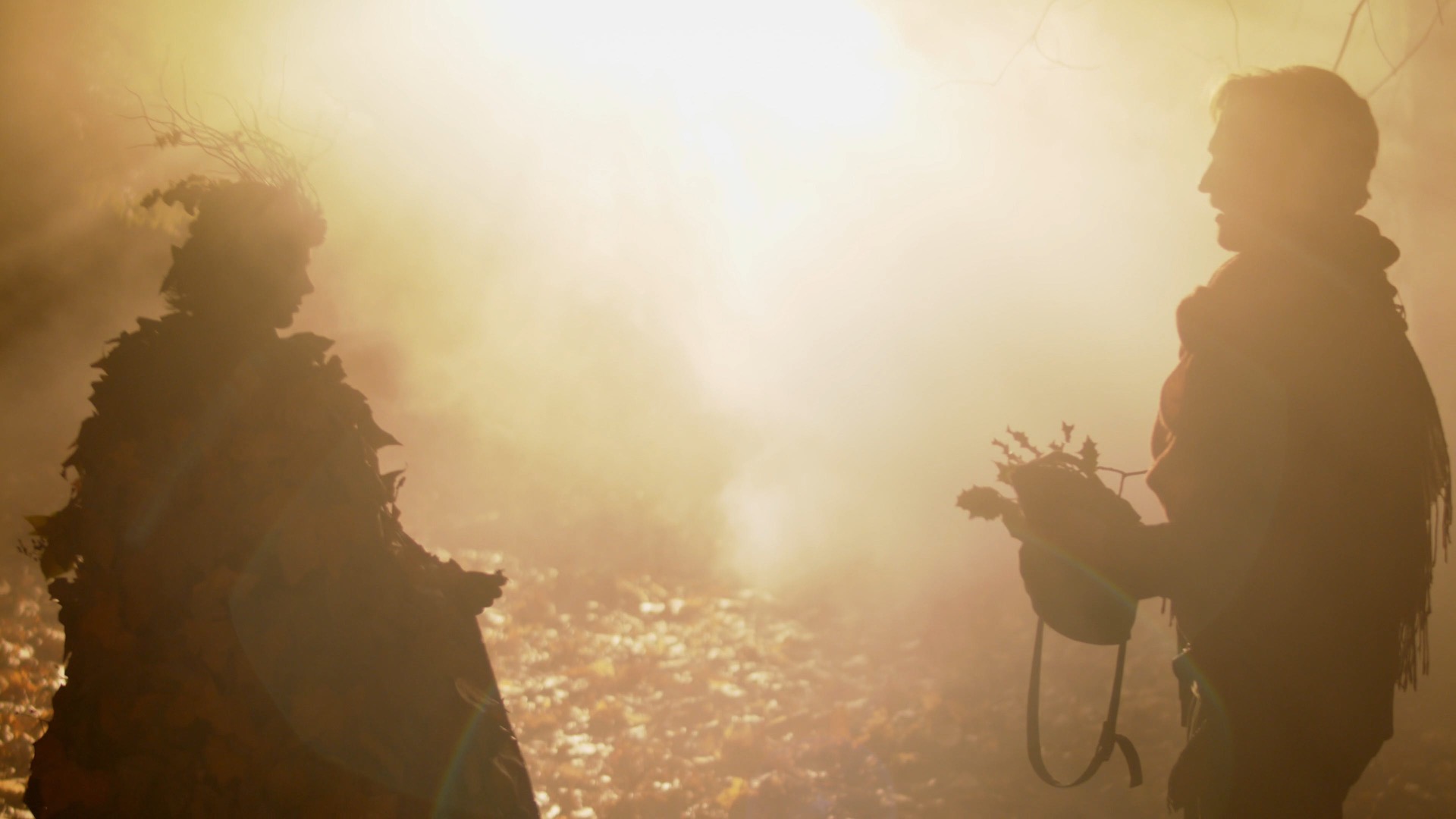
What I ended up doing was putting an 800 in the background, ostensibly as a setting sun, and bouncing a blinder off poly-board as fill. We shot the whole scene through in a single handheld shot, once with smoke and once without, then picked up a few close-ups.I tried to hide the lack of light in the background by allowing the 800 to flare the lens and render the smoke almost impenetrable at times. Vanda and her editor, Tom Chandler, leant into the strange, stylised look and bravely intercut the smoky and smokeless takes. The result is much more magical and expressive than what we would have shot if we had still had daylight.

You can watch the finished film here. It won me Best Cinematographer at the New York Cinematography Awards (August 2019) and Film Craft Award: Cinematography at Play Short International Film Awards (2019).

The Cinematography of “Alder”

Undisclosed Project: Culmination

Today filming begins on the Shakespearian feature I have been prepping since early February. All of last week was again spent in rehearsals, this time focusing on the second half of the script.

By the end of the week I had storyboarded almost the entire film, using Artemis Pro. The production designer was able to print these out and go through them looking for any backgrounds that he might not yet have dressed, or any obtrusive existing objects that should be removed. The 1st AD was also using them to help him plan, as he had not been present at rehearsals. This led to a minor panic when I erroneously included some characters in the background of a shot that those actors were not scheduled for!

Aside from producing these storyboards and getting a fantastic understanding of how all the scenes are going to be played and blocked, a big benefit of the rehearsal weeks was the opportunity to get to know the cast. Normally I have to wave a big camera in an actor’s face the first time I meet them. It’s much better to ease them and me into the process the way we’ve done on this production. A particular highlight was when the well-known lead actor performed some of the famous soliloquies – in the absence of a camera – right into my eyes.

It was a very busy week for all concerned. When the cast weren’t in rehearsals they were in costume fittings or make-up tests, or training for the sword-fight, or doing press interviews.

The gaffer started work on Wednesday, and was joined by the best boy and spark on Thursday. After loading in the equipment, their first task was to re-globe all the sconces and ceiling lights in the auditorium. Later they gelled all the emergency lights to make them dimmer and warmer in colour, ran distro to various convenient points, and cut poly-boards to size.

The camera kit also turned up on Thursday, a slightly surreal event for me after so long working in the building with just my laptop and iPhone. For a few scenes Sean wants to create a kaleidoscopic effect, so I had purchased some cheap kaleidoscope party glasses, a 6” teaching prism, and a set of crystals which can be hung off the matte box. Ironically the cheap glasses give the best effect! These will be hand-bashed in front of the lens, whereas the prism can be clamped to a noga arm for a more controlled effect.

I gave the focus puller a tour of the building so that he could start to think about monitor positions. That will definitely be a tricky aspect of the production with all the cramped backstage spaces.

I feel better-prepared now than I have ever felt going into a feature. It is such a contrast to, say, Heretiks, where I had just one week to get up to speed, and the gaffer had no prep time whatsoever. Nonetheless, there are some things you just can’t work out until the day, and that’s where the stress and excitement come from!

I’ll continue to write a blog during production, but I won’t be publishing it until the film is released. So there will be no new posts for the next few weeks, but normal service will resume in May! See you on the other side.

Undisclosed Project: Culmination

Undisclosed Project: Observation

Well, it’s all very real now. For six weeks I’ve been documenting my non-continuous prep period on a feature film adaptation of a well-known Shakespeare play. It won’t be announced to the press until it is close to release, so I still can’t share the title or any other identifying details. I’ll go so far as to say that it’s being shot in a theatre (though not all on stage), and the director is from a theatre background

On Monday I checked into the hotel and began the first of two full-time prep weeks. Unusually, these two weeks are filled with rehearsals. I may, once or twice, have worked on a film that had perhaps a single day of rehearsals. Two weeks is unheard of, but of course it’s perfectly normal in theatre.

The strange thing for me is that just when a scene is taking shape – the point where I’d normally get involved, when the blocking is nearly final and it’s time to think about shots – we move on to the next one. The last bit of the rehearsals will be done, as normal, on the day of shooting.

As the actors explore the spaces, I do too. Some of them have changed quite dramatically, thanks to the efforts of the art department, since I last reccied them. It’s an unprecented opportunity for me to check many potential camera angles. Before we move on from a scene, I run around frantically with Artemis, trying to take enough shots to make a storyboard. A large part of today (it’s Saturday as I write this) has been taken up with selecting the best shots, scribbling annotations on them and outputting them as PDFs into a Google Drive folder where the director, 1st AD, 1st AC, production designer and others can see them.

During quieter moments, I’ve slipped off to discuss things with the production designer or the stage lighting designer, or just to sit in one of the spaces by myself and think through shots and lighting.

On Friday afternoon a tech recce took place, which I led because the director was still busy rehearsing. This was followed by a Zoom meeting to discuss issues arising.

Less fun but equally important things last week were completing a camera department risk assessment, and taking Covid tests, which leave you feeling like you jumped into a swimming pool without pinching your nose.

Undisclosed Project: Observation

Undisclosed Project: Organisation

By the time you read this I will have entered the Covid bubble for the still-as-yet-unannounced Shakespearian film, the beginning of two weeks of full time prep before cameras finally roll.

The week just gone has been something of a calm before the storm. It started with two important Zoom meetings: one about practicals, the other about the schedule.

The first meeting involved going through all the locations with the production designer explaining what practical lamps he planned to put in each, and me sometimes asking for additional ones. Practicals are going to be a big part of our lighting, and this sort of collaboration with the art department can make a real difference between a smoothly-running shoot and a world of pain wherever you’re trying to hide film lights because you don’t have enough practical sources.

The second meeting, coming shortly after I saw the shooting schedule for the first time, was an in-depth discussion of it with the director, producer, line producer and 1st AD. Most of my concerns – other than some days which felt uncomfortably heavy, and even one or two that seemed wastefully light – were around times of day and equipment. For example, one daylight interior scene was scheduled for the end of day, when we might be losing the light. (The next day I went through it all again by myself and made sure that any night scenes scheduled for daytime could be reasonably done with blacked-out windows.)

We also talked a lot about how things could be rejigged to get as much value as possible out of the two days that we have the crane. It’s expensive, and no-one wants it sitting around while we shoot little dialogue scenes in tiny rooms. Nor do I want one or two scenes in the film to have lots of crane shots and the rest to have none; a sprinkling of them throughout the film would be preferable, though it would mean lots of costume and make-up changes.

Another draft of the script was issued , with pretty minor changes, though one extra room has been introduced, so that will need a proper recce next time I’m there. Reading through a new draft and updating my notes takes the best part of a day, and though it can sometimes feel like a chore, every reading helps me understand the story and characters better.

I did a little more shot-listing later in the week, but it will be much better and easier to do this at the rehearsals over the next fortnight, when I can see how the actors are approaching their characters and how they’re going to use the spaces. I can even take Artemis photos if it doesn’t interrupt their process too much. Roll on rehearsals!

Undisclosed Project: Organisation